

India, once the bastion of telegrams, bid farewell to this 163-year-old service on July 14, 2013. As BSNL, the operator of telegram services in the country, announced its discontinuation, it marked the end of an era that had linked the vast expanse of the subcontinent for trade, administration, and personal communication.
The roots of India’s telegraphy service date back to 1851 when the British East India Company laid down the first electric telegraph line from Calcutta to Diamond Harbour. Initially intended for official use, it soon expanded across the nation, becoming a crucial tool during India’s freedom movement.
The telegraph service started in 1851 when the British East India Company built a 30-mile (48km) electric telegraph line from the city of Calcutta to its suburb of Diamond Harbour, primarily for official use. Over the next few years, telegraph lines were expanded to cover the entire country as a way of linking up the vast reaches of the subcontinent for its trade and administration. The service was opened for public use on February 1, 1855. It was later on extensively used for India’s freedom movement, also.
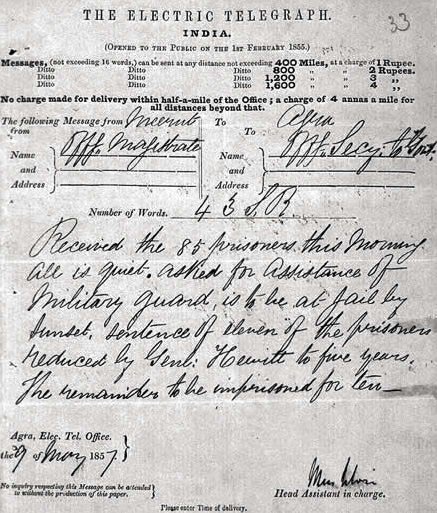
Telegrams were the pioneers of instant long-distance communication before the advent of telephones. They revolutionized correspondence, akin to modern-day text messaging. Each word was precious, as senders paid per word, fostering a unique style of concise expression.
Before the invention of the telephone, the telegram was the first system that allowed the more-or-less instant transmission of electronic messages over long distances. It was the text-messaging service of its age, an invention as awe-inspiring in its time as electricity, flight and the moving image. For the 19th and 20th centuries, its short messages, worked into Morse code and out into language again, then delivered by postmen, connected human beings in faraway places.
The world’s first ever telegram was sent by Samuel F.B. Morse, inventor of the Morse Code, from Washington to Baltimore on 26 May 1844, to his partner Alfred Vail to usher in the telegram era that displaced the Pony Express. It read:
WHAT HATH GOD WROUGHT?
Legendary figures like Oscar Wilde and Mark Twain left their mark on telegram history with their succinct messages, epitomizing the essence of brevity.
Oscar Wilde is believed to have sent the shortest-ever telegram in history, asking his publisher how his new book was doing. The message read simply: “?” The reply was equally concise: “!”
When American author Mark Twain heard that his obituary had been published, he sent a telegram from London in 1897 saying: “The reports of my death are greatly exaggerated”.
The first successful flight, by the Wright brothers, was announced by telegram from North Carolina in 1903.
Successful four flights Thursday morning.
John F. Kennedy used to joke during his 1960 presidential campaign that he had just received a telegram from his father.
Dear Jack: Don’t buy one more vote than necessary. I’ll be damned if I pay for a landslide.
The arrival of a telegram could evoke a mix of emotions, from anticipation to dread, as it often carried news of significant events or personal crises. As a child growing up in New Delhi in the 1970s, I always felt a sense of foreboding every time a knock on the door announced the arrival of a telegram. My parents would be visibly worried as telegrams usually brought bad news, like the death of a relative.
After joining Punjab National Bank as a Management Trainee in 1985, we were sent to various parts of India for training. We then used to communicate with our family often through telegrams. It was brief and fast but communicated the whole message. Text messages can never convey that air of urgency and excitement. We also miss the compression that the cost of sending a telegram necessitated. Some of them make Twitter look verbose. I also liked the way the message was printed on a thin strip of paper that was then pasted on a larger sheet to be delivered to the addressee.
For many, telegrams became an integral part of life’s milestones. Professionals, like those in banking, relied on them for urgent financial transactions, employing encryption techniques for security.
During my time at the bank, I handled numerous urgent communications and encrypted telegrams for financial transactions. Some of these involved test keys to verify the authenticity of authorized messages. At the close of each half-year, we would transmit our key figures to the Regional Office. We relied on code books and formulas to manually generate test keys, which were then appended to codified messages before sending them via telegram. Upon receiving these tested and encrypted telegrams, we would decode the codes, verify the test keys, and match them with the contents to process the message. This practice is why quick fund transfers are commonly referred to as wire transfers or TT (Telegraphic Transfers), terms that persist to this day.
The demise of telegrams mirrored broader technological shifts. While they stood the test of time for over a century, the rise of mobile phones and digital communication spelt their eventual end. The closure of telegraph services in India echoed similar farewells in other parts of the world, marking the end of an era. In Britain, telegrams came to an end in 1982 and Western Union continued telegraphy service in the US until 2006. It’s amazing that it survived so long!
Telegrams have the unique characteristic of typed capital letters and an abrupt “STOP” to mark the end of a sentence, and the sequence “NNNN” is an end-of-message indicator. ZCZC is the start of the message indicator.
Even as the telegram died out, it remained a part of popular culture.
15 July 2013
Hundreds of individuals flocked to the remaining 75 telegraph offices across the country to send their final telegrams to loved ones, cherishing them as mementoes. Due to the overwhelming demand, BSNL was compelled to cancel holidays for office staff to manage the influx.
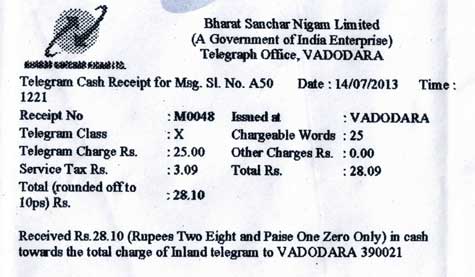
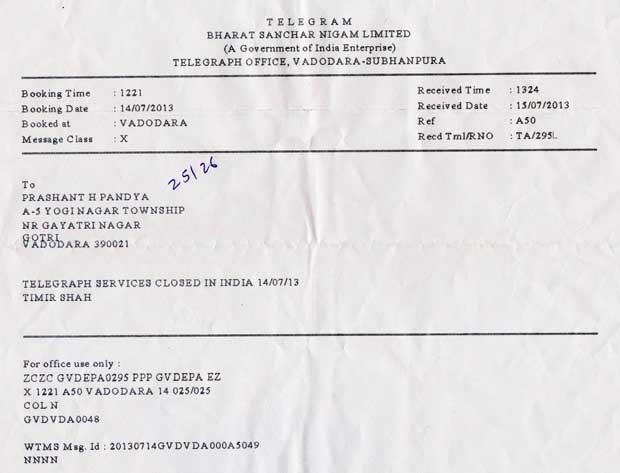
The final day of telegram service in India saw a surge of people flocking to telegraph offices, cherishing their last opportunity to send messages through this historic medium. Among them was Ashwani Mishra, who booked the last telegram at the Central Telegraph Office in New Delhi, symbolizing the end of a bygone era.
ZCZC
RIP TELEGRAM STOP
NNNN
As we bid adieu to telegrams, we also bid farewell to a piece of our collective memory, rich with nostalgia and historical significance. While technology marches forward, let us not forget the humble telegram, which once bridged distances and connected hearts in a simpler time.
I just had a thought: With telegrams becoming obsolete, how would we communicate in scenarios like an alien attack or a digital war disrupting our access to the internet? 🤔🤔🤔
