

There’s a peculiar kind of introspection that only airports can evoke — that liminal space between departure and arrival, between the known and the unknown. As I sat in the lounge at Hamad International Airport in Doha, whiling away a seven-hour layover en route from Delhi to Baghdad, I found myself thinking less about my destination and more about a fleeting, almost spiritual encounter I’d had just hours earlier.
It happened at Indira Gandhi International Airport, near the towering statue of Lord Surya in the international departure terminal. Amid the bustling footfall of hurried travellers and the metallic hum of announcements, something drew my eye — a stunning stainless-steel mural, intricately etched with Warli art motifs.
It wasn’t just a piece of décor. It felt like a quiet invocation — a whisper from India’s ancient soul, carrying stories that have travelled through centuries and civilisations.
Ancestral Echoes: Warli’s Origins Rooted in Antiquity
Warli art is not mere ornamentation. It is ancestral memory — a visual language that predates history itself. Practised by the Warli tribe of Maharashtra, this art form is believed to date as far back as 2500–3000 BCE, perhaps even earlier. Its geometric motifs and storytelling style bear an uncanny resemblance to the prehistoric rock paintings of Bhimbetka (dating from 5000–10000 BCE), suggesting an unbroken lineage that stretches deep into India’s archaeological past.
What makes Warli art even more remarkable is the way it has survived — not through books or temples, but through women. Mothers teach their daughters; grandmothers guide their granddaughters. It is a matrilineal legacy, passed down not in words but in rhythm and ritual, preserving memory through the steady repetition of brush and line.
The Language of Line: Style, Symbolism, & Sacred Geometry
Warli art is celebrated for its stark minimalism. Traditionally painted on the walls of mud huts, the backdrop is prepared using a mixture of cow dung and mud, creating a rich, earthy canvas. Over this, artists paint with white rice paste, sometimes accented with red oxide (geru). The resulting contrast — white against ochre — evokes a timeless simplicity, as if the figures are etched directly into the soil.
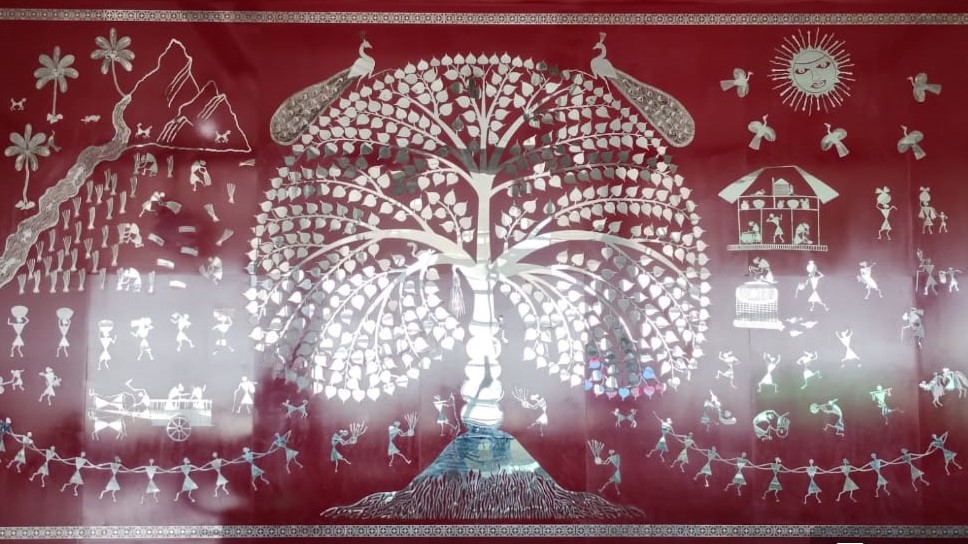
The art’s visual vocabulary is built on geometric shapes:
- Squares depict sacred spaces and ritual enclosures.
- Circles represent the sun and moon.
- Triangles symbolise mountains and trees.
Scenes of everyday life — farming, hunting, dancing, worship — populate these compositions. Yet beneath their apparent simplicity lies profound symbolism. A spiral of dancers around a central motif represents the cycle of life. A snake might warn of danger; a bird might herald safety or abundance. Warli is more than art — it is a script of symbols, a language that speaks in metaphor and movement.
Nature as Deity: A World Alive with Spirit
At the heart of Warli philosophy is an animistic worldview — the belief that everything in nature is alive and sacred. Trees, rivers, animals, winds — each is imbued with spirit, each deserves reverence.
At the heart of Warli philosophy is an animistic worldview — the belief that everything in nature is alive and sacred. Trees, rivers, animals, winds — each is imbued with spirit, each deserves reverence.
This ecological spirituality resonates deeply with other indigenous art traditions, such as Sohrai and Khovar from Jharkhand. Like Warli, these are painted on mud walls with natural pigments — such as rice paste, charcoal, and cow dung — and celebrate the rhythms of life. Sohrai, in particular, honours fertility and harvest. At the same time, Khovar marks marriage and feminine energy. All three traditions share a common ethos: they portray nature not as a backdrop but as the central protagonist.
From Village Walls to Global Terminals
The stainless-steel Warli mural at Delhi’s international terminal is far more than a decorative installation — it is a cultural ambassador. In a place defined by transience, where identities blur and languages dissolve, it roots travellers in something enduring and deeply Indian.

It is a subtle reminder that even as we cross borders and time zones, we carry with us the stories of our land.
Warli art’s journey from the walls of tribal homes to global spaces like airports, museums, and design studios is a testament to its timeless appeal. Today, its motifs find expression in textiles, architecture, digital art, and contemporary installations — always evolving, yet always honouring the spirit of its origins.
A Personal Interlude: Finding Meaning in the In-Between
For me, that encounter at the airport was more than a visual delight — it was a moment of connection. As someone who seeks meaning at the crossroads of history, culture, and personal experience, I felt an unexpected kinship with those etched figures. They seemed to speak of journeys, cycles, and continuity — themes that resonate deeply with the act of travel itself.

Sitting in the Doha lounge, I realised that this layover was not a pause in my journey. It was part of it — a reflective interlude that made me see travel not just as movement through space, but as a dialogue with time.
Preserving the Pulse of Tradition
Warli art is not a fossilised relic. It is a living tradition, alive as long as we recognise, respect, and reimagine it.
In a world increasingly defined by speed, abstraction, and digital noise, art forms like Warli remind us to slow down, to listen, and to see. They teach us that beauty resides in simplicity, that stories can be told without words, and that the soul of a culture often lives in its quietest expressions.
The next time you walk through an airport, pause before a piece of art — it might just be whispering a story that began thousands of years ago and still lives, unbroken, within us.
This stainless-steel Warli composition at Indira Gandhi International Airport is inspired by the works of master craftsmen, whose dedication ensures that this ancient tradition continues to travel — from mud walls to metal murals, from tribal homes to global terminals — carrying with it the heartbeat of India’s timeless heritage.

Wonderful artwork and yet another informative post.
LikeLiked by 1 person
Thanks, Nilanjana.
LikeLiked by 1 person
Quite informative. Style is based on geomatric pattern and shapes. Nice article.
LikeLiked by 1 person
Thanks, Mano.
LikeLike
Wow. very interesting art. Truly mesmerising.
LikeLiked by 2 people
Yes, beta. Thanks.
LikeLiked by 1 person
Beautiful!
LikeLiked by 1 person
Thanks for your read.
LikeLike