
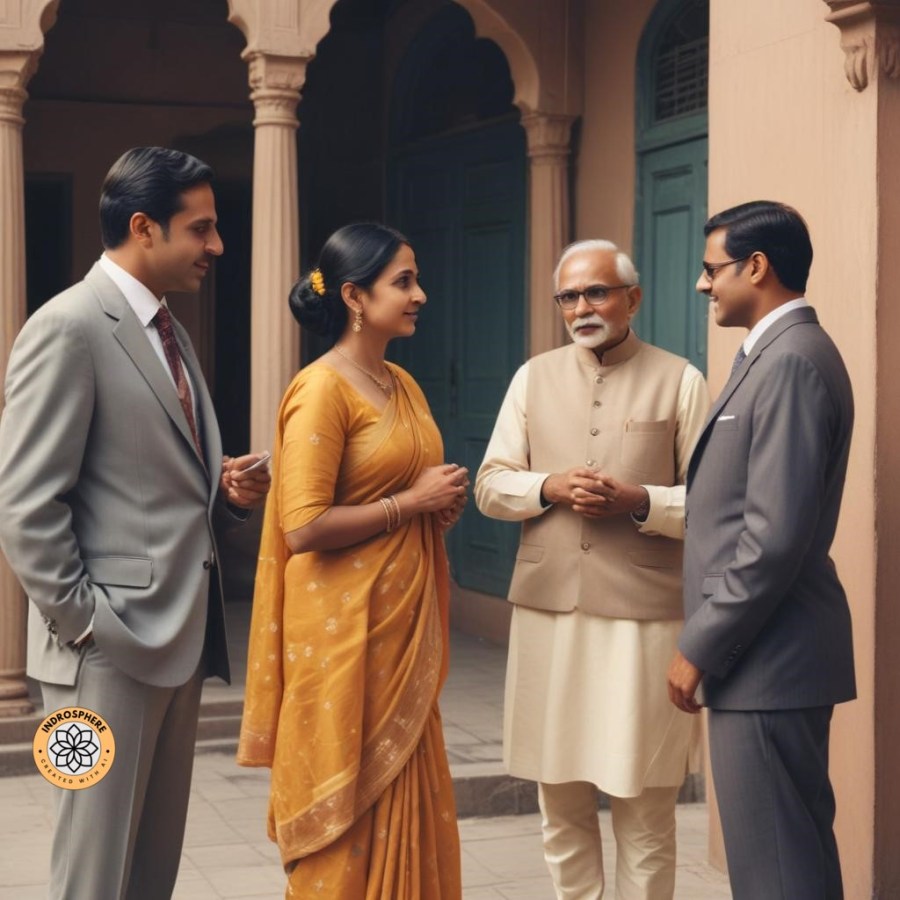
This morning, in the sacred chaos of our WhatsApp group chat—a place where memes go to die and unsolicited advice thrives—a classmate chimed in with a comment that made me pause mid-scroll. He was speaking about his wife’s school with such authority, such insider flair, that for a moment I wondered if he’d switched jobs. But no—he hadn’t. He was simply doing what he always does: talking as if he were employed there himself.
It wasn’t the first time. And it certainly won’t be the last. But today, something clicked. And just like that, an old memory stirred. A name surfaced. A story long tucked away came alive. I had rediscovered what I once christened: The Mrs. Rastogi Syndrome.
Where the Story Begins
The trail takes us back to Badaun district in Uttar Pradesh—a landscape of strong tea, crisp bhujia, and characters so vivid they could walk straight out of a novel.
I was still fairly young in my banking career when I was transferred as Branch Manager to a rural outpost there. Among my colleagues was one Mr. Rastogi, who managed a nearby branch. Our professional association grew into a warm friendship when I shifted to Civil Lines in Budaun town, where a small community of bankers lived in shared exile from their dusty, demanding rural postings.
My quarters were not far from Mr. Rastogi’s house. He lived there with his family, and their door was always open to friends. Another colleague, RD Sevak, was my immediate neighbor, a batch senior, and together we often found ourselves drawn into the Rastogi household’s orbit.
The Real Manager Emerges
Evenings at the Rastogis’ were a ritual: steaming cups of tea, plates of bhujia, and conversations that zigzagged from audit schedules to politics, from cricket scores to local gossip.
And at the center of it all was Mrs. Rastogi.
She wasn’t just a genial host. She was an active participant—confidently weighing in on staffing issues, loan proposals, inspection reports, even branch expansion strategies. She spoke with such assurance that one day, in my innocence, I asked Sevak where she was posted.
His answer still makes me smile: a chuckle, a shrug, and the words— “She’s not posted anywhere. She just… talks like that.”
Indeed, she did. With the poise of a senior banker and the authority of a regional manager. And Mr. Rastogi, a mild and dignified man, never contradicted her. If anything, there was a quiet pride in his silence.
It was in those evenings that the phrase was born—Mrs. Rastogi Syndrome—the endearing tendency to speak about one’s spouse’s professional life as if it were one’s own.
The Digital Reincarnation
Decades later, on a WhatsApp chat, I saw the syndrome reappear in a new avatar. My classmate’s running commentary on his wife’s office—peppered with HR gossip, strategy notes, and corporate wisdom—was pure, unadulterated Rastogi.
The setting had changed from Civil Lines verandahs to smartphone screens. The tea and bhujia had been replaced by emojis and GIFs. But the spirit? Utterly the same.
Why It Matters
What makes this syndrome fascinating is its harmless charm. It speaks of how lives intertwine over time, how careers spill across dinner tables, and how identities overlap in ways both comic and tender.
Boundaries between work and home blur, and what emerges is a little theatre of togetherness—where one speaks, but two voices are heard.
So the next time my classmate slips into “official mode” about his wife’s company, I might just grin and ask:
“So, when’s your transfer to her department?”
I know the laughter that will follow. And somewhere, in the echo of that laughter, I can almost see Mrs. Rastogi herself—still holding court, still offering unsolicited policy advice, and still making sure the bhujia never runs out.
Epilogue
The world may draw lines between work and home, self and other. But the Mrs. Rastogi Syndrome is a delightful rebellion against all that. It celebrates the mingling of roles, the generosity of shared lives, and the sweet absurdity of speaking with borrowed authority.
Here’s to all the Mrs. Rastogis out there—may their voices remain firm, their opinions delightfully insistent, and their bhujia eternally crisp.

Hahahaha! I like this character Mrs. Rastogi. Nice story, Indrajit.
LikeLiked by 1 person
Thanks, Rajiv.
LikeLike
This is hilarious… Wonder what will our friend do once MG retires in couple of years…
LikeLiked by 1 person
He will then be under double-retirement. Now, he is enjoying the status of “First Man of Rai School” like FLOTUS. 🙂
LikeLiked by 1 person
Hahaha…
LikeLiked by 1 person