
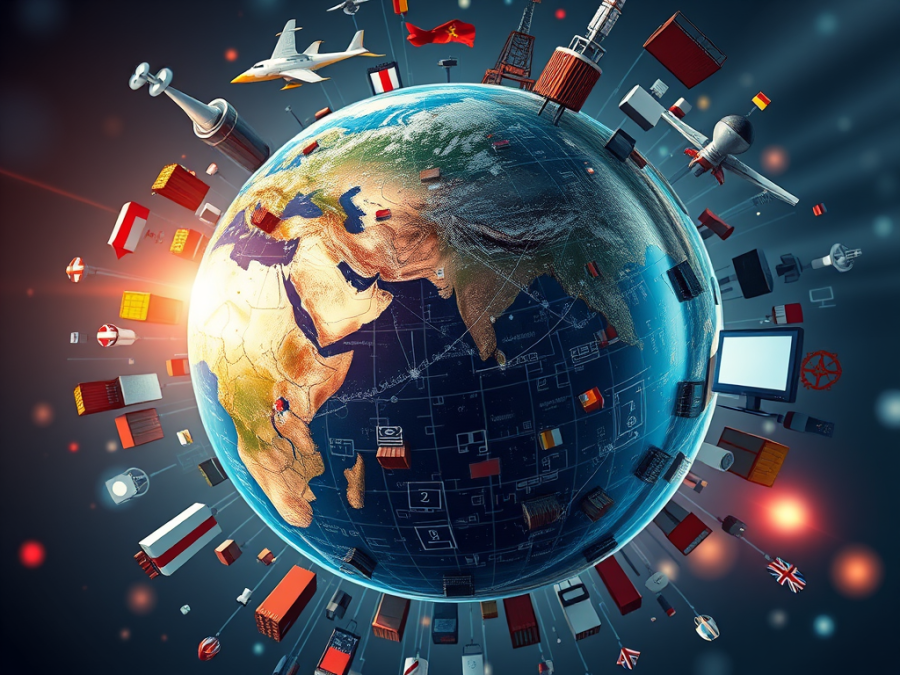
The world hums with an unprecedented interconnectedness. Goods crisscross borders with dizzying speed, information flows freely through digital networks, and cultural influences mingle in ways unimaginable just a few decades ago. This phenomenon, broadly termed globalisation, is a defining characteristic of our modern era. Yet, amidst the undeniable benefits of economic growth and increased interaction, a persistent question lingers: Does this deepening integration come at the cost of national sovereignty, or is it, in fact, a necessary engine for progress and collaboration?
This isn’t a simple either/or scenario. The relationship between globalisation and national sovereignty is complex and multifaceted, a delicate dance between interdependence and autonomy. To truly understand its implications, we need to delve into the various ways globalisation exerts its influence.
The Economic Embrace: A Double-Edged Sword
Economically, globalisation manifests through the liberalisation of trade, the rise of multinational corporations (MNCs), and the increasing interconnectedness of financial markets. Proponents argue that this fosters economic growth, creates jobs, and provides consumers with a wider array of goods and services at competitive prices. Developing nations, in particular, can benefit from access to foreign investment, technology transfer, and larger export markets, potentially lifting millions out of poverty.
However, this economic embrace can also feel like a squeeze on national sovereignty. The power of MNCs, often with budgets exceeding those of some smaller nations, can influence domestic policies and regulations. International trade agreements, while aiming to reduce barriers and promote fair competition, can also constrain a nation’s ability to protect nascent industries or implement specific social and environmental standards. The volatility of global financial markets can leave national economies vulnerable to external shocks, limiting the ability of governments to independently manage their fiscal and monetary policies.
Consider the debates surrounding trade deals. While they can open up new markets, they often require nations to cede some control over their domestic regulations concerning labour, environmental protection, and intellectual property. This can lead to concerns about a “race to the bottom,” where nations lower their standards to attract foreign investment, potentially undermining social and environmental well-being.
The Cultural Current: Homogenization vs. Hybridisation
Globalisation also has a profound impact on culture. The rapid dissemination of information and media through the internet and global communication networks can lead to the spread of dominant cultural norms and values, often originating from more powerful nations. This raises concerns about cultural homogenization, where unique local traditions and identities are eroded by a pervasive global culture.
On the other hand, globalisation can also foster cultural exchange and hybridisation. Exposure to diverse cultures can lead to new forms of artistic expression, culinary innovation, and a greater understanding and tolerance between different societies. The ease of travel and migration also contributes to this cultural mixing, enriching societies with new perspectives and traditions.
The impact on national sovereignty in this realm is more subtle but no less significant. Governments may find it challenging to protect and promote their national culture in the face of powerful global media and entertainment industries. The influx of foreign cultural products can influence national identity and values, potentially leading to social tensions and a feeling of cultural loss among some segments of the population.
The Political Playground: Shifting Power Dynamics
Politically, globalisation has led to the rise of international organisations (IGOs) like the United Nations, the World Trade Organisation, and regional blocs like the European Union. These institutions play an increasingly significant role in shaping international norms, laws, and policies, addressing issues ranging from trade and security to human rights and environmental protection.
While these organisations are crucial for fostering cooperation and addressing global challenges that transcend national borders, their existence inherently involves a degree of shared sovereignty. Nations voluntarily cede some decision-making authority to these bodies in exchange for the benefits of collective action and participation in a rule-based international order.
This can be a source of tension. Critics argue that IGOs can be dominated by powerful nations, leading to decisions that may not always align with the interests of smaller or less influential states. The increasing interconnectedness also means that domestic political decisions can have international repercussions, requiring governments to consider the views and interests of other nations and international actors.
A Necessary Driver or an Undermining Force? Finding the Balance
Ultimately, the question of whether globalisation undermines national sovereignty or acts as a necessary driver is not a matter of a definitive “yes” or “no.” It’s a complex interplay of both forces. Globalisation presents undeniable opportunities for economic growth, cultural exchange, and international cooperation. However, it also poses significant challenges to the traditional notion of national sovereignty, demanding a re-evaluation of how nations exercise their autonomy in an increasingly interconnected world.
The key lies in finding a balance. Nations need to strategically engage with globalisation, leveraging its benefits while safeguarding their core national interests and values. This requires:
- Strong domestic institutions: Robust legal frameworks, transparent governance, and a vibrant civil society are crucial for navigating the complexities of globalisation and ensuring that its benefits are shared equitably.
- Strategic international engagement: Nations must actively participate in shaping international norms and institutions, advocating for their interests and working towards a more equitable and just global order.
- A focus on multilateralism: Collaborative solutions through international cooperation are essential for addressing global challenges like climate change, pandemics, and economic instability, even if it requires some degree of shared sovereignty.
- A commitment to protecting cultural diversity: Governments and civil society organisations need to actively promote and preserve national cultures and identities in the face of global cultural flows.
In conclusion, globalisation is an undeniable force shaping our world. While it presents potential risks to traditional notions of national sovereignty, it is also a necessary driver of modern economies and international relations. The challenge for nations in the 21st century is not to resist globalisation, but to navigate its complexities strategically, ensuring that they can harness its benefits while preserving their autonomy and promoting the well-being of their citizens in an increasingly interconnected world. The tangled web of globalisation demands careful untangling, not outright severance.

Good rundown on globalisation, Indrajit. While countries will have to do the strategic balancing towards maintenance of sovereignty, there has to be the realisation that it is invariably bound to remain tempered by the spirit of give and take between nation states. The degree of interconnectedness that is necessitated by a globalised world is our best insurance against wars and conflicts.
LikeLiked by 1 person
Thanks, sir.
LikeLike
Thank you for your thoughtful response. I completely agree—globalisation, despite its complexities, fosters a web of interdependence that often serves as a deterrent against large-scale conflicts. Strategic sovereignty must indeed coexist with pragmatic cooperation. When nations acknowledge their shared interests—be it in trade, climate, health, or security—the chances of durable peace and mutual progress increase significantly. The spirit of give and take you mentioned is not just diplomatic courtesy; it’s fast becoming a geopolitical necessity.
LikeLike
Globalization brings economic opportunities, but can also threaten national sovereignty. For example, countries like India have benefited from foreign investment and technology transfer, but face challenges in protecting local industries and making independent policy decisions.
Globalization can lead to cultural homogenization (e.g., spread of Western fast food chains like McDonald’s globally). However, it also enables cultural hybridization, where local cultures blend with global influences (e.g., fusion cuisine, music genres like Bollywood or K-pop).
Globalization has shifted power dynamics, with multinational corporations and international organizations influencing policy decisions. For instance, the World Trade Organization (WTO) shapes global trade policies, while companies like Google and Amazon wield significant economic influence.
Globalization can drive economic growth, innovation, and cultural exchange. However, it can also undermine local industries, exploit natural resources, and exacerbate income inequality. For example, globalization has lifted millions out of poverty in countries like China, but has also led to environmental degradation and labor exploitation.
Finding the Balance
To balance the benefits and drawbacks, governments can implement policies that promote fair trade, protect local industries, and ensure environmental and labor standards are met. For example, countries like Norway have implemented policies to manage their natural resources sustainably and equitably.
The conclusion of the text on globalization seems to be that it’s a complex and multifaceted phenomenon. While it brings opportunities for economic growth, cultural exchange, and innovation, it also poses challenges to national sovereignty, cultural identity, and social equity.
The text suggests that finding a balance between the benefits and drawbacks of globalization is crucial. This might involve implementing policies that promote fair trade, protect local industries, and ensure environmental and labor standards are met.
In essence, the conclusion is that globalization requires careful management to maximize its benefits while minimizing its negative impacts. 🙏🏽🙏🏽
LikeLike
Thank you for this well-rounded and thoughtful analysis. You’ve captured the nuanced reality of globalization with clarity—its potential to drive progress, but also the imperative to guard against its excesses. The examples you cited, from the influence of multinationals to the cultural shifts brought on by global interconnectivity, highlight how deeply globalization permeates all aspects of modern life.
Your emphasis on policy-driven balance is key. Countries must engage with the global economy on their own terms, safeguarding their cultural ethos and economic autonomy while remaining open to innovation and collaboration. Models like Norway’s demonstrate that it is possible to harness globalization responsibly.
Ultimately, as you rightly point out, globalization isn’t inherently good or bad—it’s how we respond to it that shapes its impact. With thoughtful governance, ethical business practices, and cultural confidence, we can steer globalization toward shared prosperity and resilience. 🙏🏽
LikeLike
This is a serious topic for research. Big challenge for most of the developing countries to maintain a balance between globalisation and national sovereignity, particularly in the field of economy and culture. In case of India, we may perhaps add spirituality too. Globalisation is bound to have some influences on these elements.
Our civilisation is quite old. In ancient India our trade expanded outside the sub continent. People used to visit our country as students to acquire knowledge. We have a history of embracing globalisation thousands of years back. But our real encounter with globalisation and some of its ill effects perhaps started with British colonialism.
The heading of your article reminds me of Swami Vivekananda. He encouraged adoption of useful scientific knowledge and technologies from western countries, but warned against blindly following or immitating their religion and culture so that we do not lose our own values and national identity.
LikeLiked by 1 person
Thank you for this deeply insightful reflection. You’ve beautifully traced the arc of India’s engagement with the world—from ancient times when we were a beacon of knowledge and trade, to the colonial era that forced a different kind of globalisation upon us. Your point about the challenge of balancing economic and cultural sovereignty is particularly relevant today, as India navigates global integration while striving to preserve its civilisational essence.
Indeed, spirituality adds a unique dimension to our identity, and Swami Vivekananda’s vision serves as a timeless guide. His call to absorb what is beneficial while safeguarding our core values is perhaps more relevant now than ever before. True globalisation, as you suggest, should enrich rather than erode, and India’s historical resilience offers both cautionary lessons and inspiring possibilities.
LikeLike