
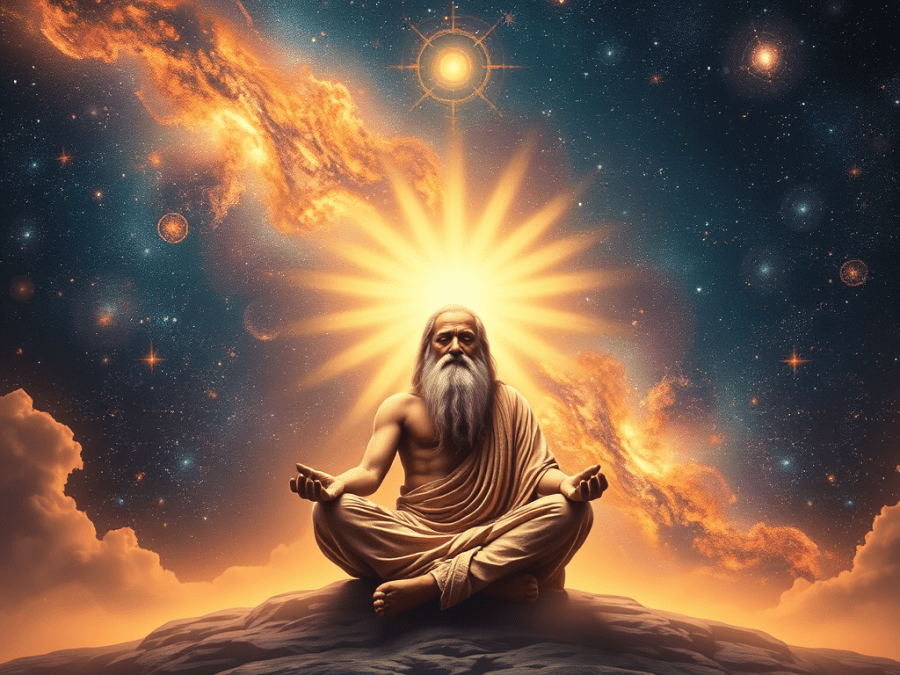
In the boundless tapestry of the universe, there exists an unspoken law, a rhythmic pulse that orchestrates everything—from the grand ballet of galaxies to the delicate unfolding of a flower. Ancient civilisations, across continents and ages, have sought to articulate this fundamental principle. In the rich spiritual landscape of Vedic India, this concept found its profound expression in the idea of Rita (ऋत). This term transcended mere definition to become the very heartbeat of the cosmos.
More than just a philosophical term, Rita represented a cosmic blueprint that not only shaped the spiritual beliefs of the Vedic people but also influenced their ethical, social, and cultural practices. This timeless principle of order, balance, and righteousness is intricately woven into the fabric of Vedic thought, providing both a framework for understanding the universe and a guide for living in harmony with it.
Rita as Cosmic Law: The Unseen Architect of the Universe
Imagine a time when the world was less understood, when the mysteries of the heavens and the earth inspired both awe and curiosity. For the Vedic sages, the regular rising of the sun, the predictable paths of the stars, and the cyclical unfolding of the seasons were not random occurrences but manifestations of a profound and underlying order. This order was Rita.
Derived from the Sanskrit root ri—meaning “to flow” or “to move”—Rita embodies the very rhythm of existence. It is the predictable pulse of the cosmos, the invisible hand that guides the celestial bodies, the silent architect behind the turning of the seasons, and the delicate equilibrium of natural forces. In this ancient framework, Rita was not merely a concept but the very law that upheld the structure of the universe.
In the sacred hymns of the Rigveda, the oldest and most revered of the Vedic texts, Rita is frequently lauded as the force that ensures cosmic predictability. Much like modern physicists seek universal laws—such as gravity or quantum mechanics—to explain the behaviour of the cosmos, the Vedic seers understood the universe as a structured system governed by an intrinsic intelligence. Rita represented this order, showing that the universe did not operate on random chaos but followed a predictable, intelligent rhythm.
The Vedic deities themselves were believed to personify and uphold Rita. One such deity, Varuna, was revered as the “upholder of Rita,” a cosmic guardian who ensured that the sun stayed its course in the sky. As the Rigveda (1.105.12) declares: “Varuna, upholder of Rita, sets the Sun in the heavens.”
Similarly, Mitra, a deity associated with contracts, agreements, and harmony, was also believed to uphold the principles of Rita, ensuring order not just in the cosmos but in human relationships as well.
Rita as Moral & Social Order: The Blueprint of Righteous Living
The influence of Rita wasn’t confined to the stars; it also found its way into the moral and social lives of the Vedic people. Living in accordance with Rita was not merely a philosophical pursuit; it was a practical guide to righteous living. To align one’s thoughts, actions, and speech with Rita meant to live in harmony with the principles of truth, order, and cosmic balance.
Core Vedic virtues were seen as direct expressions of Rita in human life. Virtues like Satya (truthfulness), Ahimsa (non-violence), and Dharma (righteous duty) were seen as expressions of Rita in human life. For the Vedic people, truth was not just a social norm but a cosmic principle. Non-violence was understood not as a passive ideal but as an active respect for the harmony of the universe. And Dharma—one’s personal duty in life—was seen as a way to align with the greater cosmic order.
The intricate and meticulously performed Vedic rituals were also deeply intertwined with Rita. These ceremonies, with their precise chants, offerings, and symbolic actions, were believed to be microcosmic reflections of the cosmic order. Rituals like Agnihotra, performed daily at sunrise and sunset with offerings of ghee, rice, and other organic substances into a sacred fire while chanting mantras, were carried out with devotion and precision. Through these practices, individuals and communities aimed to uphold cosmic harmony, ensuring prosperity, balance, and the well-being of the universe.
This profound moral dimension of Rita fostered a strong sense of interconnectedness. The Vedic worldview held that the individual, society, and the universe were not separate entities but rather integral parts of a unified whole. Human conduct was thus seen as crucial for maintaining cosmic harmony, a belief that laid significant groundwork for later Indian philosophies.
The Dynamic Interplay: Dharma, Satya, and Ahimsa
While Satya and Ahimsa are widely regarded as foundational principles, the Vedic understanding of Rita is far from simplistic. To truly live in accordance with Rita, one must also navigate the complex interplay between these values and the principle of Dharma—one’s personal duty.
Dharma is not a static rule; it’s a dynamic concept of righteous duty, often understood as svadharma – one’s specific duty based on their context (time, place, circumstance, and station in life). It is in the context of Dharma that Satya and Ahimsa are applied and sometimes reinterpreted.
This nuanced approach is evident in the Bhagavad Gita, where Prince Arjuna, a Kshatriya (warrior class), faces a moral dilemma on the battlefield. He is torn between his duty as a warrior (svadharma)—which demands that he fight to uphold justice—and his desire to avoid violence (Ahimsa) against his own family. In this moment, Lord Krishna advises him that while non-violence is a noble ideal, the greater Dharma sometimes requires actions that may be difficult but are necessary to uphold justice and cosmic order. The intent behind the action – to maintain cosmic and social order – becomes paramount. Thus, Dharma becomes the guiding force that helps navigate the complex realities of life, ensuring that one’s actions are in harmony with the universe.
Similarly, a king’s Dharma includes protecting the kingdom and punishing criminals, which may involve the use of force. While Ahimsa is a guiding ideal, the Dharma of a ruler to prevent widespread chaos and ensure justice might necessitate actions that involve violence. The crucial element is that these actions are undertaken without malice, solely for the preservation of order and the greater good.
Thus, while Satya and Ahimsa are fundamental components of a Dharmic life, Dharma is the overarching framework that determines how these virtues are applied in complex, real-world situations to ensure the continued harmony of Rita. It’s the principle that allows for the nuanced ethical decisions required to maintain the cosmic order when ideals might appear to conflict.
Rita in Art, Literature, & Ritual: A Manifestation of Creativity
The influence of Rita also extends to Vedic art, literature, and ritual, where it is expressed through both intellectual precision and creative devotion. The hymns of the Rigveda, dedicated to Rita, are some of the most poetically resonant texts in the Vedic canon. These hymns are not mere descriptions of the cosmos but expressions of awe and reverence for the cosmic order.
The Vedic rituals also displayed an extraordinary level of intellectual precision and spiritual devotion. One striking example of this is the construction of fire altars (agnicayana), as detailed in the Shatapatha Brahmana. These altars were built in geometrically precise shapes, replicating cosmic forms. The advanced geometric knowledge and meticulous measurement involved in their construction symbolised the human effort to align with the cosmic principles of Rita. This intricate balance between intellectual precision and spiritual devotion further illustrated how Rita permeated every facet of Vedic life.
Within the realm of Vedic literature, Rita also served as a metaphor for creativity. The kavis, or poets, were not merely wordsmiths but seers who possessed the ability to discern the deeper truths of the cosmos. By channelling their heightened perception, they expressed these truths in the form of inspired hymns. In this sense, Rita was a bridge between the material and spiritual realms, between the abstract and the tangible.
Rita’s Enduring Influence: A Legacy of Universal Harmony
The concept of Rita has endured throughout the history of Indian thought, influencing not only religious and philosophical traditions but also social and political life. Kings and rulers were expected to embody Rita in their governance, ensuring that their rule reflected cosmic harmony and justice. A ruler who strayed from Rita risked bringing disorder to both society and the cosmos.
In a broader cultural context, Rita symbolises the Vedic worldview of holistic harmony, wherein the cosmos, nature, and humanity are not isolated entities but are intricately interconnected. This perspective fosters a profound sense of responsibility—not just toward fellow human beings but toward the entire environment and the very fabric of existence itself.
The philosophical legacy of Rita can be seen in later Indian traditions, such as Jainism and Buddhism, which emphasise the importance of living in harmony with the natural order and recognising the interconnectedness of all life. The Jain principle of ahimsa (non-violence) and the Buddhist concept of dependent origination (pratītyasamutpāda) both echo the ideas of Rita—that the universe operates according to universal, interdependent laws.
Rita: A Timeless Wisdom
In the Vedic texts, Rita is not just a cosmic order but also a moral and ethical principle, influencing how individuals and societies should behave. It is about living in harmony with the natural world and adhering to truth, justice, and moral integrity.
Today, as we navigate the complexities of our modern world, the concept of Rita offers a timeless source of wisdom. It is more than an ancient relic from a distant past; it is a profound understanding of the inherent order of the universe and a guiding principle for living a life of purpose, truth, and harmony. In attuning our lives to the cosmic rhythm, as Rita urges, we might find a deeper sense of meaning and connection with the world around us.
In today’s world, Rita holds a timeless and profound relevance. Its ideas can be applied to modern issues like environmental sustainability, social justice, and ethical governance. In an age where many of the natural rhythms of life, from climate change to societal conflicts, are disrupted, the principle of Rita advocates for restoring balance, justice, and respect for nature.
Thus, Rita is not merely an ancient concept from the past but a timeless principle that continues to offer insight into the nature of the universe and our place within it. By aligning ourselves with the cosmic symphony of Rita, we may not only uncover deeper truths about the cosmos but also lead lives of greater harmony, purpose, and wisdom.

A very well-explained post. The Vedic Rita is not just a historical or mythological concept, but a timeless principle that offers valuable lessons for aligning personal, societal, and environmental conduct in a way that nurtures balance, harmony, and justice.
LikeLiked by 1 person
You’re right. Thanks, Nilanjana.
LikeLike
Wondering if it is the same as the word we pronounce “reet” in Hindi. As in “raghukul reet sada chali aayi…”
LikeLiked by 1 person
Indeed, Reet in “Raghukul Reet Sada Chali Aayi” pertains to the Hindi pronunciation of reet, which means customs or traditions. While Rita represents cosmic order, truth, and the laws of nature, Reet denotes the guiding customs or principles that influence behaviour. The phrase “Raghukul Reet Sada Chali Aayi” reflects a deep-rooted tradition upheld by the Raghukul lineage, grounded in values of honesty and respect. The Raghukul reet stressed the importance of honoring one’s commitments, even at the expense of significant personal sacrifice, underlining a timeless dedication to integrity.
LikeLike
Your blog beautifully explores Rita, bringing to light its profound impact on cosmic order, ethics, creativity, and philosophy. The depth of understanding and the seamless connection between these concepts reflect remarkable wisdom and insight.
Your exploration of Rita is truly enlightening—each facet you’ve covered seamlessly ties into a larger vision of universal harmony. By unveiling Rita as the unseen architect of the cosmos, you have captured its essence as the guiding force behind celestial balance and natural order. The way you have transitioned this cosmic principle into the sphere of morality and social structure showcases how Rita is not just a universal law but also a blueprint for righteous living.
Your discussion on the dynamic interplay between Dharma, Satya, and Ahimsa is especially thought-provoking, as it highlights how ethical conduct, truth, and non-violence are deeply intertwined with Rita, forming the foundation of human virtues. The connection you’ve drawn between Rita and artistic expression in literature, rituals, and creativity further demonstrates how this ancient wisdom manifests across multiple dimensions of life, shaping cultural and spiritual identities.
What stands out most is your recognition of Rita’s enduring influence—how its legacy continues to resonate in the modern world, reminding us of the interconnectedness of existence. Your insights on Rita as timeless wisdom offer a profound reflection on how these ancient philosophies continue to shape our thoughts, actions, and understanding of universal harmony.
The way you have woven these themes together is both illuminating and inspiring. Your ability to bridge philosophy, ethics, and artistic expression with a cohesive narrative is commendable. Thank you for sharing this incredible piece—it is a truly enriching read!
LikeLiked by 2 people
Thank you so much for your thoughtful and generous words! I’m deeply touched by your insightful reflections on the post. Rita, in its many dimensions, truly is a fascinating concept, and I’m glad the exploration resonated with you. Your comment further enriches the discussion, and I appreciate the way you’ve connected the themes so beautifully. Thank you for taking the time to read and share your perspective!
LikeLike
In India, every milestone in a child’s life is cherished with unique cultural practices, and the teething ceremony holds a special place among them. Known in different regions by various names such as Annaprashana, Mukhe Bhaat, or Choroonu, this ceremony symbolizes the child’s transition from a milk-only diet to the first taste of solid food. While teething itself is a natural biological process, Indian customs have long intertwined it with spiritual, cultural, and familial significance.
https://www.indianetzone.com/indian_customs_teething
LikeLiked by 1 person