
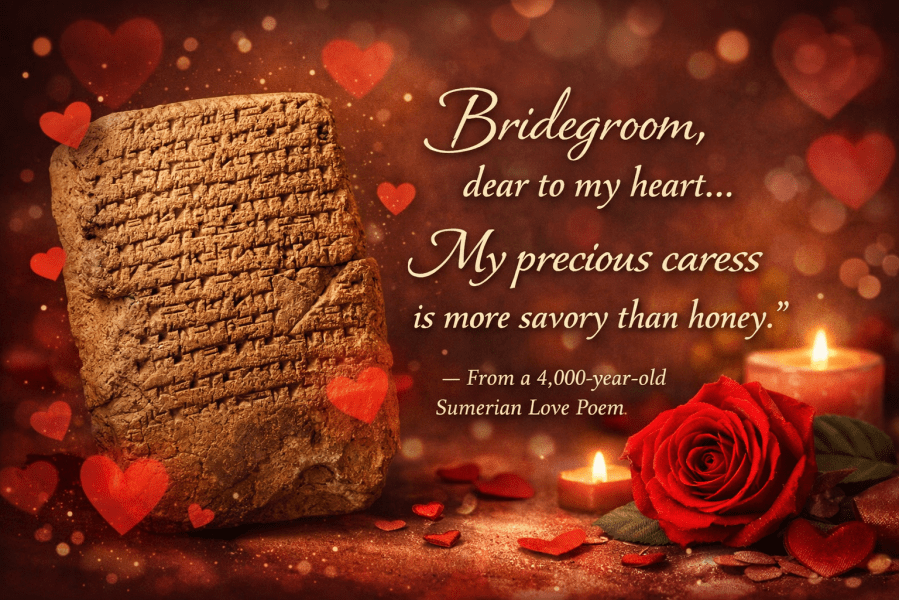
Happy Valentine’s Day! It’s a day of red roses, digital heart emojis, and last-minute dinner reservations. But if you think we invented the “love letter,” think again. Nearly 4,000 years ago, in the sun-drenched lands of Sumer, long before the first Hallmark card was printed, humans were already composing poems of longing, devotion, and desire—poems that survive to this day.
The 19th-Century Surprise
In the 19th century, archaeologists descended on Mesopotamia, largely seeking evidence to corroborate the biblical narratives of the Old Testament. Public interest—and the resulting funding—was driven by the hope that these expeditions would confirm the stories of Noah, the Great Flood, and other biblical events. Instead, they found something that changed the world’s understanding of history.
During excavations at Nineveh in 1846-1847, Austen Henry Layard unearthed the library of Ashurbanipal, the Assyrian king. Among the cuneiform tablets, translated by George Smith, scholars discovered that many biblical narratives were not unique to Hebrew tradition—they had roots in much older Mesopotamian tales. Stories like the Flood and the Fall of Man predated the Hebrew scriptures by centuries.
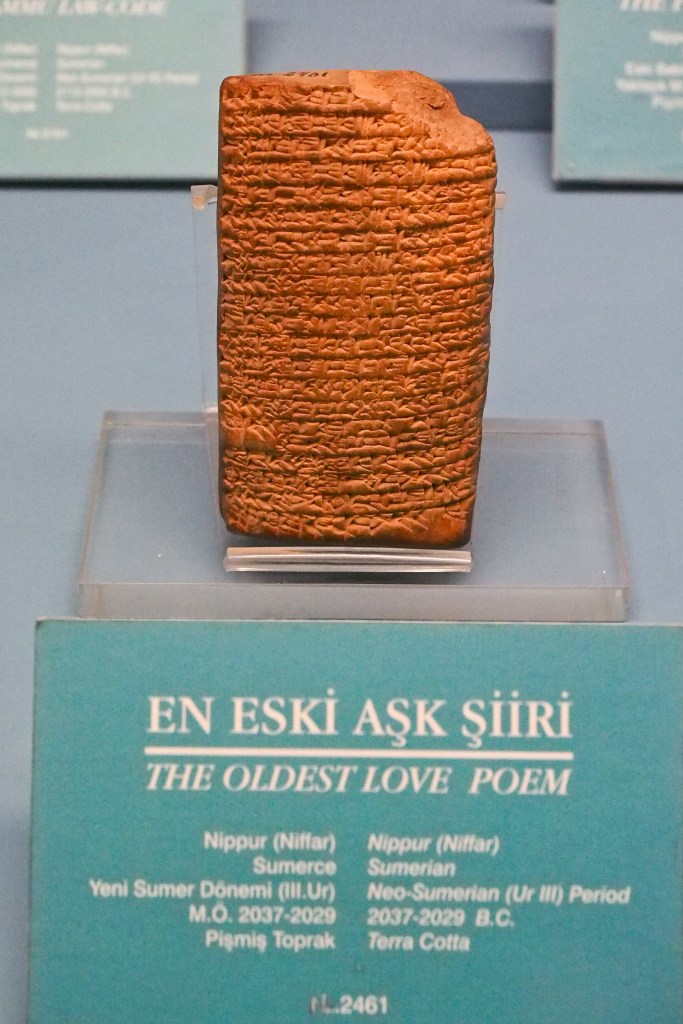
But tucked away in the dirt was Tablet 2461. It wasn’t a law or a war record. It was the world’s oldest known love poem.
“I soon realised that I was reading a poem… celebrating beauty and love, a joyous bride and a king named Shu-Sin. I held in my hand one of the oldest love songs written down by the hand of man.”
— Samuel Noah Kramer, Sumerologist
The Love Song for Shu-Sin
Composed around 2000 BCE, this poem predates the biblical Song of Songs by nearly a millennium. It was likely recited to King Shu-Sin, who ruled the city of U from 2037 to 2029 BCE.
This wasn’t just a “crush” note; it was part of the “Sacred Marriage” ritual. The King would symbolically unite with Inanna, the goddess of love and fertility, through a priestess. This divine union was believed to guarantee fertile fields and a prosperous year for the people. Talk about high-stakes romance!
Words of Love From 4,000 Years Ago
Check out this excerpt from the translation by Samuel Noah Kramer. Tell us if this doesn’t sound like something you’d find in a modern ballad:
“Bridegroom, dear to my heart,
Goodly is your beauty, honeysweet,
Lion, dear to my heart,
Goodly is your beauty, honeysweet.
You have captivated me, let me stand tremblingly before you.
Bridegroom, I would be taken by you to the bedchamber,
You have captivated me, let me stand tremblingly before you.
Lion, I would be taken by you to the bedchamber.
Bridegroom, let me caress you,
My precious caress is more savoury than honey,
In the bedchamber, honey-filled,
Let me enjoy your goodly beauty,
Lion, let me caress you,
My precious caress is more savoury than honey.”
Reading these words today, on Valentine’s Day, is a reminder that love, desire, and intimacy are timeless. Across four millennia, humans have spoken to the heart in the same way we do now: with yearning, admiration, and joy.
Shu-Sin: King, Lover, Legend
Scholars note that Shu-Sin also appears in Akkadian erotic dialogue poems, written in a form remarkably similar to the later biblical Song of Songs. Even thousands of years ago, humans were attempting the same pursuit we all do today: to capture love in words.
From Sumer to Valentine’s Day
On this Valentine’s Day, I like to imagine the New Year celebrations in Ur: music in the streets, feasts laid out, the chosen bride reciting words of desire to her king, and the people watching—understanding that love was both divine and deeply human.
Love is timeless. Whether it’s a cuneiform tablet in Ur or a text message in 2026, our drive to connect, to admire, and to express passion is the thread that connects us across time.
Love has always been worth writing, singing, and celebrating—even 4,000 years ago.

There is something profoundly humbling about the realization that four thousand years of history can be collapsed into a single, breathless stanza. Your reflection on The Love Song for Shu-Sin serves as a beautiful bridge between the sun-drenched courts of Sumer and the modern doorstep. It reminds us that while we often look to the past for “evidence” of grand events—floods, kings, and falling empires—the most enduring evidence we find is actually that of our own shared humanity. The image of the 19th-century archaeologists seeking biblical confirmation, only to find an intimate confession of desire, is a poignant irony. It suggests that while we search the earth for the divine, we often stumble upon the deeply personal. By highlighting the “sacred marriage” ritual, you’ve captured the duality of love in the ancient world: it was a force capable of ensuring the fertility of the land, yet it remained as simple and sweet as “honey” in the privacy of a bedchamber. In a world that often feels fractured by time and distance, your story reminds us that Shu-Sin’s bride spoke a language we still understand fluently today. Whether carved into a clay tablet or typed into a smartphone, the sentiment remains unchanged: we are a species that seeks to be seen, to be captivated, and to be loved. This wasn’t just a poem for a king; it was a testament to the fact that the human heart has been singing the same melody since the very beginning of recorded time. Thank you for breathing life back into those 4,000-year-old lines and for reminding us that on Valentine’s Day, we aren’t just following a modern tradition—we are participating in an ancient, unbroken human rhythm 🙏🏽🙏🏽
LikeLiked by 1 person
Thank you for this deeply generous and perceptive reading. You’ve captured exactly the quiet miracle I hoped to point toward—that beneath the layers of time, ritual, and empire, the human voice remains astonishingly familiar. The irony you note is especially moving: in searching for proof of the divine, we uncover the intimacy of longing, tenderness, and love.
Your words beautifully affirm that Shu-Sin’s bride is not a distant historical figure but a contemporary of our own hearts. If this reflection helped even briefly dissolve the distance between then and now, between clay tablets and glowing screens, I’m truly grateful. 🙏🏽
LikeLike