
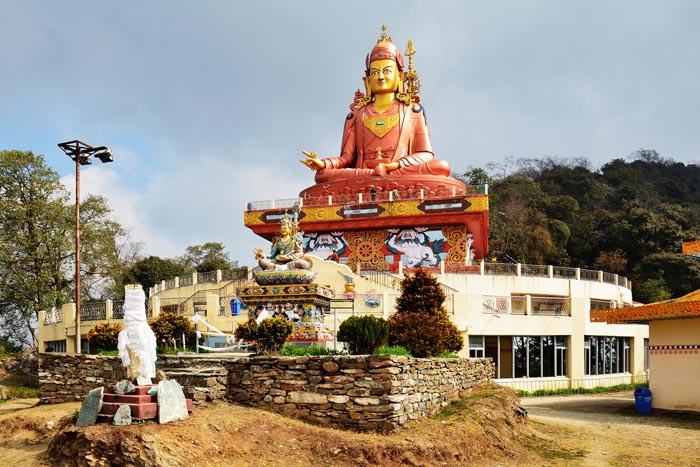
Some places announce their presence not through spectacle alone, but through silence—through a quiet stirring of the soul. Samdruptse Hill, rising gently yet commandingly above the serene town of Namchi in South Sikkim, is one such place. A hill where legends sleep beneath prayer flags, where faith has softened the memory of fire, and where the sky seems just a little closer to earth.
Namchi, aptly translated as “Sky High” in the Sikkimese tongue, sits at an elevation of about 1,675 metres (5,500 feet). It feels less like a town and more like a balcony overlooking the Eastern Himalayas. Just five kilometres away, yet spiritually worlds apart, stands Samdruptse Hill, climbing further to nearly 2,134 metres (7,000 feet). This “wish-fulfilling hill”, as its name in the Bhutia language suggests, is crowned by one of the most iconic spiritual landmarks in the Himalayas—the towering statue of Guru Padmasambhava.
The Wish-Fulfilling Hill
Samdruptse is not merely a geographical feature; it is a living myth. Local lore whispers that the hill is a dormant volcano, once restless, now pacified by centuries of prayers, mantras, and offerings. Whether one believes this tale literally or metaphorically, there is no denying the palpable calm that envelops the place. It is as if faith itself has laid a gentle hand upon the land.
Dominating the forested ridge is the colossal 45-metre-high statue of Guru Padmasambhava—Guru Rinpoche, the Precious Guru—the patron saint of Sikkim. Painted in luminous hues of copper, pink, and bronze, the statue gleams against the green hills and shifting skies, visible from miles away, even from parts of Darjeeling.
This is the tallest statue of Guru Padmasambhava in the world, an engineering and devotional marvel that took seven years to complete. Its foundation stone was laid in 1997 by His Holiness the Dalai Lama, lending the project both spiritual gravitas and historical significance.
A Beacon of Faith Across the Himalayas
Guru Padmasambhava occupies a unique and exalted place in Himalayan Buddhism. Credited with transmitting Buddhism to Tibet, Bhutan, and neighbouring regions in the 8th century CE, he is revered as the one who tamed hostile forces and anchored the Dharma in these lands. He introduced Tantric Buddhism, weaving ritual, meditation, and mysticism into a powerful spiritual path that continues to guide millions.

Often regarded as the Second Buddha, Guru Rinpoche is believed to have blessed Sikkim as a sacred refuge for Buddhist teachings, endowing it with vajra wisdom—the indestructible clarity of enlightened insight. Standing before his statue at Samdruptse, one senses not awe alone, but reassurance, as though the mountains themselves are under vigilant guardianship.
A Life Woven in Legend
Padmasambhava’s life reads like a sacred epic. Born, according to tradition, not in the usual way, but as an eight-year-old child upon a lotus blossom floating in Lake Dhanakosha in the kingdom of Oḍḍiyāna (believed to be present-day Swat Valley in Pakistan), his very arrival defied the ordinary.

Recognised early for his divine nature, he was chosen by the local king as heir to the throne. Yet Padmasambhava renounced royal privilege in favour of spiritual pursuit, travelling across northern India and beyond, spreading the Buddha’s teachings with uncompromising intensity. His journey eventually led him to the high Himalayan regions, where his influence would become eternal.
The Sacred Ascent
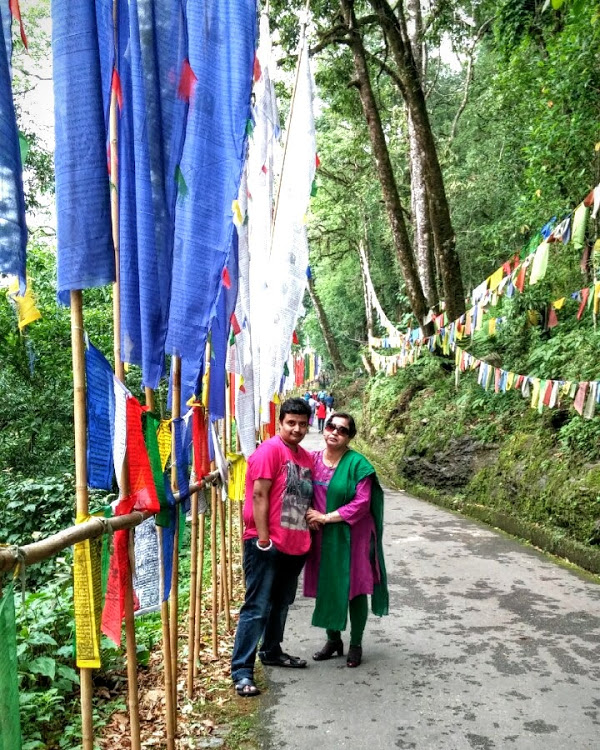
The approach to Samdruptse Hill feels ceremonial. Colourful prayer flags—lungta—line the path, fluttering in the mountain breeze, carrying mantras and blessings into the heavens. Buddhist hymns, softly amplified through discreet speakers, fill the air with a rhythm that slows the breath and quietens the mind.

Every step feels intentional, as though the journey itself is part of the prayer.
Near the statue stands the Samdruptse Monastery, one of the most sacred monastic complexes in Sikkim. Unlike the ancient monasteries scattered across the state, this one reflects a contemporary architectural sensibility, seamlessly blending Sikkimese and Tibetan aesthetics with modern design.
Yet tradition is deeply preserved here. Historic sculptures, statues, ritual artefacts, and paintings narrate centuries of spiritual and cultural evolution. A permanent photo exhibition within the complex offers a vivid window into Sikkim’s natural beauty, artistic traditions, and layered history—an understated but deeply enriching experience.
Of Cairns, Flags, & Silent Prayers
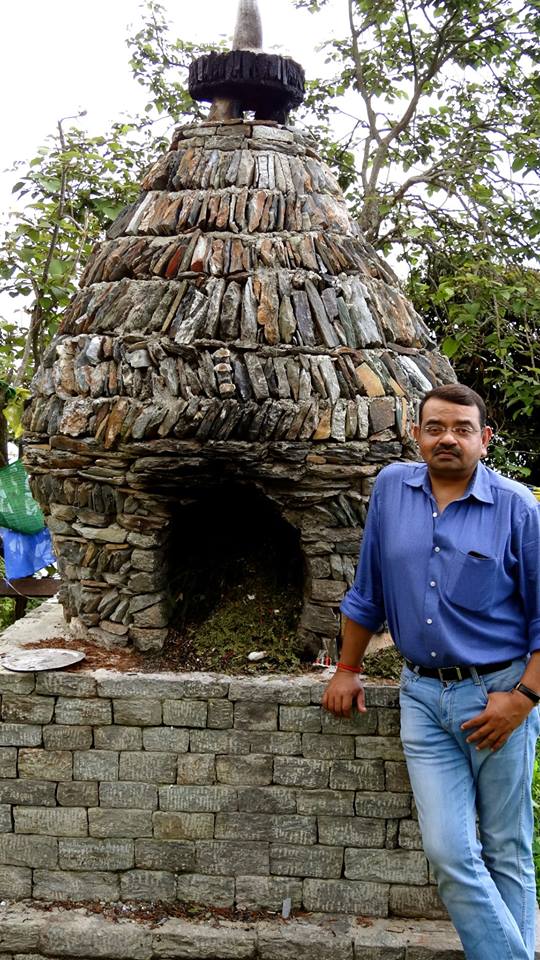
On a hillock behind the statue, Buddhists place their prayer flags and build cairns, stacking stones as symbols of good luck. These cairns, once used as landmarks and messages in unoccupied lands, are now seen as harbingers of fortune for travellers. Local myths suggest that Buddhist monks have long climbed this hill to offer prayers, seeking to keep the dormant volcano calm.


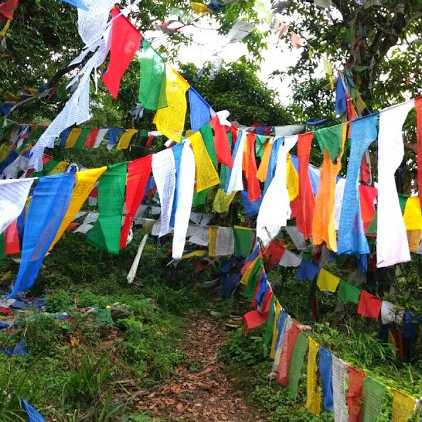
Prayer flags are planted with care, their colours slowly fading under sun and snow, their messages dissolving into the wind. Local belief holds that Buddhist monks have long climbed this hill to pray, seeking to keep the volcano—real or imagined—at peace. Whether myth or metaphor, the symbolism is powerful: faith as a force that calms even the most volatile of energies.

A Quiet Ending, A Lingering Presence
As the afternoon light softened, our visit drew to a close with a simple pleasure—a warm cup of tea at a modest restaurant near the temple complex gate. Steam rose gently from the cups as we sat in reflective silence, preparing to continue our journey towards Char Dham.


Yet something stayed behind—or perhaps came along with us.
Samdruptse Hill does not overwhelm. It does not demand belief. Instead, it offers space—space to pause, to listen, to feel. In a land already blessed with extraordinary beauty, Samdruptse stands apart, not merely as a destination, but as an experience.
A place where history, myth, and spirituality converge quietly, leaving an indelible imprint on the heart.
In the sacred stillness of Samdruptse, Sikkim reveals one of its most profound truths: that sometimes, the highest places are not measured in metres, but in meaning.

You guys must have been there long time ago because तुम सब बच्चे लग रहे हो फोटो में 😜😁
LikeLiked by 1 person
Check the date. It was 2015!
LikeLiked by 1 person
Yeah, saw it after posting 😂😄
LikeLiked by 1 person
👍🤣
LikeLike