
Among the countless festivals that enrich the cultural fabric of Bengal, Kojagori Lakshmi Puja, also known as the Lakshmi Puja of Sharad Purnima, holds a very special place. Celebrated on the full moon night of Ashwin (usually falling in October), this festival brings together devotion, folklore, and cultural heritage. It is a night when Goddess Lakshmi—the harbinger of wealth, prosperity, and well-being—is invoked with deep reverence, and homes across Bengal glow with the light of lamps, hope, and faith.
A Festival of Harvest & Abundance
Kojagori Lakshmi Puja coincides with the harvest season. Traditionally, this is when freshly harvested grains are first consumed in households, symbolizing both sustenance and gratitude. The term Kojagori itself stems from the belief that Goddess Lakshmi roams the earth on this sacred night, bestowing blessings on those who are awake and engaged in devotion. To guide her into their homes, families light rows of earthen lamps, especially at entrances, balconies, and terraces.
The Moonlit Night of Sharad Purnima
This night is also celebrated as Kaumudi Utsav, a moon-worship festival. Mythology describes Sharad Purnima as the night when the moon radiates sixteen kalas (essences), showering the earth with elixir-like beams. The moonlight is believed to have healing powers, often referred to as Amrit Varsha (the shower of nectar). In Bengal, people spend time under this full moon sky, combining worship with quiet reflection and devotion.
According to mythological stories, Kojagiri Purnima is a combination of 16 kalas — 1. Amrita 2. Maanda 3. Pusha 4. Pushti 5. Tushti 6. Rati 7. Dhriti 8. Shashani 9. Chandrika 10. Kaanti 11. Jyotsna 12. Shree 13. Priti 14. Angada 15. Poorna 16. Poornamrita.
The festival holds immense significance in Bengali culture and is celebrated with great enthusiasm and fervour. People decorate their homes with lights and flowers, prepare traditional sweets, and offer prayers to the goddess. The puja rituals involve lighting earthen lamps, reciting mantras, and offering flowers, fruits, and sweets to the deity.
Rituals & Preparations
The preparations for Kojagori Lakshmi Puja begin days in advance. Homes are cleaned meticulously and decorated with alpana—intricate motifs made from rice paste. These designs often depict lotus flowers, paddy stalks, owls (Lakshmi’s vahana), and the footprints of the goddess, symbolically inviting her into the household.
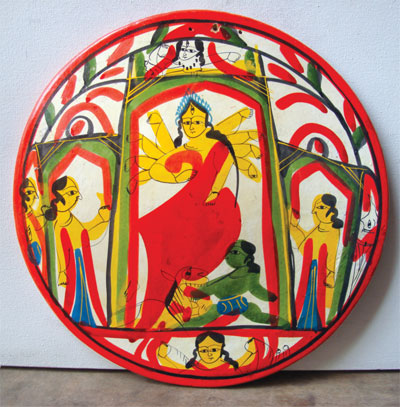
In many homes, instead of clay idols, devotees worship a paut—an earthen mould painted with images of Lakshmi and her owl.
A small mandap (altar) is set up in the puja room, decorated with flowers, lamps, and offerings. Devotees wear new clothes, chant mantras, and light oil lamps, signifying the dispelling of darkness and the arrival of divine light.
The Sacred Alpana
Alpana holds special significance in Bengali culture. This sacred art, believed to date back to the Indus Valley Civilization, is more than decoration—it is an invocation of auspiciousness. Traditionally drawn with fingers dipped in rice paste, the motifs symbolize prosperity and purity. During Kojagori Lakshmi Puja, the footprints of Lakshmi are carefully drawn from the entrance to the altar, symbolizing her arrival.
Be it weddings, pujas and other such rituals, alpana must be drawn on the altar, on floors or on chowkis or pidhi. Alpana refers to colourful motifs, sacred art or painting done on a horizontal surface on auspicious occasions in Bengal. The art typically has some religious significance. The motifs are mostly floral designs and are drawn to welcome/or to invoke the goddess.
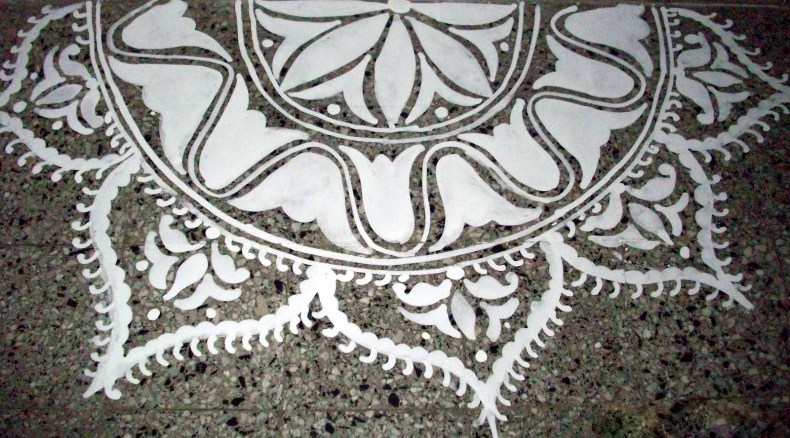
This type of art is found on the Indian subcontinent. This practice of Alpana is believed to have been coming down since the era of Indus Valley civilisation; similar motifs are seen in pots and vases of Harappa and Mohenjodaro.

The word Alpana is derived from the Sanskrit alimpana, which means ‘to plaster’ or ‘to coat with’. Traditionally in Bengal, alpana is strictly white since the liquid paste used is rice powder mixed in water. It is drawn using the right finger of the right hand and only a specific set of motifs are drawn. There is no restriction on size, shape or measurement. The artist can display his/her creativity in drawing alpana with various combinations of motifs with varying shapes, sizes and placements.


For Lakshmi puja, the motifs are usually ears of husk of paddy (dhan-er chhora), lotus (iconographically associated with Lakshmi and symbolic of purity and beauty), feet of Lakshmi, owl and other floral motifs. Traditionally it is drawn with fingers (fingers are used as brush) and rice paste as paint.
In an effort to usher her in, outlines of her little feet are painted on the floor from the entrance to the altar. It is believed that meticulous aesthetic preparations make the goddess happy.
On the day of the puja, devotees wake up early and take a ritual bath. They wear new clothes and offer prayers to Lord Ganesha, the remover of obstacles, before commencing the Lakshmi Puja. The puja involves the chanting of sacred mantras, offering flowers, fruits, and sweets to the goddess, and lighting oil lamps to symbolize the dispelling of darkness and the arrival of divine light.
One of the highlights of Kojagori Lakshmi Puja is the observance of an all-night vigil. Devotees stay awake throughout the night, engaging in devotional singing, storytelling, and recitation of hymns dedicated to Goddess Lakshmi. It is believed that staying awake during this night pleases the goddess and ensures her blessings for the entire year.
It is also a common belief that in order to guide goddess Lakshmi to the households, residents lit up diyas, candles, earthen or electric lamps on the terraces or balconies especially to show the path. Lamps are also lit to ward off evil spirits and devotional songs are sung in praise of Goddess Lakshmi.
Family Traditions & Togetherness
For many families, Kojagori Lakshmi Puja is not just a religious observance, but also a celebration of togetherness. In our household, Lakshmi Puja is performed every Thursday, but Kojagori Purnima carries a special aura. This year, it was heartening to have everyone at home under one roof. Judhajit drew alpana and the goddess’s footprints with rice paste, I conducted the rituals, and Jagrata prepared the bhog with devotion. The day reminded me of earlier years when my mother and Jagrata would spend hours preparing prasad for relatives and friends, and our home overflowed with warmth, laughter, and the fragrance of festivity.
The Bhog & Prasad
Food, as always in Bengali culture, plays a central role. The Prasad (sacred offering) prepared for Kojagori Lakshmi Puja holds great significance. Different items are offered to the goddess like a variety of seasonal fruits, raisins, grains, rice, naivedya prepared from milk products, homemade sweetmeats like murir moa (puffed rice balls), til-er naru (black sesame seeds laddoo), narkel naru (coconut jaggery laddoo), murki (candied popped rice) and khichuri-bhog with leaves of tulsi (holy basil) along with labra (mix vegetable), tomato khejur (date) chutney and payesh (rice pudding). Luchi (poori), cholar (chana) dal, chanar dalna (paneer curry), and suji halwa are additional entities in the bhog. These delicacies are offered to Goddess Lakshmi and later distributed among family members and friends as a symbol of sharing prosperity and happiness.

A Night-Long Vigil
One of the unique traditions of Kojagori Lakshmi Puja is the all-night vigil. Families stay awake, chanting hymns, singing devotional songs, and sharing stories about the goddess. It is believed that those who remain awake on this night invite Lakshmi’s blessings for the entire year. In many neighborhoods, devotional gatherings create an atmosphere of collective celebration, with lamps warding off darkness and songs carrying prayers into the night.
Faith, Legends, & Symbolism
The folklore around Kojagori Lakshmi Puja emphasizes the values of devotion and perseverance. One popular legend speaks of a king who had lost his wealth. His queen observed a fast and worshipped Lakshmi on this night, upon which the goddess blessed them and restored their prosperity. Such stories remind devotees of the transformative power of faith and devotion.
The Social Spirit of the Festival
Beyond its rituals, Kojagori Lakshmi Puja carries a profound social message—wealth is not merely to be hoarded, but shared. The festival emphasizes generosity, neighborly exchange of sweets, and feeding the needy. In essence, it is not only about invoking material prosperity, but also about cultivating gratitude, compassion, and community spirit.
Closing with Prayer
The festival often concludes with the chanting of the Mahalakshmi Ashtakam Stotra, a timeless Sanskrit hymn invoking Lakshmi’s blessings for happiness, fortune, and the removal of obstacles. The verses echo across homes, merging faith with hope, devotion with joy.
॥ श्री महालक्ष्म्यष्टकम् ॥
नमस्तेस्तू महामाये श्रीपिठे सूरपुजिते ।
शंख चक्र गदा हस्ते महालक्ष्मी नमोस्तूते ॥ १ ॥
नमस्ते गरूडारूढे कोलासूर भयंकरी ।
सर्व पाप हरे देवी महालक्ष्मी नमोस्तूते ॥ २ ॥
सर्वज्ञे सर्ववरदे सर्वदुष्ट भयंकरी ।
सर्व दुःख हरे देवी महालक्ष्मी नमोस्तूते ॥३ ॥
सिद्धीबुद्धूीप्रदे देवी भुक्तिमुक्ति प्रदायिनी ।
मंत्रमूर्ते सदा देवी महालक्ष्मी नमोस्तूते ॥ ४ ॥
आद्यंतरहिते देवी आद्यशक्ती महेश्वरी ।
योगजे योगसंभूते महालक्ष्मी नमोस्तूते ॥ ५ ॥
स्थूल सूक्ष्म महारौद्रे महाशक्ती महोदरे ।
महापाप हरे देवी महालक्ष्मी नमोस्तूते ॥ ६ ॥
पद्मासनस्थिते देवी परब्रम्हस्वरूपिणी ।
परमेशि जगन्मातर्र महालक्ष्मी नमोस्तूते ॥ ७ ॥
श्वेतांबरधरे देवी नानालंकार भूषिते ।
जगत्स्थिते जगन्मार्त महालक्ष्मी नमोस्तूते ॥ ८ ॥
महालक्ष्म्यष्टकस्तोत्रं यः पठेत् भक्तिमान्नरः ।
सर्वसिद्धीमवाप्नोति राज्यं प्राप्नोति सर्वदा ॥ ९ ॥
एककाले पठेन्नित्यं महापापविनाशनं ।
द्विकालं यः पठेन्नित्यं धनधान्य समन्वितः ॥१०॥
त्रिकालं यः पठेन्नित्यं महाशत्रूविनाशनं ।
महालक्ष्मीर्भवेन्नित्यं प्रसन्ना वरदा शुभा ॥११॥
॥इतिंद्रकृत श्रीमहालक्ष्म्यष्टकस्तवः संपूर्णः ॥
A Celebration of Light & Abundance
Kojagori Lakshmi Puja is not merely a night of worship; it is a celebration of abundance—of harvest, of togetherness, of light. It invites us to recognize the blessings we already have, while also urging us to extend them to others. As families stay awake under the silvery moonlight, their homes glowing with lamps and their hearts with faith, the festival becomes a reaffirmation of life’s richest values—gratitude, generosity, and hope.
May Goddess Lakshmi bless every household with peace, prosperity, and fulfilment in the year ahead.
ॐ महालक्ष्म्यै नमो नमः
ॐ विष्णुप्रियायै नमो नमः
ॐ घनप्रदायै नमो नमः
ॐ विश्वजनन्यै नमो नमः||

Very nicely written. Lakshmi is the God of Wealth for most of the Indians. Its very nice to see that how nicely Lakshmi Puja is celebrated in bengal, Assam and Orissa; its awesome in one word. Moreover its difficult to do the puja without any prist, also getting a prist is also bit difficult in the big cities. Thats the reason I prefer to buy puja pack from cycle where Mantra chantting and all things are inside and a nice instruction for puja were given. Once again thank you for sharing your nice Lakshmi puja experience with us, although our Lakshmi puja is coming on 23th of November.
LikeLiked by 1 person
Without knowing the significance of Kojagori Laxmi Puja, I have been facilitating, first my mother (after Baba passed away) and now my wife. Thanks for sharing such rich info.
LikeLiked by 1 person
Thanks 🙏
LikeLike