
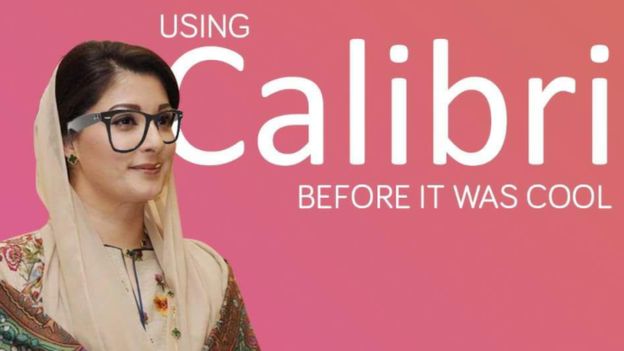
In the world of politics, where power struggles and controversies often dominate headlines, it’s not often that a font takes center stage. Yet, in a surprising turn of events, Microsoft’s Calibri font became a key player in the downfall of Pakistan’s Prime Minister, Nawaz Sharif.
In July 2017, the Supreme Court of Pakistan disqualified Nawaz Sharif from office after an investigation sparked by the Panama Papers revelations. These documents detailed how Sharif’s family-owned offshore companies that held luxury properties in London. At the heart of the controversy was a declaration dated February 2006, which purportedly showed that Nawaz Sharif’s daughter, Maryam Sharif, was only a trustee of these offshore companies.
What made this declaration suspicious was not its content, but rather the font in which it was typed—Calibri. The Calibri font, designed by Lucas de Groot, replaced Times New Roman as Microsoft Word’s default typeface in 2007. However, Microsoft’s own website notes that a beta version of Calibri (version 1.0) was available for download as early as 2005. This nuance would become crucial in the investigation.
The use of Calibri raised eyebrows because the font was not commercially available until 2007, a year after the date on the document. This discrepancy suggested that the document may have been forged or tampered with, as it would have been highly unusual for a 2006 document to be typed in a font not widely available until 2007.
Microsoft’s ClearType system, which enhances text readability on LCD monitors, was another factor in Calibri’s significance. This technology was introduced to improve the visual quality of on-screen fonts, making Calibri a practical choice for Microsoft Office applications such as Word, Excel, Outlook, and PowerPoint.
The unfolding scandal became emblematic of the complexities and unexpected turns that can define political crises. While the core issues revolved around alleged financial misconduct and accountability, the scrutiny over a font choice underscored the meticulous nature of modern forensic investigations. In an era where digital footprints and technological artefacts can make or break legal cases, the Calibri controversy served as a stark reminder of how even seemingly trivial details can have far-reaching consequences.
For Nawaz Sharif, the Calibri font became synonymous with his political downfall, illustrating the interconnectedness of technology, governance, and accountability in the 21st century. As the dust settled, the Calibri saga left a lasting legacy, not just in Pakistan’s political history, but also as a cautionary tale in the annals of global political scandals.
In conclusion, while fonts are often overlooked in everyday use, the Calibri font managed to carve out a unique place in the realm of international politics—an unexpected testament to the power of design and technology in shaping our world.

Thanks for sharing the knowledge…
LikeLiked by 1 person
What a Fontastic observation!!
LikeLiked by 1 person
I never knew about this aspect of the Panama leak scandal in Pakistan
LikeLiked by 1 person
It’s seemingly a weird case… as if it’s out of some fiction. But it’s a fact! 🙂
LikeLiked by 1 person
True. It looks unbelievable. Sometimes it happens like this… exceptions….
LikeLiked by 1 person
Yes, costly exceptions!
LikeLike
interesting! 🙂
LikeLiked by 1 person
Interesting!
LikeLiked by 1 person
Hahahaha..sometimes a change in font is just enough.
LikeLiked by 1 person
Yes, and then they didn’t think that the font would become their grave one day. 🙂
LikeLiked by 1 person