
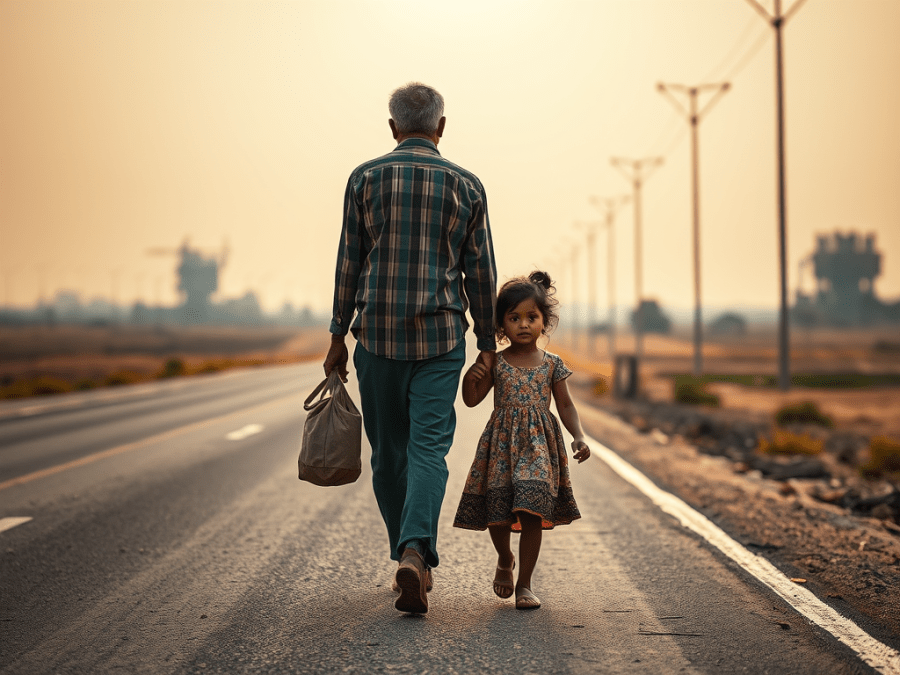
The spring of 2020 will remain etched in our collective memory—not just as the time the world paused, but as the moment a nation’s invisible workforce finally came into focus. When the COVID-19 pandemic struck, it didn’t just infect lungs; it exposed a deeper malaise—one rooted in inequity, oversight, and systemic neglect. Amid the eerie stillness of India’s lockdown, a human tide began to move.
This was the reverse migration—millions of daily wage earners, pushed to the margins of city life, now forced to abandon those very cities they had helped build brick by brick. With factories shut, markets closed, and public transport suspended, the only option left was to walk.
And so they did.
The Road That Led Nowhere
In Delhi, Mumbai, Ahmedabad, and countless other urban sprawls, the hum of machinery ceased. But what replaced it was even more unsettling—the rhythmic shuffle of tired feet, the clink of steel containers tied to bundles, and the silent resolve of those determined to get home.
There’s one image that still refuses to fade—of a father walking with his daughter, a sack slung across his shoulder and hope heavy in his eyes. She was no older than seven, her small hands clutching the edge of his shirt. Days later, she collapsed from exhaustion and died before they could reach home.
Her story was not an isolated tragedy; it was a mirror held up to a nation.
The Great Exodus
With no trains, no buses, and no jobs, thousands set out on foot, covering unimaginable distances. Some hitched rides on vegetable trucks; others pedaled rickety cycles with children balanced on the handlebars. From Delhi to Azamgarh, Mumbai to Malda, Surat to Samastipur—the exodus stretched across the map like a scar.
It wasn’t just a physical journey—it was a painful return to roots many had left behind not for dreams, but for survival.
India sees about 140 million seasonal migrants every year—people who move from rural belts to urban centers in search of livelihood. They become the hands that mix cement for luxury apartments, stitch garments in sweatshops, load goods in warehouses, cook in roadside dhabas, and clean homes that aren’t theirs. Yet, in policy documents and popular discourse, they remain invisible.
These workers, mostly from marginalized communities, are often poorly educated, with no formal training or social security. They enter into exploitative, informal arrangements, and their mobility—once a sign of economic dynamism—becomes their curse in times of crisis.
The Cost of Neglect
As the lockdown dragged on, the implications became clearer. The cities that had taken them for granted suddenly felt hollow. Construction projects stalled. Supply chains sputtered. The wheels of urban life—so dependent on cheap, invisible labour—ground to a halt.
Meanwhile, rural India braced for a reverse shock. Many returning migrants brought with them not just COVID fears, but economic uncertainties. Village economies, already stretched thin by years of drought, flood, and shrinking agricultural yields, were now tasked with absorbing this sudden influx.
The behavioural shift in these workers—who may now think twice before leaving again—could alter the socio-economic fabric of the country for years to come.
A Time to Rethink
In response, the government launched the Atma-Nirbhar Bharat package—₹20 lakh crore aimed at fostering self-reliance. While the initiative promotes local manufacturing, agricultural resilience, and infrastructure creation, it must also prioritize the dignity and welfare of the migrant worker.
There’s an urgent need for systemic reform. We need universal social security systems that follow the worker, not the job. Rural employment schemes must be strengthened. Skill development should become a national mission. And labour codes must offer not just protection but dignity.
In the short term, state and central governments must ensure seamless coordination for transportation, food supply, and temporary shelter. NGOs and civil society groups have already stepped up—organizing langars, setting up community kitchens, and distributing essentials. But this shouldn’t be a one-off humanitarian response—it should be the beginning of a national reckoning.
Beyond Charity, Towards Justice
The stories of India’s migrant workers are not just tales of hardship—they’re stories of resilience. Of mothers carrying children across state lines, of teenagers cycling hundreds of kilometers to bring their fathers home, of communities who fed strangers without asking for names or castes.
As we build the future, we must remember this past. Let us not return to “normal” if normal means invisibilizing the very people who hold up our economy. The girl who died walking beside her father deserves more than a moment of silence. She deserves a country that sees, values, and protects its workers—every single one of them.
Because a society that fails its most vulnerable is a society in need of healing.

The plight of these poor people is very pathetic. I wish that they and their problems were adequately factored in government programmes. I wish the new special economic package also takes them into consideration. They have been left out by every government since independence.
LikeLiked by 3 people
You’re right, Nilanjana. I also hope that the new package is all-inclusive, otherwise it cannot be the Atma-Nirbhar Bharat.
LikeLike
Well said Indro, but it is time for controlling population explosion as well. No amount of economic welfare can work if the population keep increasing exponentially every single day.
I may sound brutal, apathetic but there’s strong need for forced family planning. 🙏
LikeLiked by 3 people
Yes, I agree with you 100 percent. Huge population is a problem and there is a need to put a check otherwise the demography which is being touted as dividend will become the sinkhole of economy.
UN report finds that population growth rate slowed considerably in the 2010-2019 period but the situation in UP, MP and Bihar still cause for concern. India’s population grew at an average annual rate of 1.2 percent between 2010 and 2019 to 1.36 billion, more than double the annual growth rate of China and the US, according to a report by the United Nations Population Fund. According to the report, India’s population have grown at 0.4 percentage points lower in the 2010-2019 period as compared to the decade between 2001 and 2011. There are some states, which are doing excellent in this regard. Maharashtra, West Bengal, Kerala, Tamil Nadu, Telangana, Karnataka and Andhra Pradesh are among the states where the fertility rate has fallen well below the ideal fertility rate. There’s a hope and with more spread of basic education and women’s increased role in the society, things will be better in future.
LikeLiked by 1 person
Population growth is indirectly proportional to the level of education.
LikeLiked by 1 person
And with increased role of women in society.
LikeLike
Our weakness in sound planning and communication gaps is glaring. State Centre relationships at times make it more difficult. We never want to rise above politics.
LikeLiked by 3 people
Yes, you’re right. It’s a pity that we can’t rise above petty politics even during a crisis and poor “invisible” migrant labours are suffering every time as if they belong to nowhere – not in their home state nor in their work state.
LikeLike
Poor people tends to suffer the most when it comes to collateral damage. This was the case even during the 2016 De-monetization. In spite of the plans and schemes, it never percolates to everyone. Well, the country is complex so it is bound to happen.
LikeLiked by 3 people
I agree with you. But we shouldn’t take the complexity as an excuse every time. At least, during crisis we should be able to rise above the differences and include everyone in our effort to get over the crisis.
LikeLike
I agree.
LikeLiked by 1 person
Truly a mishap has fell upon us.
LikeLiked by 3 people
We shall overcome one day, son!
LikeLiked by 1 person
But the issue of migrant workers was same before also. It’s just that we did not have enough free time to address it nor did media find it interesting ever to place it as a national issue. And I truly believe that this will remain more or less simillar even after the resolution of the Covid crisis.
LikeLiked by 2 people
They are generally excluded from the electoral system, due to their mobility. In democracy, political parties only see their votes. Therefore, they are historically being neglected. It’s really unfortunate.
LikeLiked by 1 person
We have to support our own brands and products as to bring back our economy on the track.
LikeLiked by 1 person
Definitely, national brands and industries need to be supported to revive the national economy and also the national industries and brands should own the responsibility of producing/supplying products and services without compromising on quality. The responsibilities lie on both sides: national producers and national consumers.
LikeLiked by 1 person
Beautiful post. Hope this changes the mindsets of people and motivates them to help the poor who are in need. I wrote something similar. If you are interested, please check it out. https://natesh557112956.wordpress.com/2020/06/06/a-glass-of-water-for-you-is-a-diamond-for-them/
LikeLiked by 1 person
Thanks, Natesh. You have a wonderful blog, subscribing it.
LikeLike
Thank you 😁
LikeLiked by 1 person