

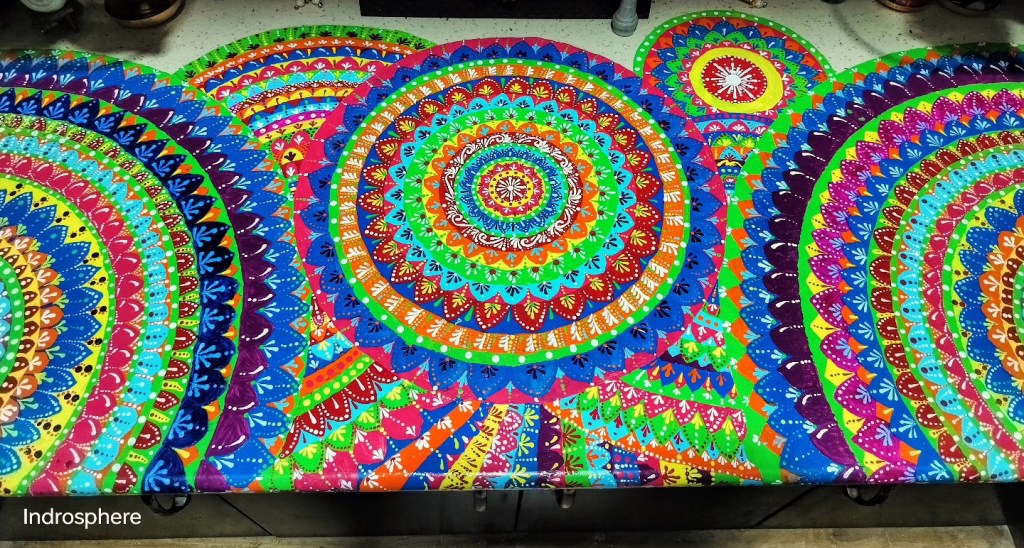
Have you ever found yourself lost in the mesmerising swirl of a mandala? Those intricate, symmetrical patterns, pulsing with vibrant colours, seem to beckon you into a world where time slows, and the soul finds a quiet rhythm. Each circle, each carefully crafted detail, feels like a whisper from the universe, inviting you to pause, reflect, and connect. For me, this fascination with mandalas deepened through the breathtaking creations of my daughter-in-law, Tania, whose passion for this ancient art form shines through her Instagram, Mandala_Art_Tania. Her work isn’t just art—it’s a window into her inner world, a vibrant tapestry weaving together spirituality, balance, and boundless creativity. Inspired by her, I invite you to join me on a journey through the history, cultural significance, and transformative power of mandalas, a sacred art form that has captivated hearts for centuries.
The Sacred Circle: Origins & Meaning
The word “mandala” derives from the ancient Sanskrit term for “circle,” a shape that has long symbolised unity, wholeness, and the infinite cycle of life. In spiritual traditions across the globe—Hinduism, Buddhism, Jainism, and even beyond—mandalas serve as sacred maps, guiding practitioners through the layers of existence toward enlightenment or divine connection. They are more than mere designs; they are cosmic diagrams, representing everything from deities and paradises to the very structure of the universe itself.
At their core, mandalas are tools for meditation and introspection. Their concentric patterns draw the eye inward, from the outer edges of the material world to the sacred centre, where the self meets the divine. In Tibetan Buddhism, monks create intricate sand mandalas, labouring for days or even weeks, only to sweep them away upon completion—a poignant reminder of life’s impermanence. In Hinduism, mandalas often take the form of yantras, geometric diagrams used in rituals to invoke deities or align the practitioner with cosmic truths. Across cultures, the act of creating or contemplating a mandala is a meditative practice, a way to still the mind and attune to the present moment.
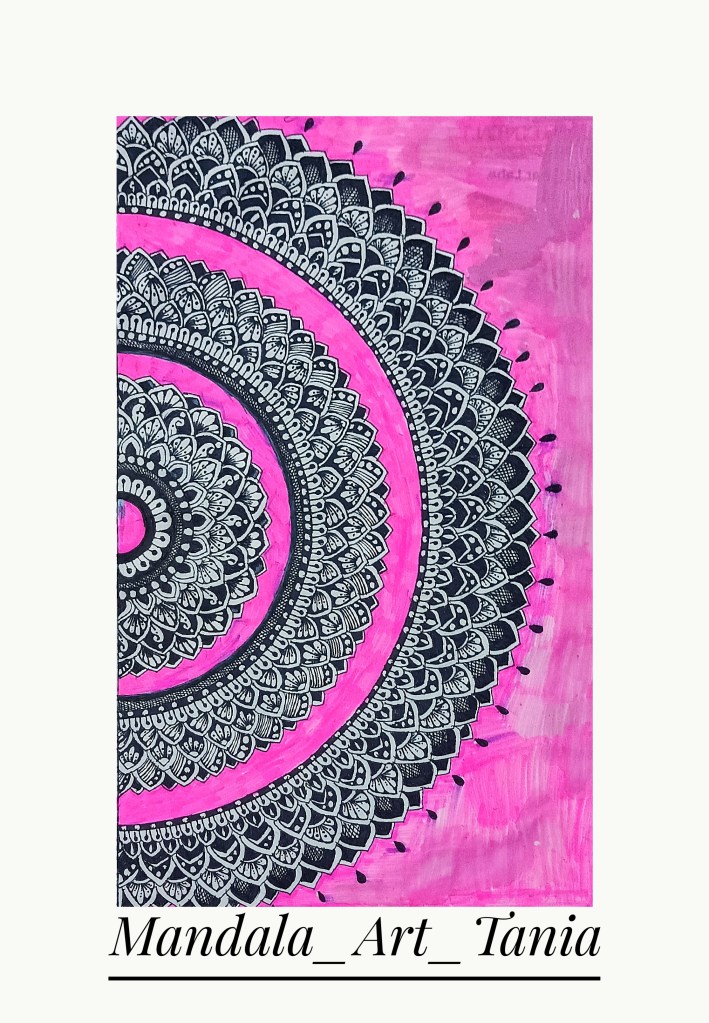
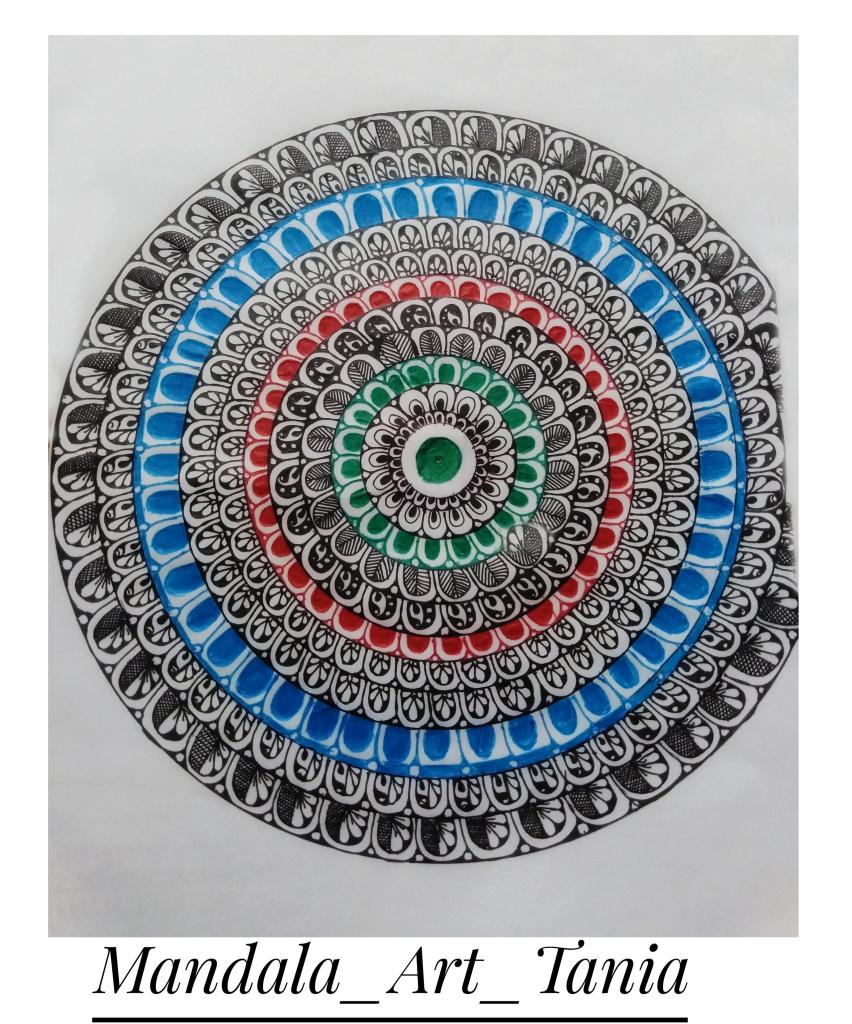
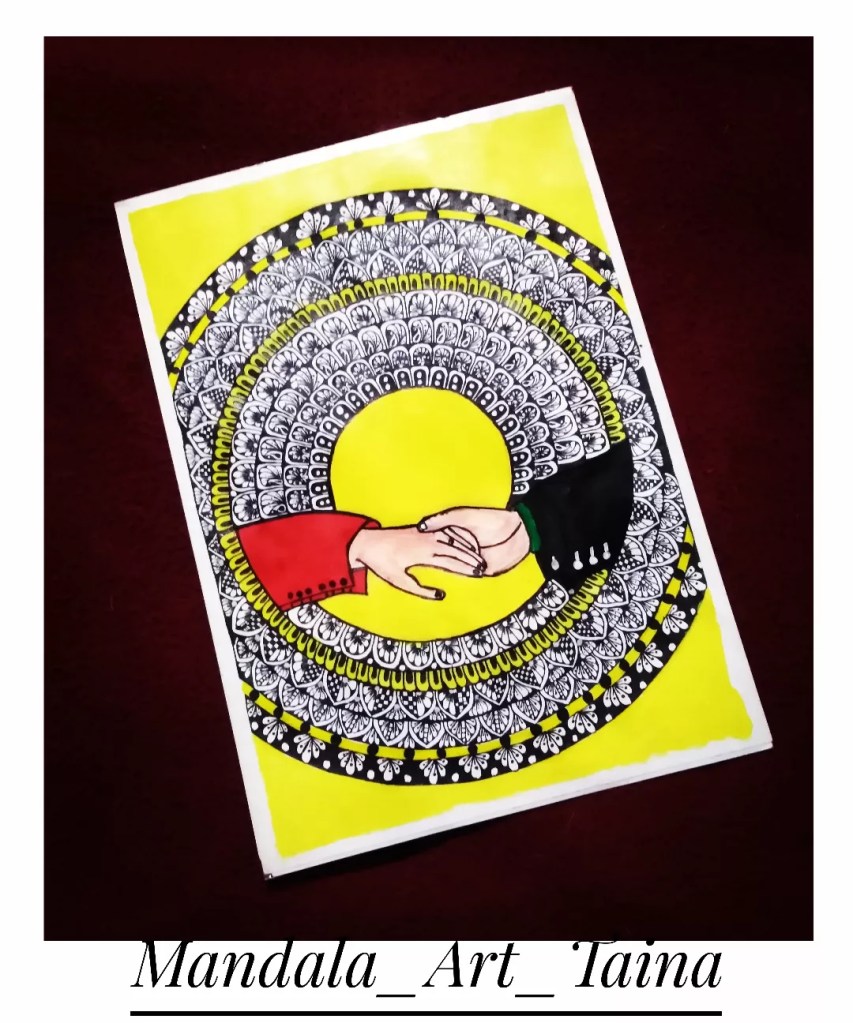
Tania’s mandalas, with their vivid colours and intricate symmetry, embody this meditative spirit. Each stroke of her pen seems to channel a deeper truth, inviting viewers to pause and reflect. Her work reminds me that mandalas are not just art—they are bridges to the soul, connecting the artist and the observer to something vast and eternal.
A Tapestry of History: Mandalas Through the Ages
The story of mandalas begins in ancient India, where their roots stretch back to the earliest spiritual traditions. The term “mandala” first appears in the Rigveda, a sacred Hindu text from around 1500–1200 BCE, where it refers to the circular arrangement of verses or the symbolic organisation of sacred spaces. In Vedic rituals, mandalas were often drawn or constructed to represent the cosmos, with deities invoked at their centre. The Natyashastra, an ancient treatise on performing arts, describes mandalas used in temple dances, where intricate floral patterns were created with coloured powders to honour the divine.
By the 1st century BCE, mandalas had become central to Buddhist art and practice. As Buddhism spread along the Silk Road, mandalas travelled with it, evolving in form and meaning. In Tibet, they became elaborate sand creations, each grain meticulously placed to form intricate cosmic diagrams. In Japan, Shingon and Tendai Buddhist sects adopted mandalas as visual representations of the Buddha’s teachings, with the Womb Realm and Diamond Realm mandalas serving as profound meditative tools. These sacred designs also found their way into Jainism, where they adorned temples and manuscripts, and even into early Christian art, where circular motifs like rose windows echoed mandala-like symmetry.
Beyond Asia, mandalas appeared in diverse forms. In Islamic art, intricate geometric patterns in mosques and manuscripts reflected the same principles of balance and unity. Native American traditions, such as the Navajo sand paintings used in healing ceremonies, share striking similarities with mandalic structures, emphasising harmony with nature and the cosmos. Even the ancient Indus Valley Civilisation (circa 2600–1900 BCE) left behind symmetrical designs that resemble modern rangoli, the colourful floor art still created during Indian festivals like Diwali.
This global presence underscores the mandala’s universal appeal. Across time and cultures, humans have turned to the circle to express their connection to the divine, the cosmos, and each other. Whether etched in stone, painted with sand, or drawn with modern tools, mandalas remain timeless symbols of unity and transcendence.
Mandalas & Yantras: Sacred Cousins
While mandalas and yantras are often intertwined, they carry distinct roles in spiritual practice. Yantras, primarily associated with Hinduism, are geometric diagrams designed to focus the mind during meditation or worship. Often simpler in colour—favouring stark contrasts like black, red, or gold—yantras feature a central point (bindu) representing the divine, surrounded by triangles, squares, and circles that symbolise the unfolding of cosmic energy. Each yantra is associated with a specific deity, such as the Sri Yantra, which invokes the goddess Lakshmi for prosperity and spiritual awakening.
Mandalas, by contrast, tend to be more elaborate and colourful, often depicting entire cosmologies or spiritual realms. While yantras guide the practitioner inward toward a singular divine focus, mandalas invite exploration of the broader universe, encompassing both the external and internal worlds. Yet both share a common purpose: to align the individual with the divine through geometry, symmetry, and intention.
Tania’s work often blends these traditions, incorporating the precision of yantras with the vibrant, flowing patterns of mandalas. Her designs feel both structured and free, a balance of discipline and creativity that mirrors the spiritual duality of these sacred forms.

Exploring the Many Faces of Mandalas
Mandalas come in many forms, each with its own aesthetic and symbolic significance. Here are some of the most popular types:
- Sand Mandalas: These intricate, multi-coloured designs are created by Tibetan Buddhist monks and Hindu Tantric priests using coloured sand. Once the mandala is complete, it is ritually destroyed to symbolise the impermanence of life, a powerful reminder of the transient nature of all things.
- Yantras: These square-shaped mandalas with a central deity are used in Hinduism to invoke gods and unlock cosmic truths, guiding practitioners to a deeper understanding of the universe and their place within it.
- Floral Mandalas: Featuring flowers or petals, these mandalas are deeply connected to nature, beauty, and the harmonious cycles of life. They are often seen as symbols of growth and transformation.
- Geometric Mandalas: Composed of precise geometric shapes and symmetrical patterns, these mandalas emphasise balance, order, and harmony. They are often associated with mathematics and logic, showing how beauty can arise from structured organisation.
- Abstract Mandalas: These mandalas are created intuitively, without a rigid structure or specific rules. They often express personal feelings, emotions, and experiences, offering an organic path to self-exploration and creative expression.
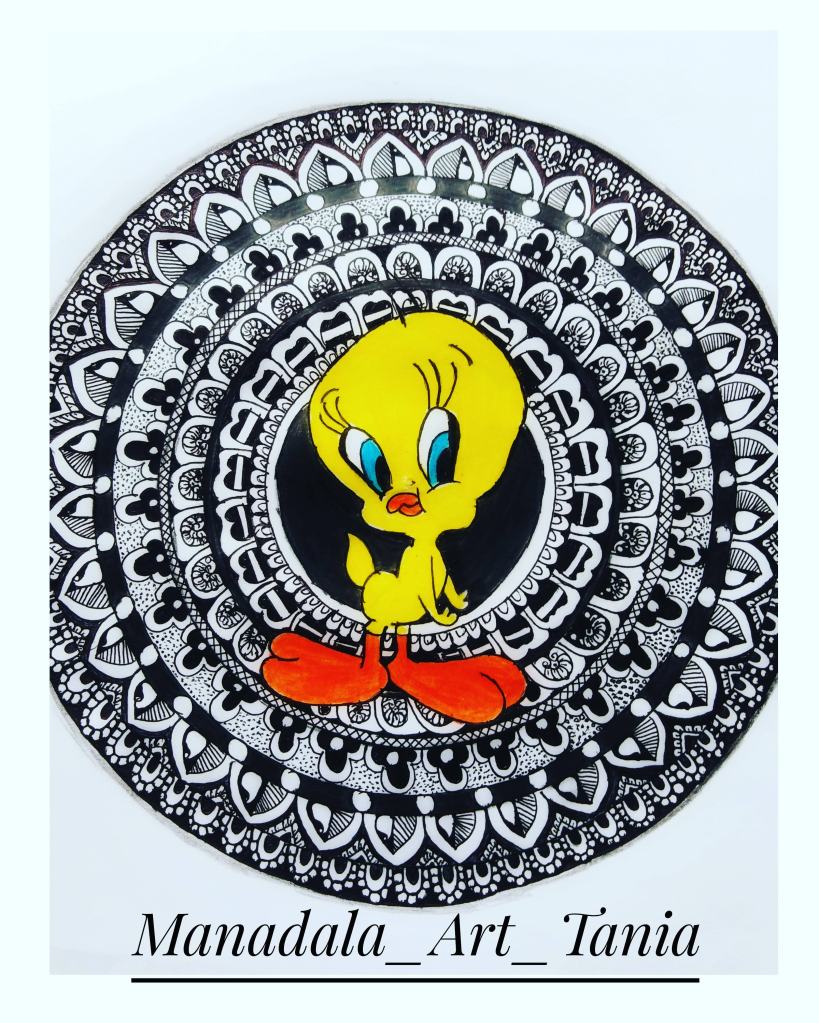

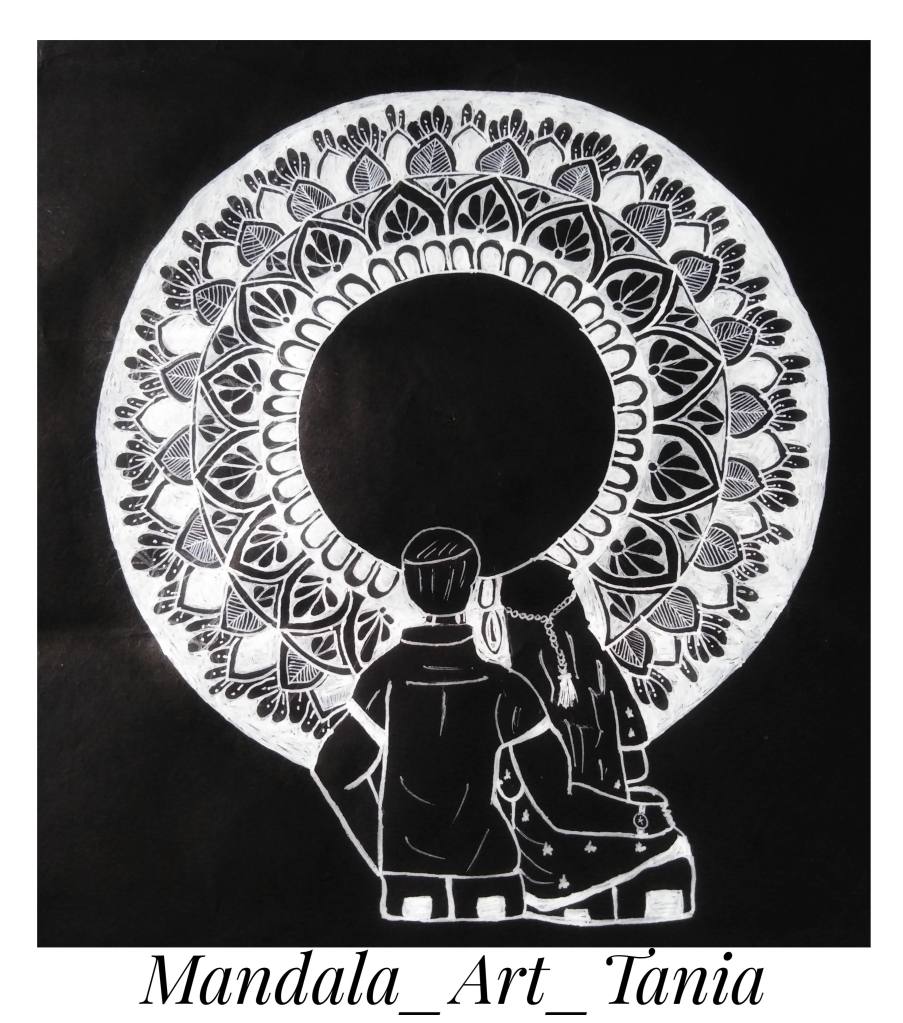
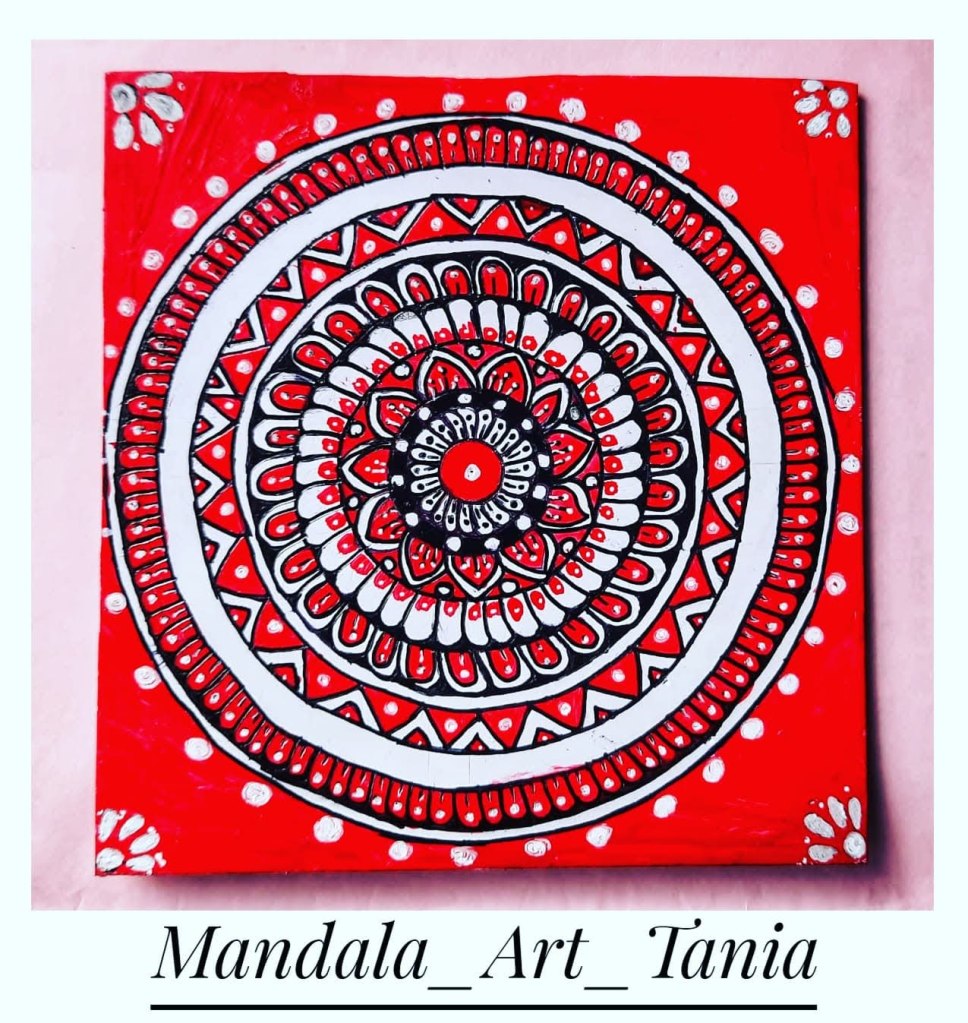
Each type of mandala offers a different path to connection, whether through ritual, nature, logic, or personal expression. Their diversity is a testament to their enduring power to resonate across cultures and contexts.
The Healing Power of Mandalas
Beyond their spiritual and aesthetic roles, mandalas hold profound therapeutic value. The act of creating a mandala is inherently meditative, requiring focus, patience, and presence. As the artist draws or colours, their mind quiets, entering a state of flow that can reduce stress and promote emotional healing. Psychiatrist Carl Jung, who studied mandalas extensively, saw them as representations of the self, using them in therapy to help patients explore their subconscious and find balance.
For viewers, mandalas can evoke a similar sense of calm and introspection. Their symmetry and rhythm create a visual harmony that soothes the mind, while their layered designs invite contemplation of deeper truths. Tania’s mandalas, with their vibrant hues and intricate details, have this effect on me. Each piece feels like a story, a moment of her soul captured on paper, inviting me to reflect on my own journey.
A Personal Reflection: Tania’s Art & Beyond
Tania’s mandalas have opened my eyes to the profound beauty of this art form. Her Instagram, Mandala_Art_Tania, is a gallery of creations that pulse with life, each one a testament to her skill and spiritual depth. Her work reminds me that mandalas are not just historical artefacts or religious tools—they are living expressions of the human spirit, capable of bridging cultures, eras, and individual hearts.
As I’ve explored the world of mandalas, I’ve come to see them as more than art. They are invitations to pause, to breathe, to connect with something greater. Whether you’re drawn to their historical richness, their spiritual significance, or their therapeutic power, mandalas offer a path to discovery.
I invite you to step into this world—perhaps by exploring the creations of artists like Tania and ordering her custom Mandalas via DM on her Instagram account. You may discover, as I have, that the simple act of following a circle can guide you to unexpected places, where beauty, meaning, and serenity come together in a timeless dance.

Wow really detailed. I guess the discussion we had last night about the mandalas and its origin did leave quite an impact. Even the circular constructions like the Gumbaz we see can also be considered Mandala
LikeLiked by 1 person
Yes, sure. The circular pattern of Arabic Mandala is a ritual symbol in Indian culture which represents universe. It also has a meaning of unity and harmony. The mandala art in Islam is a combination of geometric arrangements and cultural motifs.
LikeLiked by 1 person
Wow, very lovely drawing by your daughter-in-law, Indrajit. She’s an excellent artist. God bless her.
LikeLiked by 1 person
Thanks, Nilanjana.
LikeLike
Nice and informative post. Wow, Tania is a wonderful artist. God bless.
LikeLiked by 1 person
Thanks, Sanchita.
LikeLike
Wonderful and detailed explanation. Thanks for bringing out the connection with Alpana. Have some exposure to Mandala thanks to my wife who uses crochet for mandala creations. Have also seen references to sand mandalas in some movies/serials, but more as a humorous set-off.
LikeLiked by 1 person
Thanks, sir.
LikeLike
Lovely article. Got to know another facet of Tania. She is a trained artist. The design is now used almost everywhere, including traditional dresses like kurtas. Looking at this form of colourful art really gives feelings of relaxation.
LikeLiked by 1 person
Yes, you’re right. She’s good in Mandala art.
LikeLike
These look stunning! Recently I’ve developed an interest in Mandala art. 🙂
LikeLiked by 1 person
That’s interesting. Keep drawing Mandala.
LikeLike
Thank you! Actually i havent drawn it, just looked at it, but its a good idea to try drawing Mandala i guess 🙂
LikeLiked by 1 person
Yes, very much. All the best.
LikeLike
The word mandala was brought to my notice through the Zouk bag that I just bought which had this exotic design on it. Intrigued by the art work, I searched up on it to find more of this amazing art work and now I see the fabulous work of your daughter in law. The history behind this art is also enchanting and somehow I find a connect with the south as the word mandalam is a cycle of time, a circle or a territory that can be traced to Chola time period.
A wonderful post that is a marvel of our rich traditions.
LikeLiked by 1 person
Thanks for your like and more information.
LikeLike
Pingback: Stagum’s Multi-Layer Wall Art: A Sustainable Approach to Modern Decor - STAGUM