
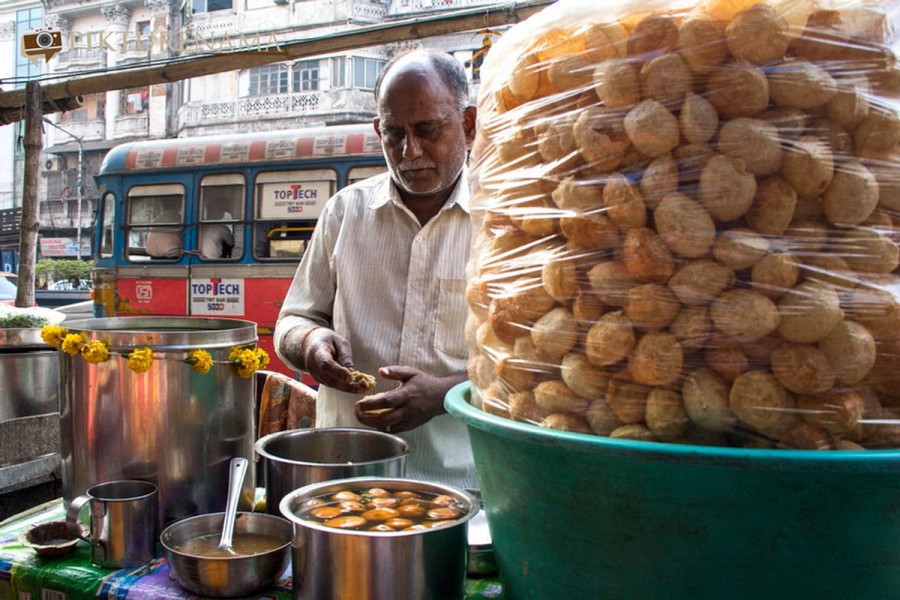
Earlier this month, as dawn broke over Ranchi and I settled into my daily ritual of sipping tea and scrolling through my morning news feed, a splash of colour on my screen made me pause. There, nestled between headlines of politics and weather forecasts, was a Google Doodle unlike the usual ones that honour scientists or commemorate anniversaries. This one was different. This one made my heart do a little happy dance—it was a celebration of Pani Puri.
Yes, you read that right. Google had turned its global spotlight on our humble, glorious, and utterly addictive pani puri. I couldn’t help but smile. For a moment, the vast chasm between the digital colossus and the bustling street corners of India felt joyously bridged. This was no mere snack being celebrated—it was an emotion, a memory, a shared cultural heartbeat.
And for me, as for millions of others across this subcontinent, pani puri is so much more than the sum of its parts. It is childhood revisited. It is friendships rekindled. It is that burst of tangy chaos in the mouth that no Michelin-starred amuse-bouche can rival. And in seeing it honoured in such a global, artistic way, something within me—nostalgic and hungry—stirred.

The doodle marked July 12th, the anniversary of a feat both delicious and delightful: Indori Zayka, a street food outlet in Indore, Madhya Pradesh, set a world record in 2015 for offering the most variety of pani puri flavours. Just imagine—an entire menu dedicated to reinventing the tiny, hollow sphere that has ruled our roadside cravings for generations. A menu that whispered possibilities, innovation, and above all, love.
Here in Ranchi, where the air carries hints of mustard oil and the honk of impatient scooters, we call it phuchka. A name that, to my Bengali ears, carries a music of its own—the little “phuch” sound as the crisp puri cracks under pressure, releasing a flood of spicy pani that floods your senses. In Delhi, I first encountered it as golgappa, its name as rounded as the puri itself. Travel south or west, and the names morph—but the magic remains unchanged.

A tiny puri, puffed up to golden perfection, becomes a canvas for so much: mashed potatoes, chickpeas, onions, spices, tangy tamarind water, and that glorious green elixir—mint and coriander pani. Each bite is a gamble, a burst of spice, sourness, and crunch that commands silence as it floods your mouth and soul in one swift motion.
As a child, an outing wasn’t complete without that final stop at the phuchkawala. I still remember the metallic clink of his spatula tapping against puris, the earthy aroma of cumin-infused water, and the gentle jostling of patrons gathered around his modest cart. We’d stretch out our hands eagerly, like pilgrims at a shrine, awaiting our turn at redemption.

My wife, Jagrata and I used to compete—how many could we eat in one go? We’d laugh through streaming eyes as the chilli hit home, cheeks flushed, noses sniffing, but refusing to stop. It wasn’t gluttony; it was ritual. Joy. Belonging.
And oh, the stories wrapped around pani puri! The doodle article spoke of its possible origins—some say from the ancient kingdom of Magadha, where it was once known as phulki. Others swear by the Mahabharata tale, where Draupadi, challenged to make a meal from leftovers, conjured up the first pani puri, earning Kunti’s eternal blessing. Whether folklore or fact, these tales add layers of magic to an already mystical snack.
Of course, every region has its own twist. In Bengal, Bihar, and Jharkhand, phuchka stands tall with its earthy, whole wheat puris—slightly denser, more robust, perfectly suited to the fiery tang of the spiced tamarind water that defines our local palate. The filling, too, often includes boiled black gram or mashed potatoes seasoned with roasted spices, and that tiny drizzle of mustard oil that packs a punch.
And then there’s the pani—the soul of the show. That green, fragrant potion is made from mint, coriander, roasted cumin, black salt, green chillies, and lemon. Served ice-cold, it slaps you awake, reminding you that life is too short for blandness.
Modern times have seen some wild reinventions. I’ve read of fusion pani puris with tequila or vodka in plush urban bars. Interesting, though the purist in me baulks a little. Suvajit, my cousin from Barrackpore, once served me ice cream phuchkas—crunchy shells cradling scoops of kulfi and rabri. I admit, it was sinful, and surprisingly divine.
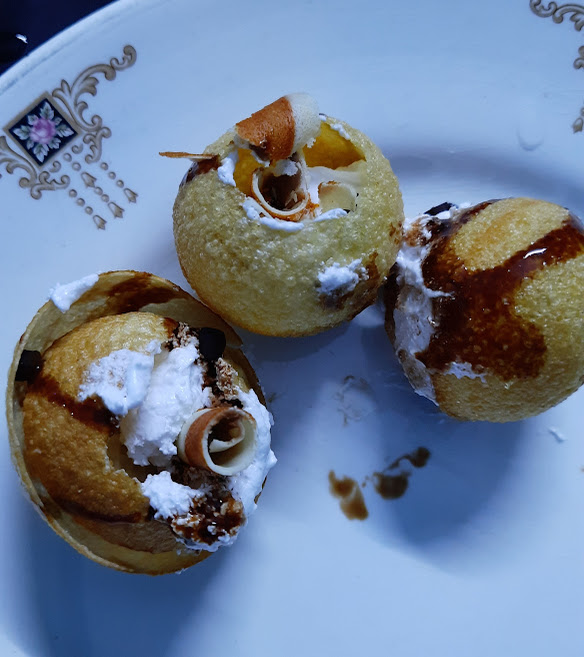
But innovation aside, there’s something beautifully democratic about pani puri. It doesn’t care who you are—student, corporate executive, artist, or retired banker. When you stand by that cart, balancing a plate in one hand and a puri in another, all are equal. All are seekers of that same zingy ecstasy.

And believe it or not, it’s not just empty indulgence. That filling? Rich in fibre and protein. That pani? Loaded with minerals and digestive spices. No, I wouldn’t recommend skipping your greens for a plate of pani puri—but compared to processed chips or sugar-laden snacks, our beloved phuchka holds its own.
What moved me the most that morning wasn’t just Google’s doodle. It was what it symbolised—a recognition of something intensely local, fiercely loved, and rooted in memory. In an increasingly homogenised world, it felt like a gentle celebration of our diversity, our shared rituals, and our timeless love for simple pleasures.
Pani puri isn’t just food. It’s a language. A bridge between generations, a reason for reunions, a taste that transports. It’s the lingering flavour of street corners, college canteens, narrow alleys, and long summer evenings. It’s an emotion.
So here’s to that tiny puri, filled with dreams and drizzled with spice. To the vendors who remember your preferred spice level. To the childhood spent wiping pani off chins and begging for ek aur. To the memories that flood in with every bite.
Thank you, Google, for reminding me that joy still comes in small, round packages—one phuchka at a time.

Wonderful.
LikeLiked by 1 person
Thanks, Laltu.
LikeLike
One of favourite snacks of all time. Yummy.
LikeLiked by 1 person
👍👍
LikeLike
I like the origin stories. Next time I eat golgappa, I will be more respectful. It has a history of over 2000 years and linked to Mahabharata!
LikeLiked by 1 person
Hahaha 😂. Thanks, Nilanjana
LikeLike
Interesting history of phuchka. Thanks for sharing.
LikeLiked by 1 person
Thanks, Sanchita.
LikeLike
thanks for writing this . interesting story
LikeLiked by 1 person
Thanks for your reading.
LikeLiked by 1 person
lets connect , nice to meet ya🤝🏻🙌🏻
LikeLiked by 1 person
Another informative post,
A few days ago, I wrote a post on Sattu, I did not know that the history of Golgappa is also related to Magadha.
At some places in Purvanchal, Uttar Pradesh, Pani Puri is also known as Phulki.
LikeLiked by 1 person
Yes, Pani Puri is an amazing item where a small vendor serves multiple customized pani puris made to the taste of each of his clients. That’s awesome!
LikeLike
Absolutely loved how you captured the essence of pani puri – a true burst of flavor and nostalgia in every bite! Thanks for sharing such a mouthwatering piece.
LikeLike
Thank you!
LikeLike
Pingback: Draupadi and Pani Puri – Manish Mohandas