
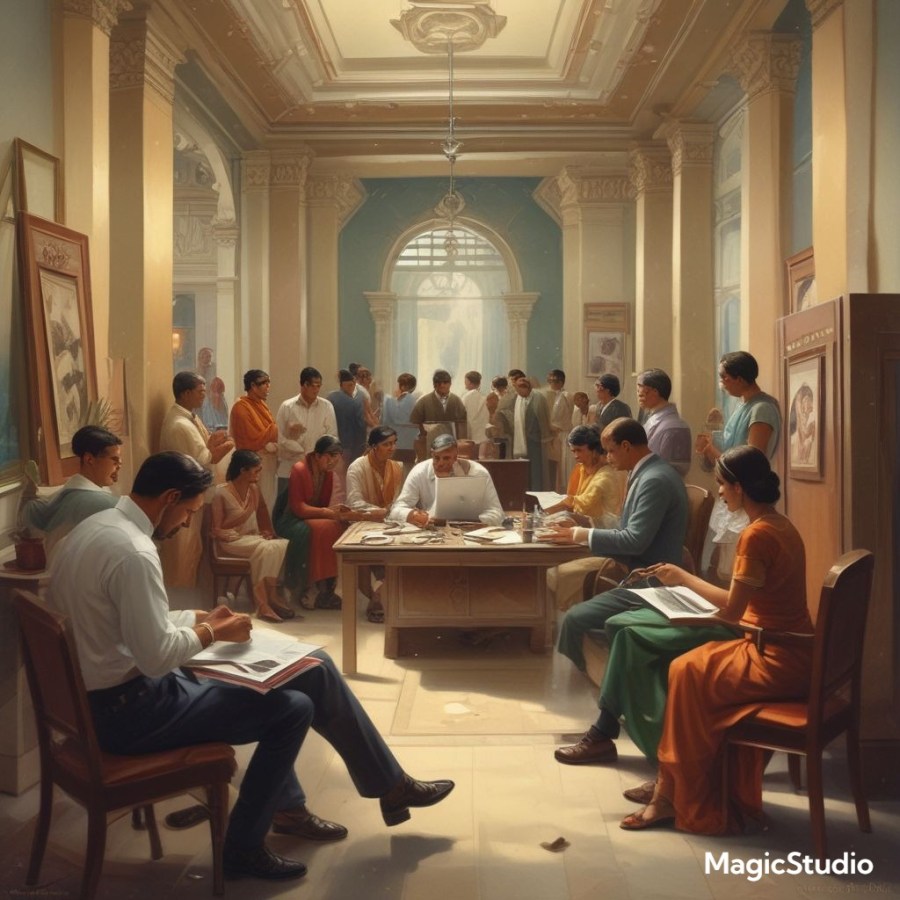
As we move towards an increasingly digital world, it’s easy to forget the days of manual banking. But for those who remember, the annual year-end closing events in banks were a memorable event. Back in the day, banks relied heavily on manual processes to keep track of their finances.
In the centre of a vibrant urban area in Uttar Pradesh, India, there existed a venerable government-owned bank edifice that had dutifully catered to the local populace for many generations. This bank represented dependability and confidence, and as I began my tenure as a recently assigned Management Trainee (Probationary Officer) at a branch of a government-owned bank, the sensation was profoundly awe-inspiring. It was during the mid-1980s, a time when all operations were executed through manual procedures. Sizeable fund transfers relied on encrypted telegrams or telex communication. Despite the labour-intensive nature of these tasks, I find myself reminiscing fondly about those bygone days.
As the calendar approached its final days, the bank’s staff began preparing for the grand year-end closing. In those days, the annual year-end book closure was done on the 1st of January, as on the 31st of December. It was a tradition that spanned decades and brought the entire staff together for a few days of dedicated work and celebration.
The year-end closing was a time for bank employees to come together and work tirelessly to close out the year’s financial records. It was a time for camaraderie, hard work, and celebration. It was like a festival. The festival typically lasted for several days and involved long hours of work. Employees would come in early and stay late, working together to ensure that everything was accounted for. There were often snacks and refreshments provided to keep everyone going, and the atmosphere was one of excitement and anticipation.
The process started weeks in advance. The bank’s manager used to carefully review the financial records and get ambitious targets for the year-end from the Regional and Zonal offices. Each department had its own set of goals, from increasing deposits, business figures, and profits, to managing loans and recoveries.
The bank’s clerks and accountants were tasked with the meticulous work of calculating interest, posting on ledgers, and teller cards, then balancing the ledgers and ensuring that every transaction was accurately recorded. Manual processes were prone to errors, and it wasn’t uncommon for mistakes to be made. But with teamwork and determination, these challenges were always overcome. The year-end closing was a time of precision and patience, where even the smallest error could have significant consequences.
This was a time-consuming and interesting exercise. In many branches, there were two main bank workmen unions. When the manager released an office order distributing the ledgers, there used to be a claim and counter-claim by both the union leaders that the manager was supporting one union by allotting lighter ledgers to them, etc. There used to be demands for more overtime payments, etc. The clerks used to delay the start of the work unless their demands were met. Slowly some compromise was made and the clerks also knew that they had to complete the job before the 31st December. Once the interests were posted, those were to be checked by the officer allotted for checking the ledgers and to ensure reconciliation and balancing of books.
Then slowly the work used to pick up and people used to sit late to finish the interest computation, posting, balancing of ledgers, and reconciliation with the teller cards. The atmosphere used to change to a festive season. People used to work, eat samosas, drink tea and do their work. Sometimes, there used to be a competition too.
Meanwhile, the branch’s Assistant Manager managed the influx of customers who wanted to complete their transactions before the year-end. People lined up, seeking to open new accounts, make deposits, or inquire about their savings. The atmosphere in the bank was electric, as customers mingled with staff, sharing their financial aspirations for the upcoming year.
On the final working day of the year, the bank resembled a beehive. The tellers worked tirelessly, accepting last-minute deposits and encashing cheques. The clerks diligently reconciled the accounts and made sure every paise was accounted for. The manager walked around the bank, overseeing the operations and offering words of encouragement to his dedicated team. He was also busy arranging last-moment business to meet the targets given to the branch by the Regional Office.
The closing day was formerly a private workday reserved for bank officials to finalize their bookkeeping. A “Bank Closed” sign was displayed on a notice board to prevent customers from entering the bank.
As the closing hour drew near, the staff felt a mixture of exhaustion and accomplishment. The year-end targets had been met, and the financial records were in perfect order. It was a moment of immense pride and relief, knowing that their hard work had paid off.
But the year-end activities didn’t end with the closing of the bank. The evening was reserved for a grand celebration. The bank’s employees, from the senior managers to the clerks and attendants, gathered in the bank’s ornate meeting room, which had been transformed into a banquet hall.
In the past, there was an elaborate celebration on that day. The branch manager would organize a lavish lunch for the staff, featuring a variety of both non-vegetarian and vegetarian dishes to cater to everyone’s preferences. Work would frequently extend into the late hours of the night. Some employees would only work if the manager provided whiskey during the evenings. During those times, there was a sense of camaraderie within the branch.
I was reminiscing about a specific occasion. The closing procedures were being carried out, out of sight, behind a swinging door. Closing the books was a time-consuming process, involving tasks such as finalizing the daybook, making entries in the general and subsidiary general ledgers, reconciling the trial balance, and then creating the balance sheet and profit and loss statement.
Mr. Gupta, the manager, was occupied with overseeing the smooth progress of the work and coordinating with the restaurant owner responsible for providing lunch to the staff. Since it was the closing day, and the targets had been met, the lunch had to be extravagant. The menu consisted of meat dishes for non-vegetarian employees and paneer dishes for the vegetarian ones.
Mr. Mishra, a seasoned expert with exceptional mathematical skills, was engrossed in his tasks, diligently working on his daybook, long books, and journals, as well as the general and subsidiary general ledgers to assemble the trial balance. Concurrently, Mr. Mahato began to hum a tune by Manna Dey while he was in the process of creating the annual closing reports, which needed to be produced in triplicate. Once a report was finished, additional team members were responsible for making copies of the reports.
Meanwhile, the telephone rang in the office of the Senior Manager, Mr. Saxena. He requested Mr. Bhatia, one of the assistant managers, to obtain the data from Mr. Mishra. Mr. Bhatia left the Senior Manager’s office and approached Mr. Mishra, saying, “Mishraji, please provide your figures; the request is coming from Takla.” “Takla” was the nickname of the Regional Manager, given his bald appearance.
In a playful manner, Mr. Mishra responded, “36-40-36.” This elicited laughter from everyone in the room. Mr. Mishra wasn’t the only one occupied; several individuals were involved in preparing the returns, and others were engaged in duplicating the forms. The loan returns were substantial in size and required a considerable amount of information to be entered for each loan.
Gradually, as the day transitioned into night, Mr. Mishra completed his trial balance. Following that, he would proceed to create the balance sheet and the profit and loss statement. He calculated the values for crucial parameters that must be conveyed swiftly to the Regional Office and Zonal Office. During those times, the quickest means of communication was Telegram. As Mr. Mishra finalized these important figures, Mr. Gupta began composing concise telegrams since they incurred charges based on word count. A messenger was promptly dispatched to the Post & Telegraph Office to transmit these telegrams. Simultaneously, Mr. Saxena conveyed the key figures to the Regional Manager via telephone.
At that point, the female staff had already departed for their residences. Some of the male employees remained to finalize the returns. Gradually, bottles of whiskey made an appearance, as several of the men were unwilling to work through the night without it. It created a unique atmosphere, blending elements of anticipation, weariness, a sense of urgency to complete the remaining tasks, and a celebration of reaching significant milestones.
As technology has advanced, the year-end closing event has become a thing of the past. Automated processes have made it much easier to keep track of finances, and the need for manual labour has decreased significantly. But for those who experienced it, the year-end closing event will always hold a special place in their hearts. It was a time when hard work and dedication were celebrated, and when the bonds between colleagues were strengthened.
The year-end activities in the traditional manual banking era served as a poignant reminder of the commitment and collaboration that had upheld the institution for many generations. It was a moment to reflect on past achievements and embrace the potential of the upcoming year. Although manual banking practices have made way for modernization, the essence of those year-end festivities endures in the recollections and sentiments of the bank’s staff from that bygone era, a testament to their steadfast dedication to their work and community.
Our expertise in manual operations has given us a substantial edge in the digital age by granting us a deeper comprehension of systems and procedures. The practical knowledge acquired from manual operations establishes a strong groundwork. This experience has granted us a deep understanding of the complexities of fundamental processes, allowing us to pinpoint areas for enhancement and efficiency. The problem-solving abilities refined in manual operations hold significant value, especially in swiftly resolving issues that arise unexpectedly in digital systems. The capability to troubleshoot and tackle challenges in real-time proves immensely advantageous in the digital realm, where unforeseen hurdles often surface.
I feel fortunate and privileged to have started my banking career during that time and to have been part of overseeing and guiding the shift to today’s digital banking era. We can utilize our abilities to connect traditional and digital methods, guaranteeing a seamless and effective transition.

Those were the days…
Even manually checking the ledgers in the morning every day was an established, time-honoured tradition.
LikeLiked by 1 person
Often, sir, we would perform morning checks the night before so that the day would begin with correct records. Thanks, sir.
LikeLiked by 1 person
You reminded me of the days when we used “acetate sheets” to make our presentation and graduated to colour slides before Microsoft PowerPoint made it’s appearance thus taking out the fun and camaraderie of team work during annual sales and marketing conferences.
It was because of those manual working that made us what we are…
LikeLiked by 1 person
Thanks, Aro. Yes, you are right. Our background in manual operations has bestowed upon us a significant advantage in the digital era, equipping us with an enhanced understanding of systems and processes. The hands-on experience gained from manual operations forms a robust foundation. It has provided us with profound insights into the intricacies of underlying processes, enabling the identification of areas for improvement and optimization. The problem-solving skills honed in manual operations are particularly valuable. The capacity to troubleshoot and address issues in real-time proves highly beneficial in the realm of digital systems, where unforeseen challenges frequently emerge.
LikeLike
Excellent. Vividly explained the process of closing work and how bankers enjoyed the closing work during manual days
LikeLiked by 1 person
Thanks, Gautam.
LikeLike
Well narrated. Gone are those days…
LikeLiked by 1 person
Thanks, Partha Da
LikeLike
Very nice and touching article
LikeLiked by 1 person
Thanks, Rana.
LikeLike
You awaken the old memory. Good article.
LikeLiked by 1 person
Thanks, Rajiv.
LikeLike
Awesome post! You reminded our career-beginning days.
LikeLiked by 1 person
Thanks, Grover Saheb.
LikeLike