
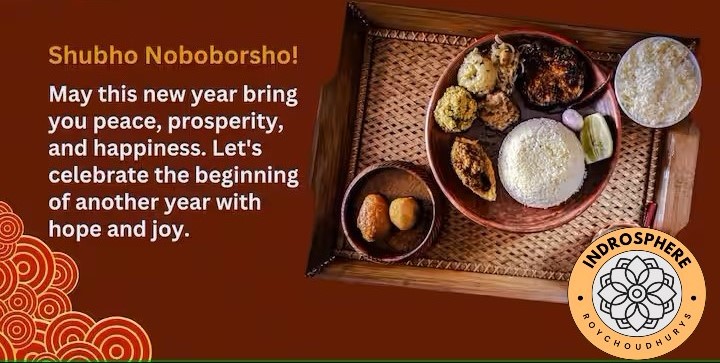
In the heart of Bengal, amidst the vibrant colours, melodious tunes, and the aroma of traditional delicacies, lies a celebration that epitomises the spirit of renewal and cultural richness. Shubho Noboborsho, the Bengali New Year, is not just a date on the calendar; it’s a testament to the resilience of a community, a celebration of heritage, and a time-honoured tradition that unites generations.
A Calendar Rooted in Legacy
Every year, on the 14th or 15th of April—depending on the Bengali calendar—Bengalis across the globe come together to welcome the New Year with open arms and hopeful hearts. The origins of this celebration trace back to the 16th century, during the reign of Mughal Emperor Akbar, who introduced the Bangabda calendar to streamline agricultural tax collection. What began as an administrative reform soon blossomed into a cultural cornerstone.
The Bangabda, a lunar-solar calendar system, is meticulously aligned with both the movements of the moon and the sun, reflecting the agricultural and spiritual rhythms of Bengal. Rooted in ancient Indian astronomical traditions, it is more than a tool for timekeeping—it is a vessel of cultural memory, guiding the cadence of festivals, rituals, and seasonal transitions that shape Bengali life.
Welcoming Boishakh: The Spirit of Noboborsho
The Bengali year begins with Boishakh, ushering in Poila Boishakh, the first day of the New Year. It is a time of vibrant renewal, when homes are scrubbed clean and adorned with Alpana—delicate patterns drawn with rice flour and water—and colourful rangolis that mirror the joy in every heart.
The scent of Rosogolla, Sandesh, and Mishti Doi wafts through kitchens as families prepare lavish feasts to welcome guests and loved ones. The day brims with cultural events, fairs, and processions, none more iconic than the Mongol Shobhajatra—a parade of good wishes that winds through towns and villages, showcasing masks, banners, and sculptures that speak to social issues, unity, and hope.
Music, Dance, and the Pulse of Tradition
Music and dance are the lifeblood of Shubho Noboborsho. The soulful strains of Baul songs echo through the air, accompanied by the rhythmic beat of the dhak. Folk performances like Jatra and Gambhira captivate audiences with their vibrant costumes and spirited storytelling, while Rabindra Sangeet—the lyrical legacy of Rabindranath Tagore—adds a layer of poetic grace to the celebrations.
From theatrical performances and poetry recitals to traditional games and rituals, every moment is steeped in the enduring legacy of Bengali art, literature, and craftsmanship. It is a celebration not only of time but of timelessness.
Preserving Traditions in a Changing World
Yet, as urbanisation and migration reshape our lives, many of these cherished traditions face the threat of fading away. The pursuit of education and employment in distant cities often distances us from the cultural rhythms we once knew so intimately.
To those who continue to uphold these rituals—who decorate their homes with Alpana, who sing Baul songs under the open sky, who gather their communities for Mongol Shobhajatra—I offer my deepest gratitude. Their dedication ensures that our heritage remains vibrant, a beacon of inspiration for generations to come.
Postcards & Memories: A Personal Reflection
In my childhood, Shubho Noboborsho carried a tender tradition: writing postcards to elders, extending heartfelt wishes and seeking their blessings. I remember the anticipation of sending and receiving those letters, each one a tangible token of love and respect. My parents cherished them, holding onto the warmth they carried.
Today, that tradition has quietly slipped into memory. In the age of WhatsApp and Facebook, greetings are exchanged in seconds—efficient, yes, but lacking the intimacy of a handwritten message. The joy of waiting for a postcard, of holding it in your hands and reading words penned with care, is something I deeply miss.
Perhaps, amidst the digital flurry, there is still room to revive these gestures. To bring back the personal touch. To remind ourselves that connection is not just about speed, but about sincerity.
A New Dawn, A Shared Hope
As the sun sets on another year and the dawn of Noboborsho approaches, let us pause to reflect. Let us honour the bonds of family and community, express gratitude for the blessings of the past, and set intentions for the future. Just as spring breathes new life into nature, Shubho Noboborsho rejuvenates the spirit, infusing hearts with optimism and hope.
Let us join hands in celebration—of heritage, of renewal, of the enduring beauty of Bengali culture. Shubho Noboborsho to one and all. May the year ahead be filled with joy, prosperity, and endless possibilities.
নতুন বছরের রাঙা প্রভাতে
জীবন খোলে নতুন পাতাতে,
শালুক ফুলে জলভরা পুকুর,
আকাশে মেলে স্বপ্নের চিত্রপট।
আসে পয়লা বৈশাখ হেসে,
মাটির গন্ধে প্রাণ রসে রসে,
পান্তা-ইলিশ, আলপনার ছবি,
বাঙালির হৃদয় গায় নবগীতি।
গীত হয় কৃষকের আশা,
বসুন্ধরা পায় নব ভাষা,
ঘুড়ি ওড়ে শিশুর আকাশে,
প্রেম জাগে রাঙা উপলক্ষে।
রাখি গেঞ্জে পুরনো ব্যথা,
চোখে আঁকি নূতনের কথা,
এই তো বাংলা, প্রাণের উৎসব,
নববর্ষে গাঁথি হৃদয়ের রব।
In the crimson dawn of a brand-new year,
Life unfolds on a page crystal clear,
Lotus blooms on ponds serene,
The sky reveals a dream-like scene.
Poila Boishakh arrives with a smile,
Fragrant earth enchants for a while,
Panta-Ilish, rangoli bright,
In every heart, new songs ignite.
The farmer hums a tune of cheer,
The earth itself gains voice so clear,
Kites soar high in youthful skies,
Love awakens with new sunrise.
We shed the pain of yesteryear,
And paint tomorrow bright and clear,
This is Bengal — a soulful spree,
In New Year’s joy, we all feel free.

Shubho Noboborsho wishes!
LikeLiked by 1 person
Thanks, sir.
LikeLike
Shubho Noboborsho, Indrajit.
LikeLiked by 1 person
Thanks, Sanchita.
LikeLike
Shubho Noboborsho! I also miss those letters that we used to exchange with our friends and relatives.
LikeLiked by 1 person
Thanks
LikeLiked by 1 person
শুভ নববর্ষ!
LikeLiked by 1 person
🙏
LikeLiked by 1 person