
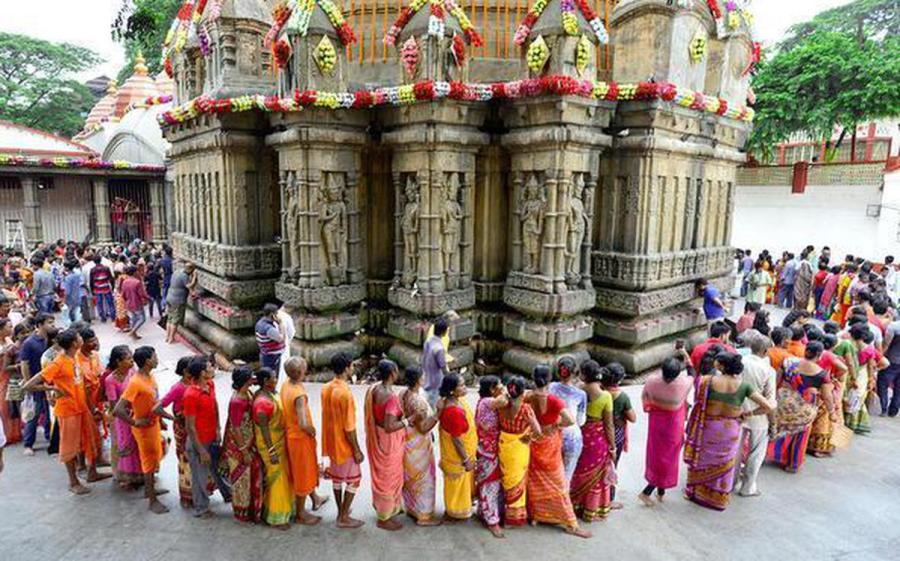
The air, thick with humidity and devotion, is alive with fervent anticipation. Today, as the gates of the revered Kamakhya Temple in Guwahati, Assam, close, a powerful ritual begins—marking the start of the annual Ambubachi Mela. For millions of Hindu devotees, this is not merely another festival; it’s a deeply spiritual event that connects them to the divine feminine, celebrating an ancient tradition woven with reverence, mystery, and power.
Though today is June 22nd, 2024, and I find myself in Ranchi, Jharkhand, my thoughts wander back in time—to a journey that was never meant to be, to a wish that remains unfulfilled. The news of the Ambubachi Mela always stirs a bittersweet ache in me. A gentle reminder that some paths, no matter how deeply desired, are meant to remain incomplete.
Kamakhya Temple: The Abode of Desire
The Ambubachi Mela, often hailed as the “Mahakumbh of the East,” centres around one of the holiest and most enigmatic temples in India: the Kamakhya Temple. Nestled atop the Nilachal Hills, overlooking the mighty Brahmaputra, Kamakhya is the embodiment of Kameshvari, the goddess of desire, revered particularly within the tantric traditions of Hinduism.
The temple itself is steeped in mythological lore. It is believed that this very site is where the yoni (genitals) of Goddess Sati fell after her tragic self-immolation, a symbol of the eternal feminine energy. Moreover, it is said that Kama Deva, the god of love, regained his potency here, lending the name Kamakhya—The Abode of Desire—to this sacred place.
The temple’s origins can be traced back to ancient times, but the structure we see today was constructed in the early 16th century under the patronage of Nara Narayana of the Koch dynasty after the original building was destroyed. Its distinctive beehive-shaped shikhara (spire) and intricate carvings remain a testament to the fusion of devotion, mythology, and architectural genius.
The Sacred Tradition of the Ambubachi Mela
The heart of the Ambubachi Mela lies in a unique tradition, coinciding with the monsoon season, when it is believed that the goddess undergoes her annual menstrual cycle. Just as the earth, during its monsoon “menses,” is considered most fertile, so too is the goddess thought to be in her most potent and productive state. For three days, the temple doors are closed, the regular rituals cease, and the flow of devotees halts. This temporary closure is not a mark of impurity, but a gesture of respect for the goddess’s natural cycle—a sacred acknowledgement of the life-giving forces of womanhood and nature.
It was in the late 1980s, while I was navigating the world of loans and foreign exchange in a bank in Aligarh, that a long-cherished dream took root – my mother’s desire to visit the Kamakhya Temple. Despite the unsettling news of civil unrest brewing in Assam, her yearning was strong, and I, wanting to fulfil her wish, booked our tickets on the Tinsukia Express from Aligarh to Guwahati.
A Journey Interrupted: My Unfulfilled Pilgrimage
In the late 1980s, while navigating the complexities of foreign exchange and banking in Aligarh, a dream was quietly taking root in my heart. It was not my own dream, but my mother’s—a deep yearning to visit the Kamakhya Temple. Despite the increasing reports of civil unrest brewing in Assam, my mother’s desire never wavered. I, too, wished to fulfil this sacred wish of hers. And so, I booked our tickets on the Tinsukia Express from Aligarh to Guwahati.
The journey began with the rhythmic clattering of the train wheels, each click and clack a melody that carried us eastward. The initial leg of the trip was smooth, and we watched in awe as the landscape transformed from the arid plains to the lush, green expanses of Eastern India. But as we approached Malda in West Bengal, a palpable tension began to fill the air, and whispers of disturbances started to ripple through the train compartments. There was a growing unease—a sharp contrast to the excitement that had filled our hearts at the journey’s outset.
Despite the increasing tension, our train pressed on, albeit with delays. Around 9 PM, we came to a sudden stop at a small, rural station. The train, now an isolated island in the vast darkness, was immobilised. Hunger crept up on us, and fatigue settled like a heavy cloak. However, in this unexpected pause, the kindness of the local villagers shone through. They offered homemade sustenance—warm parathas and simple omelettes—that the passengers eagerly devoured.
After a long day of uncertainty, we tried to sleep, the rhythmic chirping of crickets our lullaby. But the next morning, a revelation awaited us. We had reached New Jalpaiguri Junction (NJP), miles away from our intended destination. The Travelling Ticket Examiner (TTE), his face weary and resigned, explained that the Bodo insurgents had orchestrated blasts on the railway tracks ahead, rendering further travel by train impossible.
We were handed a railway memo, a slip of paper entitling us to a refund for the journey from NJP to Guwahati. The ticket counter processed our refund swiftly, almost as though it were routine—an indication of the frequent disruptions caused by civil unrest in those days. Our journey, abruptly interrupted, ended there—at a busy junction, far from the sacred hills we had set out to reach.
The Sacred Beckoning: An Unanswered Call
It was then that I fully grasped the meaning of the saying, “One can only visit a deity when they are called.” Our thwarted attempt at pilgrimage, though disappointing, felt like an affirmation of this belief. A gentle reminder that not all journeys are meant to be completed in our own time. Some sacred paths, no matter how deeply we long to walk them, are simply not ours to traverse.
My mother, too, was never able to visit the Kamakhya Temple. And to this day, I have not made the pilgrimage myself. The memory of that interrupted journey remains vivid in my mind—an emotional knot that I have carried with me through the years. Yet, I cannot help but hold onto hope. I believe that one day, in the right moment, when the divine call resonates clearly within me, I will stand on the Nilachal Hills and experience the spiritual embrace of the Ambubachi Mela.
Until then, I will patiently wait, listening for the sacred whisper from the East. I will continue to honor the divine feminine in my own way, awaiting the day when the gates of Kamakhya will open for me. It will be then, and only then, that I will be truly ready to answer its beckoning.
Until that time arrives, the journey remains incomplete—still sacred, still filled with longing, still a journey that must wait for the right moment to unfold.

The saying “one can only visit a deity when they are called” holds true. In my personal experiences, I’ve found that despite careful planning, we were unable to go on a pilgrimage. Your story is particularly extreme, as you were actually traveling, only for it to be abruptly cut short by a terror incident.
LikeLiked by 1 person
Thanks, Sanchita, for sharing your experience.
LikeLike
lets go together with full family this time.
LikeLiked by 1 person
Okay. Hope She would call us this time. Jai Maa.
LikeLike