

The air in Ranchi is electric. It’s the heart of Navratri, and the city pulses with an energy that transcends the mundane. Streets blaze with colour. The dhaak’s hypnotic rhythm vibrates through the air. The scent of incense, marigolds, and fresh offerings envelops you like an embrace from the divine. This is not just a festival. It’s a communion with Shakti, with tradition, and with something timeless and eternal.
During these nine sacred nights, as the divine feminine manifests in her fiercest and most graceful forms, my thoughts stretch beyond the present, beyond India even. I find myself traversing centuries and continents, seeking out the same sacred archetype that stands before us as Durga, the invincible goddess. And I find her — not just in the clay idols of Bengal or the verses of the Devi Mahatmyam—but in the sands of Mesopotamia, the tombs of Egypt, the temples of Greece, and the hills of Mesoamerica.
Durga: The Living Flame of Shakti
My own spiritual journey is deeply intertwined with the vibrant tapestry of Hinduism, and Durga, the invincible warrior goddess, holds a special place in my heart. She isn’t just an idol in a pandal; she’s a living force, the Adishakti – the primordial energy that birthed the cosmos. Growing up, the stories of her fierce battles against demons, particularly the mighty Mahishasura, were more than just tales.
They were lessons in the triumph of righteousness, the inherent strength that lies within the feminine. The magnificent idols erected during Navratri, each depicting her in a powerful stance with her array of weapons, serve as a potent reminder that the divine feminine is not just gentle and nurturing but also fiercely protective.

Centuries ago, in Chandraketugarh, near modern-day Kolkata, a terracotta figure of Durga dating to around 200 BCE was unearthed — a quiet yet profound reminder that the reverence for this divine feminine force is as ancient as our civilisation itself.
Inanna & Ishtar: The Goddesses of the Fertile Crescent
As dhaaks beat in Ranchi, my imagination drifts to the cradle of civilisation — Mesopotamia. Among the ziggurats and cuneiform tablets, two names echo with feminine power: Inanna and Ishtar.
Inanna, the Sumerian “Queen of Heaven,” is the earliest known goddess to embody both fertility and warfare. Her descent into the Underworld is a myth steeped in death and rebirth — themes echoed in the seasonal cycles and in the Devi’s transformation from Durga to Kali. She strips away each layer of herself, confronting the darkness not just of the world, but of the self. She returns not weaker but wiser.

Her later counterpart, Ishtar, adopted by the Akkadians and Babylonians, was equally fierce. A goddess of love and battle, her symbol was the lion. In reliefs, she strides confidently, surrounded by roaring beasts. There is a resonance here with Durga’s lion mount, both a companion and a symbol of divine fearlessness.
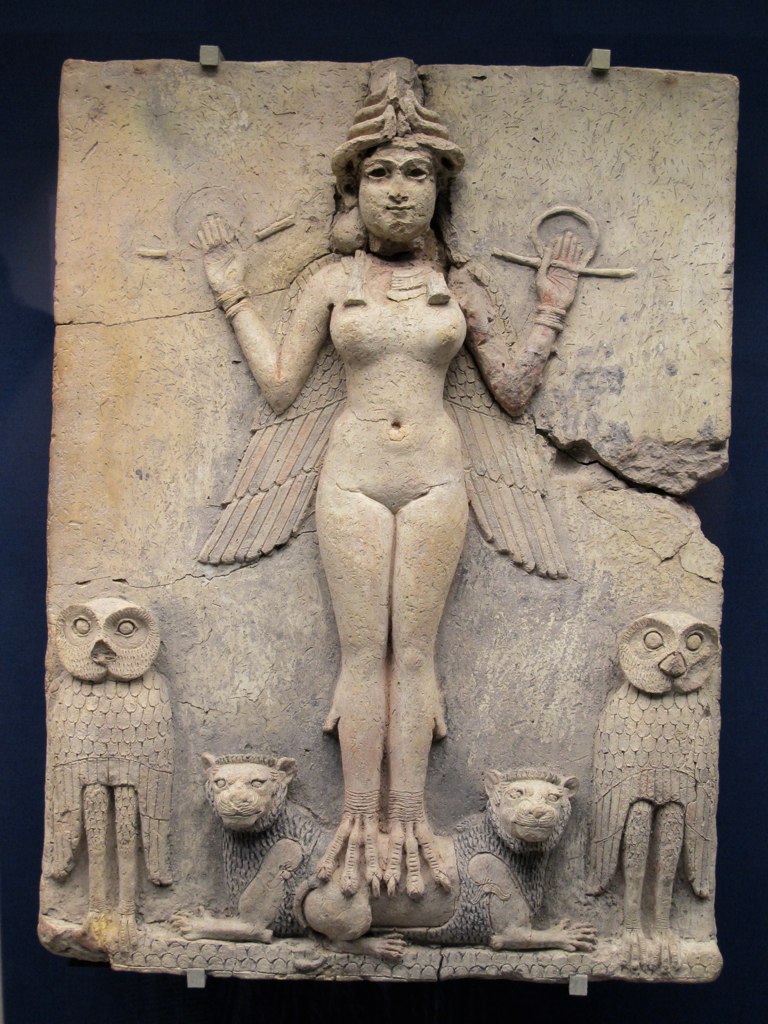
These were not goddesses to be placated. They were goddesses to be respected, feared, and loved — agents of cosmic equilibrium.
Symbols & Archetypes: Across Civilisations
What is most striking about these goddesses is their multifaceted nature. They are nurturers and destroyers, lovers and avengers, mothers and warriors. They shatter the binary, refusing to be boxed into a single identity.
The animal symbolism further cemented this connection in my mind. Durga’s lion isn’t just a vehicle; it embodies her courage and her ability to conquer fear. Similarly, Inanna’s association with serpents (representing transformation and healing) and bulls (symbolising strength and fertility), and Ishtar’s powerful lion, all speak to their dominion over the natural world and their role as guardians of cosmic order. It’s as if these animals served as earthly manifestations of their divine attributes.
The Global Sisterhood of Goddesses
From Mesopotamia to Mesoamerica, the Mother Goddess has appeared in countless forms:
- Isis in Egypt, protector and healer, whose magic resurrects Osiris and nurtures Horus — a beacon of maternal devotion and spiritual power.
- Gaia and Demeter in Greece, the Earth Mother and the harvest goddess — embodiments of life, grief, and the eternal bond between mother and child.
- Magna Mater (Cybele) in Rome, wild and untamed, venerated as the protector of cities and civilisations.
- Coatlicue in Aztec belief, both womb and tomb, terrifying in her raw duality.
- Mazu in coastal China, calm yet commanding, protecting fishermen and seafarers — a modern echo of divine guardianship.
Despite differences in language, geography, and ritual, these goddesses share a common essence — they are manifestations of a power that is both spiritual and elemental, deeply rooted in nature, human emotion, and collective memory.
Why the Divine Feminine Still Matters
In a world often driven by domination, speed, and logic, the divine feminine offers something different, not as an opposite, but as a complementary force. She teaches us to listen, to nurture, to stand our ground when necessary, and to embrace the rhythms of life rather than suppress them.
During Navratri, as I move through the rhythmic beats, the devotional chants, and the powerful visuals of Durga, I don’t just see a goddess of my culture. I see a symbol of resilience and wisdom that has echoed across civilisations and centuries.
She is the mother who creates, the warrior who defends, the destroyer who purifies, and the lover who binds all life together.
In Conclusion: One Goddess, Many Names
The Mother Goddess may wear different names — Durga, Inanna, Ishtar, Isis, Demeter, Gaia, Mazu — but her essence remains the same. She reminds us that power can be compassionate, that strength can be nurturing, and that the sacred feminine deserves not just reverence, but understanding.
In this celebration of Shakti, let us remember her not only in clay idols and rituals, but also in history, myth, and everyday life, where she continues to live on in women who lead, create, protect, and transform the world around them.
And as the dhaaks of Ranchi beat on into the night, I stand still — listening not just with my ears, but with my heart — to a song sung since the beginning of time: the eternal rhythm of the Mother.
She rises with the sun in crimson flame,
A whisper in the wind, a thousand names.
From riverbeds to desert stone,
She walks where hearts have made her throne.
Inanna’s cry, Ishtar’s roar,
Durga’s blade in mythic lore.
She births the stars, she breaks the night,
She is the silence and the fight.
A lion’s stride, a serpent’s grace,
She wears the cosmos on her face.
In every cradle, every tomb,
She dances through creation’s womb.
Not bound by creed, nor time, nor land,
She moves through souls like shifting sand.
A mother’s touch, a warrior’s glare,
She is the breath in every prayer.
So light the lamp, and beat the drum,
For She who was, and is, and will come.
Across the world, in temple and tree,
She lives in you, she lives in me.


Great post! 👏 Thanks.
LikeLike
Thank you!
LikeLike
Nice post of Goddesses on Navratri. Loved your sections on ancient Sumerian and Mesopotamian goddesses.
LikeLiked by 2 people
Thanks, Nilanjana.
LikeLike
Mother Goddess was worshipped by every ancient civilization from the time it started as a society and then evolved into a civilization across the world.
LikeLiked by 1 person
Thanks, Sanchita. You are right. Jai Maa!
LikeLike
Nice post. Happy navratri.
LikeLiked by 1 person
Thanks, sir! Happy Navratri and Durgotsav!
LikeLiked by 1 person
I didn’t know anything about these goddess (Inanna and Ishtar)before , but I did know about Durga. Thank you very much. I learned a lot from your article.
My journey into the world of Inanna snd Ishtar has not only broadened my understanding of ancient cultures but also deepened my appreciation for the universal themes that connect us across time and geography. The stories of these goddesses serve as a testament to the power of cultural exchange and the enduring legacy of our shared human heritage.
Thanks once again 🙏🏽
LikeLiked by 1 person
True. The civilizations evolved in parallel and then might have some cross cultural influences. Actually people encountered similar problems, difficulties, and challenges, therefore the solutions are quite similar. Another aspect is that goddesses lost their importance as societies turned male-dominated or patriarchal. We Bengalis mainly kept the Shakti worship alive primarily because we are not purely Vedic. This is my perspective.
LikeLike