
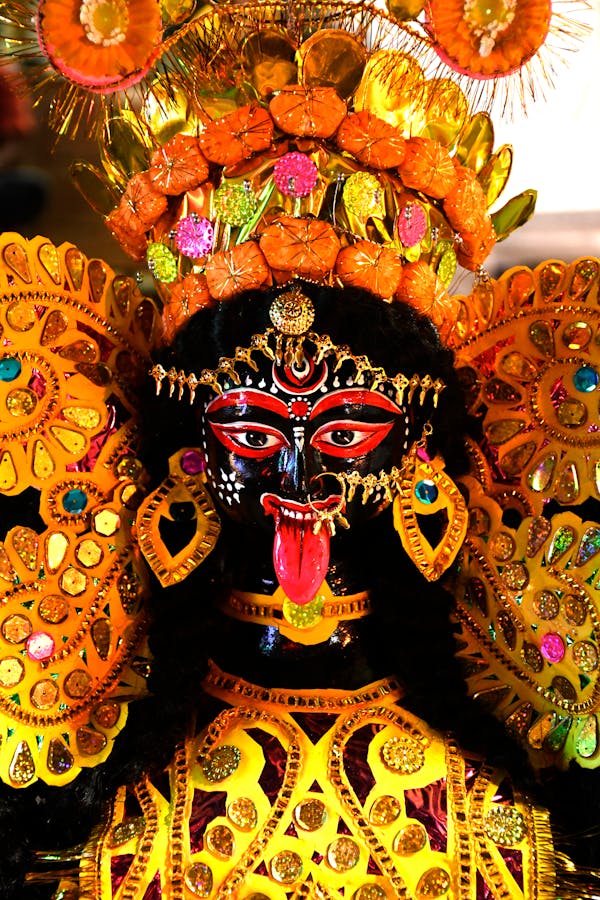
For Bengalis, Kali Puja is not merely another festival—it is a night steeped in reverence, mysticism, and transformation. While much of India celebrates Diwali as a festival of light and prosperity, Bengal turns toward the dark yet protective embrace of Maa Kali, the fierce mother who destroys ignorance and ego to nurture renewal.
On this moonless night, lamps are lit not just to banish darkness but to honour the formidable goddess who reminds us that destruction is not an end—it is a beginning.
“When the rest of India lights lamps for Lakshmi, Bengal lights them for Kali — the mother who destroys to renew.”
The Origins: When Darkness Was Divine
Long before Kali became a household deity, her worship began in places few would dare to linger—the cremation ground, the shmaśān. Amid the crackle of pyres and the howl of jackals, lone Tantriks invoked her through mantras whispered into the smoke.
Their offerings were not sweets or incense, but skull-bowls, ashes, and fear—symbols of impermanence. Kali, then, was not the gentle mother of domestic shrines. She was wild, uncontainable, the threshold goddess who danced where life and death met.
But Bengal, with its unique genius for spiritual domestication, gradually softened her image without dulling her power. By the 16th century, pilgrims thronged to Kalighat, hibiscus in hand, calling to her not in terror, but in devotion. She became Dakshina Kali—her right foot forward, her gaze compassionate, her tongue still red but her eyes full of love. It is believed that the worship of Dakshinkalika, a specific form of Kali, was introduced to Bengal by the sage Krishnananda Agamvagish in the 15th or 16th century.

From Shmaśān to Courtyard: A Transformation of Faith
By the 18th century, Raja Krishnachandra of Nadia, mystic king and devout follower, turned Kali Puja into a royal festival—an event to rival Durga Puja. The courtyards of Bengal’s zamindars glowed with rows of lamps, as mantras once chanted beside pyres now echoed off lime-washed walls.
In the 19th century, Rani Rashmoni’s iconic Dakshineswar Temple and the devotion of Sri Ramakrishna Paramhansa sealed Kali’s transformation—from the fearsome goddess of the cremation ground to the mother of Bengal.
And yet, her duality endures. On Kali Puja night, Bengal’s courtyards become gentle reflections of the cremation ground—the flickering lamps like pyres, the ululations like mantras, the air thick with both devotion and the scent of fried luchis. Children’s laughter replaces the jackal’s howl. The goddess stands at the centre—terrible, tender, timeless.
“Perhaps that is Bengal’s greatest magic—to take the wild and invite her in for dinner.”
The Sacred Feminine: Myth, Meaning, & Symbolism
Kali’s earliest mention comes from the Markandeya Purana, where she emerges from Goddess Parvati to annihilate demons. Her iconography—garland of skulls, bloodied sword, severed head—is not grotesque but deeply symbolic. Each severed head represents a human vice—greed, ego, ignorance, illusion—cut down by divine awareness.
In collective Bengali consciousness, Kali is both the fierce protector and the nurturing mother. Her dance of destruction is also the dance of renewal. Through her, Bengalis learn the rhythm of the universe—the balance of creation and dissolution.
Tantra & the Midnight Invocation
Kali’s worship has always been intertwined with Tantric philosophy, which views divinity as both light and shadow. For the Tantrik, the Amavasya—the new moon night—is not darkness to fear but an invitation to introspection and truth.
Even today, hidden Tantric rituals take place in remote corners of Bengal. These secretive rites, focused on liberation rather than fear, explore the depths of consciousness and the surrender of self to the divine mother. Though mysterious, they remain the spiritual core of Kali Puja’s midnight intensity.
Faith Through the Ages: The Evolution of Kali Puja
The formal celebration of Kali Puja began around the 17th century, under the influence of King Krishnachandra of Nadia. His devotion elevated private worship into a grand public festival.
In the 19th century, saints like Ramakrishna Paramhansa and reformers like Swami Vivekananda redefined Kali’s image. Ramakrishna saw in her not terror, but infinite compassion—a mother to whom he could speak, laugh, and cry. Through him, Bengal learned that faith is not submission—it is intimacy.
It is this evolution—from fear to familiarity, from power to protection—that captures Bengal’s spiritual genius.
Modern-Day Bengal: Devotion in the Age of Light
In today’s Bengal, Kali Puja is both spiritual and spectacular. Kolkata transforms into a glowing city of thousands of pandals, each competing to present the goddess with awe-inspiring artistry. From traditional idols to avant-garde installations, these pandals reflect the creativity that defines Bengal.
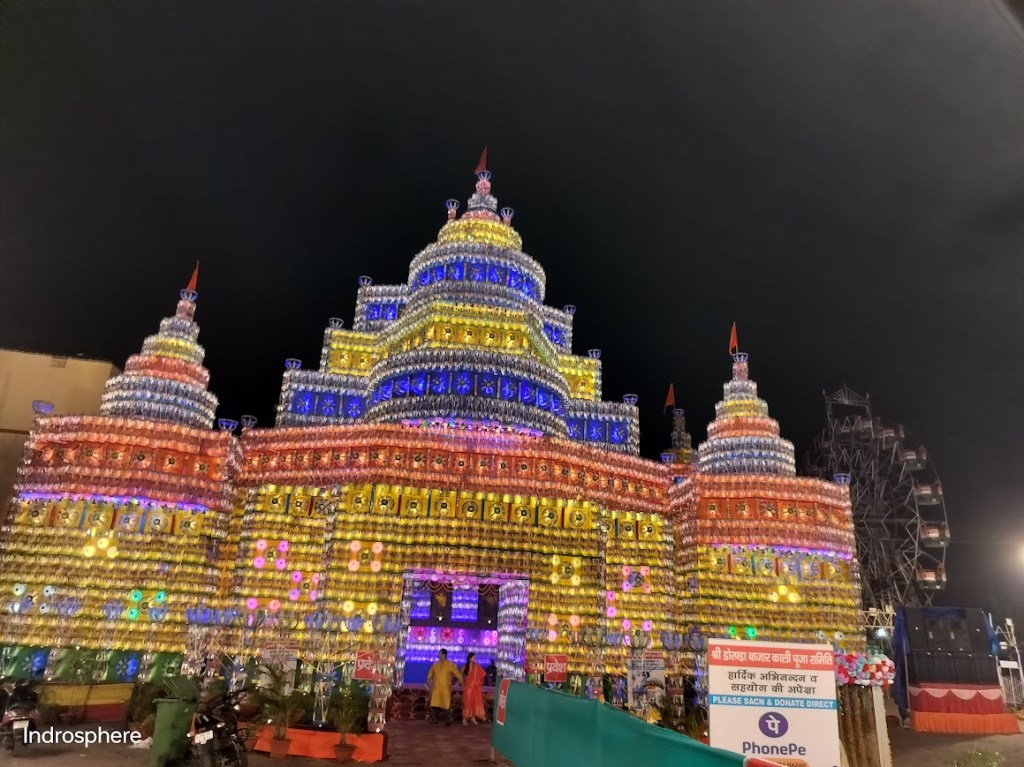
The festival’s streets are alive with food stalls selling khichuri, beguni, alu bhaja, and sweets like rasgulla and sandesh. Families spend the night visiting pandals, lighting lamps, and offering prayers.
Animal sacrifice, once part of the old Tantric ritual, has faded; yet the essence of offering remains—the surrender of one’s inner darkness to the goddess’s purifying fire.
Cultural Resonance: The Goddess Within Us
Like Durga Puja, Kali Puja stands at the heart of Bengali cultural and spiritual identity. It reflects a worldview that sees beauty in paradox—the maternal in the terrifying, the divine in the dark.


For some, Kali is the energy to overcome personal battles. For others, she is the compassionate mother who shields and forgives. To all, she represents transformation—the eternal balance between creation and destruction.
Through her, Bengal continues to celebrate not just religion, but the poetry of existence.
Conclusion: The Eternal Dance of Faith
Kali Puja is not a festival of fear—it is a festival of faith that accepts all shades of life. In her, Bengalis find the courage to embrace the unknown, the unseen, the uncomfortable.
The goddess who once roamed cremation grounds now sits gently beside our lamps and sweets, smiling as we chant her name.
Faith, like Kali herself, evolves—it moves from the wild to the familiar, from terror to tenderness, yet never loses its truth.
And so, every year, as the new moon rises over Bengal, lamps flicker, mantras echo, and darkness becomes divine.
Jai Maa Kali!

জয় মা কালী!
LikeLiked by 1 person
🙏🙏
LikeLike
Your article, “Kali Puja: From the Cremation Ground to the Bengali Courtyard,” is nothing short of a literary pilgrimage — a masterful weaving of theology, history, and cultural anthropology that pulses with reverence and insight.
A Commentary on a Sacred Tapestry
What strikes me most is the depth of your understanding you brings to the sacred feminine — not just as a theological construct, but as a living, breathing presence in the Bengali psyche. The journey from shmaśān to angan is not merely spatial; it is symbolic of Bengal’s unique spiritual alchemy — the ability to domesticate the divine without diminishing its power.
The line — “Perhaps that is Bengal’s greatest magic—to take the wild and invite her in for dinner” — is not just poetic; it’s profound. It captures the essence of how Kali, once feared in the shadows of cremation grounds, now presides lovingly over homes, courtyards, and hearts.
A Scholar’s Gaze, A Devotee’s Heart
You don’t just recount history — he resurrects it. From the Tantrik chants whispered into smoke to the lime-washed walls of zamindari courtyards, every detail is textured with care. The invocation of figures like Krishnananda Agamvagish, Raja Krishnachandra, Rani Rashmoni, and Sri Ramakrishna reflects not only scholarly depth but a genuine reverence for the lineage of devotion that shaped Kali Puja into what it is today.
The article also does justice to the Tantric roots of Kali worship — often misunderstood or sensationalised — by presenting them as a path of introspection, surrender, and spiritual liberation. That nuance is rare and deeply appreciated.
Kali as Metaphor and Mother
What elevates this piece is its ability to transcend ritual and reach into the symbolic. Kali is not just a deity here — she is a mirror to our inner world. The severed heads are not grotesque but allegorical; the jackal’s howl becomes a metaphor for our own fears; the flickering lamps, a testament to our resilience.
The closing lines — “Faith, like Kali herself, evolves—it moves from the wild to the familiar, from terror to tenderness, yet never loses its truth” — are a meditation in themselves. They remind us that true devotion is not static; it is a dance, much like Kali’s own, between destruction and renewal, fear and love.
In a time when festivals are often reduced to spectacle, this article reclaims the soul of Kali Puja — not just as a celebration, but as a spiritual reckoning. You have not only chronicled a tradition; you have channelled its spirit.
Please accept my admiration — this is writing that doesn’t just inform, it transforms.
Jay Maa Kali
May Her fierce grace continue to inspire such luminous storytelling.🙏🏽🙏🏽
LikeLiked by 1 person
Thank you so much for your deeply moving words. Your reflection captures the very spirit I hoped to convey — that Kali Puja is as much an inward journey as it is a cultural celebration. Bengal’s ability to embrace the fierce and the tender within the same divine form continues to fascinate and humble me. I’m truly grateful for your thoughtful reading and generous appreciation.
Jay Maa Kali — may her transformative grace guide us all. 🙏🏽
LikeLike