
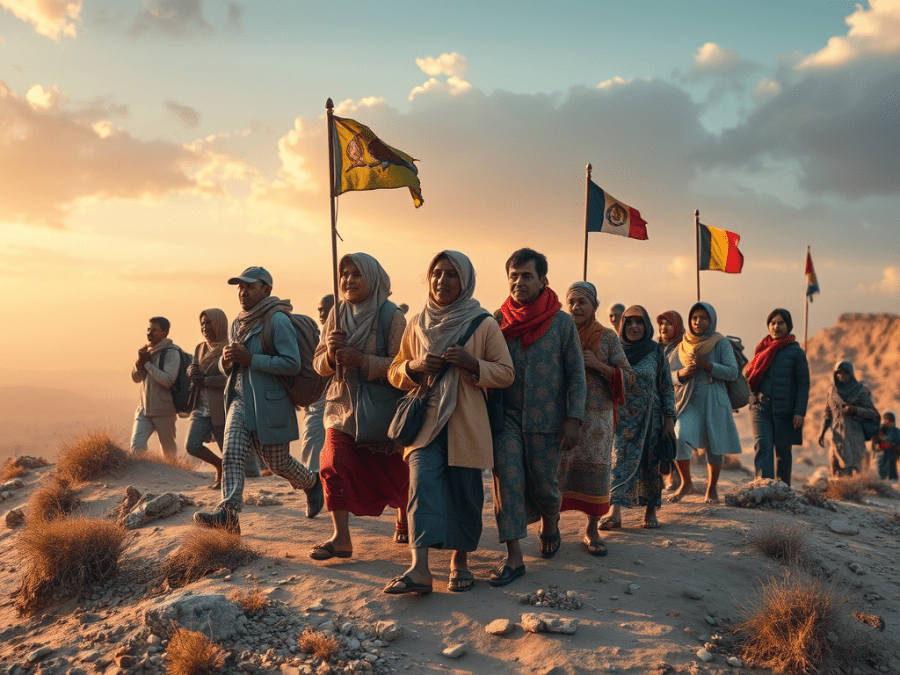
Migration. It’s a word woven into the very fabric of human history. It has been an integral part of the human story since the dawn of time. From early hunter-gatherers seeking fertile lands to modern professionals chasing career aspirations in distant cities, the movement has been fundamental to survival, growth, and evolution. Yet, paradoxically, those who move in search of a better life are often the easiest to blame for societal problems, the most convenient scapegoats for economic and political discontent.
A Tale as Old as Time
Human history is an endless saga of migration. Our ancestors crossed continents, braved oceans, and settled in foreign lands in search of prosperity and security. Civilizations rose and fell, shaped by the ebb and flow of people bringing new knowledge, skills, and cultures. Think of the Sumerians, Egyptians, Greeks, Romans, Chinese, Indians, and Persians – all built upon waves of migration. Even the rise of great metropolises today, from New York to Mumbai, owes itself to the confluence of migrants shaping the economic and social fabric.
But it’s not just humans. Migration is a natural phenomenon embedded in all species. We see it in birds e.g. Siberian Gulls, in wildebeests traversing the African savannah, in whales journeying across oceans. And yet, for humans, the act of moving from one place to another has often been met with hostility. The irony is unmistakable—migration is necessary for survival, yet the migrant is unwelcome.
The Politics of Exclusion
Throughout history, migrants have been the easiest people to hate. Whether it was the Irish in 19th-century America, Jews fleeing persecution in Europe, Zoroastrians fleeing persecution in Persia, or South Asians migrating to the UK post-colonialism, every era has had its ‘outsiders’ who were seen as threats to the native order. Today, migrants are being chased from American borders with cruelty that shocks the conscience. The same America that benefits from their labour—be it in agriculture, hospitality, or healthcare—deports them without a second thought. The hypocrisy is evident when restaurateurs bemoan the loss of their workforce while still supporting harsh immigration policies.
India, too, grapples with this issue. The treatment of Rohingyas, the fearmongering about ‘Bangladeshis,’ the resentment towards North Indians in Tamil Nadu and Karnataka, and the discrimination against Biharis in North India and Maharashtra all highlight how migration remains a contentious issue. Ironically, the very people despised for ‘taking jobs’ are indispensable to the economy, driving auto-rickshaws, constructing buildings, working as housemaids, and tending to fields.
Europeans, too, have been significant migrants throughout history. Their movement to America and Australia resulted in the forced displacement of indigenous populations, making aboriginal communities minorities in their own lands, subjected to colonial rule and systemic discrimination. These migrations altered the social and political landscape of entire continents, leaving deep scars that continue to impact the present.
Divisions Within & Without
Beyond national or regional migration, divisions exist even within cities. In Kolkata, there’s a cultural distinction between North and South Kolkata residents. Delhi sees a similar divide, with South Delhi dismissing those from ‘Jamuna paar’ or Old Delhi. Mumbai’s Bandra looks at Andheri East with a certain condescension. The treatment of North-East Indians, who are often mistaken for foreigners in their own country, further exposes the ingrained biases against ‘outsiders.’
It makes one wonder—why do we fear those who arrive after us? Why is there a deep-seated need to protect ‘our’ turf when, not too long ago, our ancestors were the very outsiders we now seek to exclude? Perhaps this fear stems from an innate survival instinct, a tribalism that once ensured security but now serves as a barrier to progress and unity.
A Personal Reflection
My own family’s journey is a microcosm of this grand migration story. My parents left West Bengal for Delhi, seeking better opportunities. I was born and raised in Delhi, in a milieu dominated by Punjabi culture. When my career took me to Ranchi, my Bengali roots clashed with the Punjabi accent I had inherited from my upbringing. My first phone call with the Senior Branch Manager in Dhanbad ended with him immediately inquiring about ‘the Bengali guy with a Punjabi accent.’
My son, born in Lucknow, spent his infancy in Delhi and was raised in Ranchi, and considers this city his hometown. His identity, already shaped by geographical movement, will continue to evolve. I wonder where he and his future generations will find themselves. Will they feel settled? Or will they, too, be caught in the migration cycle, forever searching for a place to call home?
Yin-Yang Paradox
It seems migration and the resistance to it are two sides of the same coin—the yin and yang of human existence. Just as there is a primal instinct to seek better pastures, there is an equally primal instinct to fear the new arrivals. But does it always have to be this way?
History shows that societies that embraced migrants flourished. The cultural melting pots of the world—New York, London, Mumbai—are testaments to how diversity breeds progress. The question remains: can we move past our deeply ingrained biases? Can we recognise that migration is not a threat but a natural, inevitable part of life?
Crucially, migrants also have a responsibility. Respecting the culture and ethos of their new home is essential. They should strive to mingle with the local population, enriching and evolving the society through cultural exchange rather than imposing their own culture and beliefs. It is essential to abstain from playing the victim card to manipulate societal behaviour and responsibilities.
Integration, not imposition, should be the goal. Cultural exchange should enrich and evolve society, not create divisions. Both cultures must be mutually acceptable and tolerant, adhering to universal toleration. The evolution and progress of society should be a shared journey, not a battleground where one group turns against another in hostility.
The Complexities of Illegal Migration
Illegal migration, while driven by the natural human impulse to seek a better life, poses complex challenges. Often fueled by economic hardship, political instability, and environmental disasters, individuals resort to perilous and unlawful methods to migrate. This desperation creates significant humanitarian concerns, including vulnerability to human trafficking, exploitation, and the risk of severe legal repercussions. For host countries, illegal migration can strain resources, raise security concerns, and fuel anti-immigrant sentiment.
Host nations have the sovereign right to enforce immigration laws and repatriate undocumented foreigners to their countries of origin. However, deportations should be carried out with dignity, ensuring that individuals are not subjected to inhumane treatment. The use of excessive force or degrading treatment is unacceptable. At the same time, countries of origin must take responsibility for their citizens residing illegally abroad and facilitate their return without undue obstruction. A balanced approach that upholds the rule of law while respecting fundamental human rights is crucial for managing migration fairly and justly.
Addressing the Root Causes: A Path to Sustainable Solutions
However, the solution lies not in fortifying borders or enacting stricter immigration policies, but in addressing the root causes of irregular migration. Global cooperation is essential to mitigate economic disparities, promote equitable development, and foster opportunities within countries of origin. A world where opportunity is more evenly distributed would reduce the desperation that drives individuals to risk their lives crossing borders unlawfully. Rather than penalizing those fleeing poverty, the international community should strive to create a world where migration is a choice, not a necessity. While this vision may seem idealistic and perhaps even unattainable in the short term, meaningful progress toward it is essential. Until we address the underlying drivers of irregular migration, the complex challenges it presents will persist.
Reflecting on the future, I hope future generations inherit a world that embraces migrants with greater openness and acceptance. I envision a time when they are not perceived as “outsiders” but as essential contributors to a more vibrant and diverse global society. At the same time, migrants must integrate respectfully into their host communities, appreciating local cultures rather than imposing their own in ways that may disrupt social harmony. Meaningful cultural exchange should be the goal, fostering mutual understanding and coexistence. After all, aren’t we all, in some way, migrants on an ever-evolving journey?
While celebrating the enriching aspects of migration, we must also acknowledge the need for safe, legal, and orderly processes to ensure stability and fairness for all.

Indrajit, your analysis of the reasons, risks, and issues surrounding migration was excellent. It’s clear that this is a complex and ongoing problem, and unfortunately, many people will continue to be negatively impacted for the foreseeable future.
LikeLiked by 1 person
Thanks, Gyan.
LikeLike
Very nicely put. All of our ancestors were migrants once, it’s in our DNA. I’ve had mine analysed, and although I can trace all the branches of my family tree back for hundreds of years and they’re all in the UK, my DNA tells me I have strong roots in the Mediterranean regions as well as Scandinavia.
LikeLiked by 1 person
That’s fascinating! It’s incredible how DNA can reveal hidden chapters of our ancestry that written records might not capture. Migration has shaped us all in ways we may not even realize. Have you looked into how those Mediterranean and Scandinavian roots might have influenced your family’s history or traditions?
LikeLiked by 1 person
I think it must have been too long ago for there to be any noticeable influences today. Probably more a case of recognising that the recorded history of, say, the Vikings in Britain will be part of my own history.
LikeLiked by 1 person
True. The Vikings were part of Britain’s history means they’re still part of your story in a broader sense. It’s fascinating how history weaves together different cultures and migrations over time.
LikeLiked by 1 person
Ah, history weaves everything together!
LikeLiked by 1 person
👍 Thanks, Mick.
LikeLiked by 1 person
This is a profound and timely topic. Beautifully written! Migration is an inherent part of the human story, a testament to our innate desire for exploration, discovery, and a better life. Acceptance is the bridge that connects us, allowing us to see beyond borders. Behind every migrant is a story of courage, resilience, and determination—a story that deserves to be heard, respected, and valued.
LikeLiked by 2 people
Beautifully said! Migration is indeed woven into the fabric of human history, shaping cultures and communities across generations. When we embrace acceptance, we not only honor these journeys but also enrich our own understanding of the world. Every migrant’s story is a testament to the strength of the human spirit. However, it’s important to acknowledge that illegal migration poses significant risks and challenges. It can be perilous, often involving dangerous journeys and exploitation, and it’s subject to the vagaries of immigration laws and the actions of the host nation’s enforcement agencies. While we celebrate the positive aspects of migration, we must also recognize the importance of safe, legal, and orderly processes.
LikeLike
Powerful post, . The history of migration is our shared history ~ a beautiful peek at who we are as humans, and a true testament to our ancestors who dared to seek something worthwhile… it is inspirational. The sharing of culture, wisdom, and most important, love. Wonderful presentation and writing, Indrajit.
LikeLiked by 1 person
Thank you so much for your thoughtful words! Migration has indeed shaped our identities in profound ways, weaving together cultures, stories, and traditions that define who we are today. Our ancestors’ resilience and courage continue to inspire us, reminding us that the pursuit of something greater—be it knowledge, belonging, or a better future—is at the heart of human history. I truly appreciate your kind words and engagement with my writing!
LikeLike
Your writing always brings a nice pause to life ~ to ponder and think of the words and ideas you share. Thank you!
LikeLiked by 1 person
That’s such a kind and thoughtful thing to say! I’m truly grateful that my words resonate with you. Knowing that they offer a moment of reflection makes writing even more meaningful. Thank you for taking the time to share this—it means a lot! 😊
LikeLike
Very well rounded artcile. In an age of jingoism – when being logical is viewed as signs of weakness, the words come as balm to frayed nerves.
LikeLiked by 1 person
Thank you for your thoughtful words! I truly appreciate your perspective. In times like these, logic and nuance are more important than ever.
LikeLike