
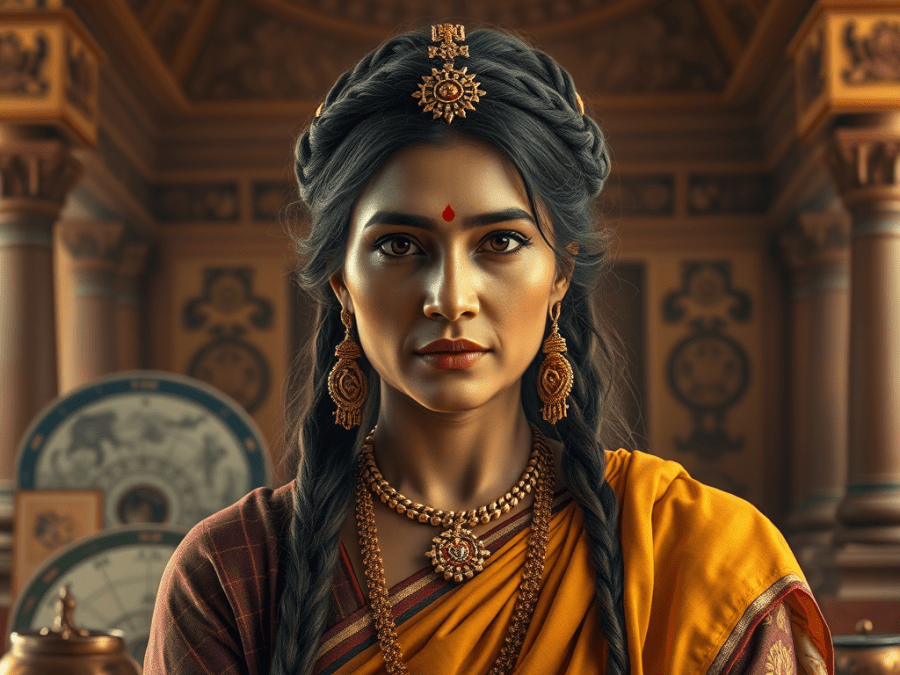
As the radiant festival of Chaitra Navaratri unfolds, we bow before the Navadurga — nine divine manifestations of Goddess Durga — each embodying strength, wisdom, and resilience. It is a time of introspection and reverence, when we celebrate not only the goddess but also the many mortal women who have mirrored her indomitable spirit through intellect, compassion, and defiance.
Among them stands the enigmatic figure of Khona — the brilliant woman of ancient Bengal whose life was a tapestry woven with light and shadow. Her name, still whispered in Bengal’s fields and courtyards, symbolises both genius and grief — a story of knowledge silenced and wisdom immortalised.
A Journey of Destiny & Knowledge
Imagine the intellectual splendour of King Vikramaditya’s court in Ujjain — a sanctuary of scholars, poets, and astronomers debating under star-strewn skies. It was here, amid celestial charts and philosophical discourse, that a young woman named Leelavati arrived from Sinhala Dvipa (modern-day Sri Lanka), accompanied by her childhood companion Mihir.
What followed could have been a tale scripted by destiny itself. Leelavati revealed a secret that shook the court — Mihir was none other than Varahamihira’s long-lost son. This revelation, though dramatic, forged a new constellation of relationships and intellect.
Under Varahamihira’s tutelage, Mihir flourished. Leelavati, soon affectionately called Khona, began crafting her own celestial vocabulary — one that translated astral patterns into earthly guidance. She observed the skies not for kings, but for farmers, bridging the gap between the heavens and the soil.
Khona’s genius was not confined to abstract stargazing. Her interpretations of planetary rhythms found tangible expression in agricultural forecasting — an extraordinary blend of astronomy and agronomy. Her intellect transformed astrology from an elite art into a science of sustenance, guiding Bengal’s agrarian life.
The Rise of Khona: A Threat to Patriarchal Norms
Khona’s wisdom crystallized in what we now know as the “Khonar Bachan” — a compendium of rustic aphorisms, each an exquisite fusion of observation, intuition, and practicality. These sayings, preserved through generations, embody Bengal’s ancient relationship with its rivers, monsoons, and soil.
“Jodi borshay na hoy dhaan, tobe sarabochormaan”
(If paddy does not grow in the monsoon, the year’s worth is lost.)
“Kolmi roye kochu rope, jaowa jabena bochu dope”
(Plant water spinach and taro, and you shall never go hungry.)
Each proverb distilled centuries of observation into rhythm and rhyme — simple enough to be remembered, yet profound enough to guide livelihoods. Through her voice, Khona democratized knowledge, bringing celestial logic down to the furrows of Bengal’s fields.
Yet, Khona’s growing prominence unsettled the patriarchal hierarchy of her time. Her intellect, audacity, and authority as a woman in a male-dominated field were revolutionary. The admiration she first earned gradually transformed into resentment — particularly from Varahamihira, whose reputation she began to eclipse.
The Tragic Silencing: Khona’s Fate
Legend has it that, unable to bear Khona’s ascendancy, Varahamihira ordered her tongue to be cut off — a grotesque metaphor for the suppression of female intellect. Whether literal or symbolic, the act represents a grim truth: the fear of a woman’s wisdom in a world governed by patriarchal insecurity.
Whether this episode is literal or allegorical, it captures a devastating truth — the systematic silencing of women’s intellect throughout history. The act represented not merely personal cruelty but a societal verdict: that a woman’s wisdom, once it transcended the domestic sphere, was dangerous.
Yet irony is history’s most poetic device. In silencing her, her oppressors immortalised her. The Khonar Bachan survived — carried through generations of farmers and storytellers who invoked her words with reverence.
Khona, thus, became the eternal whisper of Bengal’s fields, her mutilated tongue transmuted into collective memory and enduring oral tradition.
Khona’s Wisdom: Science Wrapped in Folklore
Long before “climate science” entered textbooks, Khona had already observed nature’s laws and translated them into practice. Her insights into weather cycles, soil behaviour, and sustainable cropping were grounded in empirical observation.
“Shukno masher purba batas, barshakale korbe sarbanash.”
(An east wind in a dry month foretells ruin in the rainy season.)
Modern meteorology now validates many such sayings — revealing Khona not as a mystic, but as an early scientist of the land. Her worldview was profoundly ecological, seeing human life as part of a continuum that linked the earth, sky, and spirit.
Khona’s sayings extended beyond agriculture — touching on health, ethics, and interpersonal conduct — revealing a holistic philosophy that saw life, land, and cosmos as one continuum.
The Mound of Khona-Mihir: Echoes from Chandraketugarh
The legend of Khona and Mihir finds an archaeological echo in Chandraketugarh, near modern-day Kolkata. Excavations here have revealed a mound locally called “Khona-Mihirer Dhibi”, suggesting a link to the couple’s burial or commemorative site.
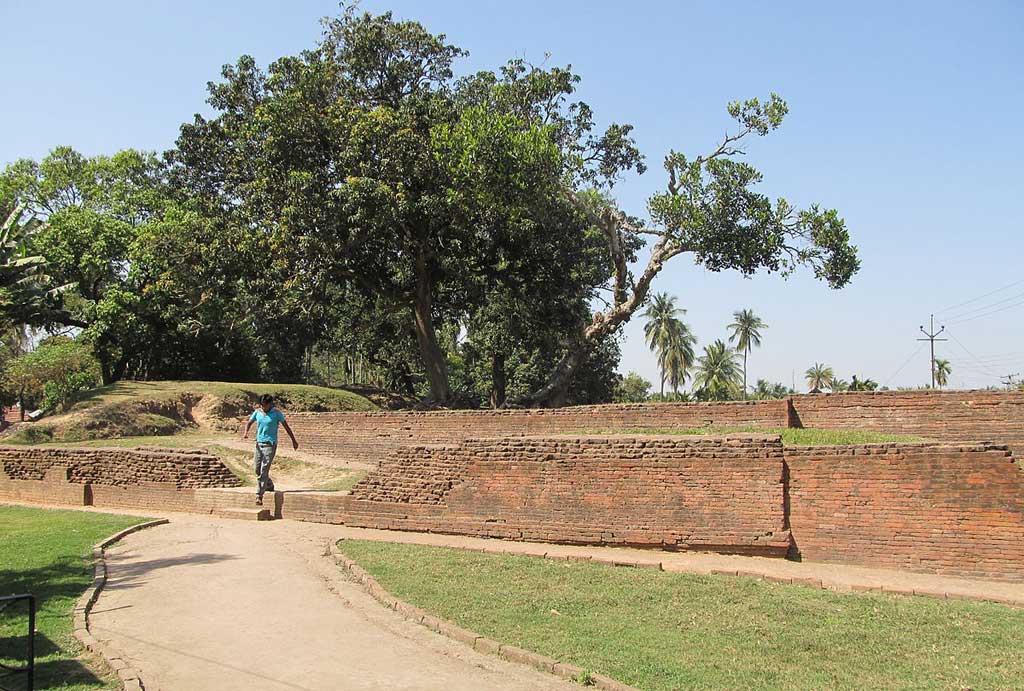
Artefacts from the site, including terracotta plaques, pottery, and coins dating back over two millennia, testify to Bengal’s early sophistication in art and astronomy. Scholars see in these findings a tangible link to Khona’s existence and the intellectual culture that nurtured her genius.
Chandraketugarh, situated near the ancient trade routes of the Ganga delta, was once a thriving urban centre under the Gangaridai and later Gupta empires. It is fitting, perhaps poetic, that Khona’s legacy — a woman bridging science and society — should rest in a land that symbolised Bengal’s syncretic genius.
Khona’s Relevance in the Modern World
In rural Bengal and Bangladesh today, Khona’s proverbs are still recited by farmers before planting season, woven into songs and folklore. They serve as both agricultural guide and cultural compass — reminders of a wisdom tradition that transcends time.
Khona stands as a symbol of resilience and intellectual courage — a woman who defied erasure, whose wisdom still animates the consciousness of a region. In her, we see not only Bengal’s daughter but the eternal archetype of Shakti — strength in silence, knowledge in defiance.
Conclusion: In the Spirit of Navaratri
As we celebrate Chaitra Navaratri, invoking the power of Durga and her nine forms, Khona’s story takes on sacred resonance. Like the goddess, she too fought — not with weapons, but with words and wisdom. Her story reminds us that knowledge, once awakened, cannot be silenced.
Khona’s voice — once cut, now immortal — is the whisper of Bengal’s soul, the rustle in the rice fields, the song of resilience that endures through centuries.
“Her silence was not the end — it was the beginning of a thousand echoes.”
In her resilience, we rediscover the eternal Shakti, the power that neither fire can burn nor patriarchy can bury.

Remarkable stories you are unearthing. Tragic tale, and one that has played out many times; an established order fearful of losing its power, even though eventually its desperation leads to its downfall.
LikeLiked by 1 person
Thanks, sir. Absolutely, it’s a poignant reflection of history. The fear of losing power often drives systems to repress knowledge and wisdom, especially when it comes from voices deemed “unsuitable” or “threatening” to the status quo. But as we’ve seen time and time again, that fear only sows the seeds for eventual change, even if it takes generations. The struggle for equality and recognition often carries tragic consequences, but it also plants the seeds for future generations to rise with greater awareness. It’s a cycle, but one that, in the long run, ensures progress.
LikeLike
Thanks, Indrajit, for sharing that story. Now I understand who Leelavati was in those Vedic arithmetic questions from school. It’s sad that she was a victim of human ego and patriarchy. It’s good that Bengal still remembers her, and I hope the next generation continues her legacy.
LikeLiked by 1 person
Thanks, Gyan. I do hope so.
LikeLike
Indrajit, thank you for sharing that story. It’s a shame she had to pay such a price due to human ego and patriarchy. I hope her legacy continues to inspire future generations.
LikeLike
Thank you, Sanchita.
LikeLike
Khona’s teachings are a testament to the rich spiritual heritage of ancient Bengal. Her wisdom, born from the confluence of Hindu, Buddhist, and Tantric traditions, offers a unique glimpse into the mystical and philosophical landscape of the region.
LikeLiked by 2 people
Thanks, Grover Saheb, for your input.
LikeLike