
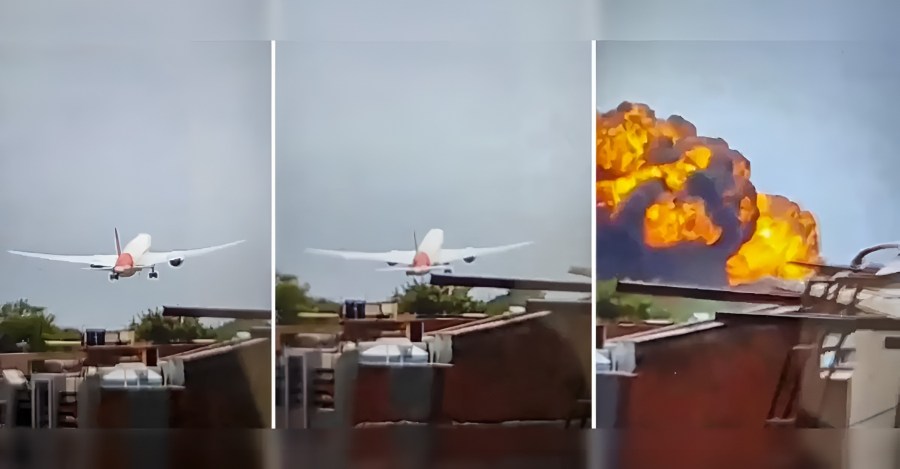
June 12, 2025, will remain etched in the collective memory of India—and indeed the world—as a day of immeasurable sorrow. That morning, Air India Flight AI171, a Boeing 787-8 Dreamliner bound for London’s Gatwick Airport, plunged into the boys’ hostel of a medical college in Ahmedabad. In moments, what should have been a routine international departure turned into a blazing horror.
The aircraft was carrying 242 individuals—230 passengers, 10 crew members, and 2 pilots. Only one would survive: Vishwashkumar Ramesh, a young engineering graduate from Vadodara. Among the dead were also five medical students on the ground, caught in the wrong place at the wrong time. The crash, followed by a devastating explosion from the fully fueled aircraft, has left not only charred ruins in its wake but also a thousand unanswered questions.
This was the first fatal crash involving a Boeing 787 Dreamliner since its commercial debut in 2011. In an age when aviation is statistically safer than ever before, how could such a catastrophe unfold just seconds after takeoff?
Theories & Thrust: What Could Have Gone Wrong?
When tragedies of this scale occur, social media lights up with speculation. Some are rooted in technical understanding; others fan the flames of conspiracy. But true justice to the lives lost can only come from rigorous investigation, not rushed judgment.
Here’s a distillation of the most plausible hypotheses currently being explored by India’s Aircraft Accident Investigation Bureau (AAIB), supported by Boeing, GE Aerospace, and international aviation authorities.
1. Dual Engine Failure: A Rare Catastrophe
Video footage and eyewitness accounts suggest the aircraft struggled to gain altitude, peaking at just 625 feet before its descent. A rare but possible cause is a simultaneous failure of both GE engines—an event so improbable that it is barely simulated in standard pilot training.
Could fuel contamination have led to a flameout? Or was there a bird strike affecting both engines—a phenomenon statistically rare but not impossible, especially at an airport with 38 documented bird strikes in 2022–23?
A plume of dust trailing the aircraft has been interpreted by some pilots as indicative of low engine thrust. Yet, no bird debris has been reported in CCTV footage so far, and dual engine failure remains a possibility, not a certainty.
2. Aircraft Configuration Errors
CCTV footage reveals something unsettling: the landing gear remained extended, and the wing flaps appeared retracted—a configuration inconsistent with standard takeoff procedures.
Normally, flaps are extended to provide additional lift, and landing gear is retracted shortly after liftoff to reduce drag. If these were not set correctly—due to mechanical malfunction or a lapse—the aircraft’s ability to ascend would have been severely compromised, particularly under extreme heat (nearly 100°F) and a full fuel load.
But would Captain Sumeet Sabharwal, a pilot with 8,200 hours of flying experience, and First Officer Clive Kunder (1,100 hours), really make such a basic error? Unless further evidence emerges, pilot error seems less likely.
3. Maintenance & Structural Issues
In 2024, Boeing whistleblower Sam Salehpour alleged structural flaws in Dreamliner fuselages, raising concerns about long-term airframe integrity. Though the FAA cleared operational 787s, and Boeing rejected the claims, this crash has revived debates on manufacturing quality control.
Air India’s ill-fated Dreamliner was 11 years old, delivered in 2014—well within the aircraft’s expected lifespan. Still, undetected wear, improper maintenance, or systemic issues may be under scrutiny. The DGCA has already initiated enhanced inspections of the remaining 33 Dreamliners in Air India’s fleet.
4. Fuel Quality & Delivery Systems
The aircraft had just been loaded with over 100 tonnes of fuel, a necessity for the transcontinental flight. Could fuel contamination, despite stringent international standards, have led to engine failure? Or did a fuel pump malfunction disrupt the supply?
Again, such failures are rare but must be ruled out only after full inspection of fuel logs, delivery mechanisms, and engine performance data from the Digital Flight Data Recorder.
5. Sabotage? Caution Is Crucial
Amid the noise, some voices on social media have cried sabotage, citing regional politics or global rivalries. But no credible evidence supports such claims. The presence of anti-terror specialists on site is standard protocol, not a sign of foul play.
Jumping to conclusions only derails the meticulous process of accident reconstruction and disrespects the memories of the dead.
6. Other Hypotheses: Technology, Environment, & Fate
Speculation continues: a failure in the aircraft’s flight management computer, unexpected deployment of the Ram Air Turbine (RAT), or performance issues due to extreme ambient heat. Even runway miscalculation was floated—though Flightradar24 confirmed the plane used the full length.
While the weather was fair, the high temperature and full payload may have worsened whatever issue occurred. Each of these theories, though credible, awaits confirmation or dismissal from the black box data.
The Road to Truth: An Investigation That Must Stand Tall
The DGCA, under Annex 13 of the International Civil Aviation Organisation (ICAO), is leading the probe. The Digital Flight Data Recorder and the Cockpit Voice Recorder have been recovered. Until both are analysed, every theory remains just that—a theory.
Air India’s Chairman, N. Chandrasekaran, has pledged transparency, and the DGCA has acted swiftly with safety audits. But history reminds us: true transparency requires independence from political and corporate pressure. Lessons from the Boeing 737 MAX disasters should be fresh in everyone’s minds.
Let Us Not Blame in Haste
Assigning blame—whether to the pilots, the airline, or the manufacturer—without clear evidence is not only premature, but reckless. Captain Sabharwal and First Officer Kunder issued a Mayday call within seconds, a sign of presence of mind and professionalism, not negligence.
In times of immense tragedy, the instinct to find someone to hold responsible is understandable. But we must resist letting anger or speculation cloud our judgment. Now, more than ever, the focus should be on uncovering the facts, standing with the grieving families, and taking steps to prevent such a catastrophe from recurring. Sensationalism and finger-pointing only add to the pain. What this moment calls for is empathy, clarity, and a commitment to accountability based on truth.
In Remembrance, With Resolve
Among the 241 lives tragically lost were 169 Indians, 53 British nationals, 7 Portuguese citizens, and 1 Canadian. Former Gujarat Chief Minister Vijay Rupani was among the victims. Five medical students, quietly sharing a meal in their hostel dining hall, were caught completely off guard—gone in an instant. As more details emerge, the death toll may unfortunately rise.
To the families mourning their beloved, to the lone survivor living with unimaginable trauma, and to the emergency responders, physicians, and civil society members who have risen in compassion, we send our deepest prayers and solidarity.

Flight AI171: May We Learn, & Never Forget
As the investigation unfolds, we must remain vigilant—but also patient. Only then can the final report, expected by June 12, 2026, offer the clarity and closure that the victims deserve.
Until then, let the memory of those lost on AI171 compel us toward a higher standard of transparency, technical scrutiny, and human empathy in all things, especially those that take us skyward.
Sources: Reuters, NDTV, The Hindu, BBC, India Today, Al Jazeera, The Guardian, CNBC, Frontline, Daily Mail, Times of India, NPR

This is a deeply heartbreaking tragedy. May God bring healing, comfort, and lasting peace to everyone.
LikeLiked by 1 person
Absolutely, a sad incident.
LikeLike
This heartbreaking tragedy serves as a stark reminder of how fragile life truly is. Each of the 241 lives lost had dreams, loved ones, and untold stories tragically interrupted. As the nation mourns, we must honor their memory by calling for accountability, striving for stronger aviation safety, and keeping their families in our hearts. May they find strength in the face of such unimaginable grief.
LikeLiked by 1 person
Thanks, Nilanjana. It’s very sad, indeed.
LikeLike
Absolutely tragic. The toll is still rising. Just read about a tea-seller on the ground who was in the wrong place. And the blame game has started. As has milking of the tragedy with emotional stories about the lives of the people who died.
LikeLike
Truly heartbreaking to witness the aftermath of such a devastating tragedy. Among the nearly 260 lives lost was 15-year-old Akash Patni, who was simply sleeping under a tree near his family’s tea stall by the BJ Medical College hostel—caught in the wrong place at the wrong time. While emotions are understandably high, let’s hope the focus remains on uncovering the truth, supporting grieving families, and taking meaningful steps to prevent such horrors in the future. The blame game and emotional sensationalism serve no purpose but to deepen the wounds. What we need now is compassion and accountability.
LikeLike
Your piece on the AI Dreamliner crash masterfully balances technical insight, investigative depth, and human sympathy. You’ve approached the tragedy with precision and compassion, honoring the lost while emphasizing transparency and truth. Your conclusion is a powerful call to action for higher standards in aviation, making this a brilliant, thoughtful, and necessary read.
LikeLiked by 2 people
Thank you so much for your deeply thoughtful and generous words. I’m truly humbled. In moments of tragedy like the Dreamliner crash, it’s easy to get lost in speculation or overwhelmed by data, but we must remember that behind every statistic is a life, a family, a story forever altered. Your comment underscores the importance of striking a balance between precision and empathy, and truth and humanity.
I’m grateful that the piece resonated with you in this way, and I sincerely hope it contributes, however modestly, to the larger conversation around safety, accountability, and compassion. We owe that to the memory of those we lost, and to those who entrust their lives to the skies every day. Thank you again for reading, feeling, and reflecting so deeply. 🙏🏽
LikeLike