
Across continents and centuries, human societies have turned to ritual as a way of anchoring their collective spirit, honouring the divine, and aligning with the rhythms of nature. While cultures may differ in language, theology, and geography, their sacred festivals often reveal a deeper, shared longing for renewal, for cosmic order, and for communion between mortals and the divine.
From the thunderous chariots of Puri’s Rath Yatra to the regal processions of Babylon’s Akitu, from the Nile-borne splendour of Egypt’s Opet Festival to the stately civic rituals of Athens’ Panathenaia, a resonant thread runs through time. These festivals are not merely cultural spectacles; they are mirrors into the soul of civilisations—ritual dramas through which humanity has interpreted the cosmos and its place within it.
Jagannatha Rath Yatra: The Chariot of the Gods
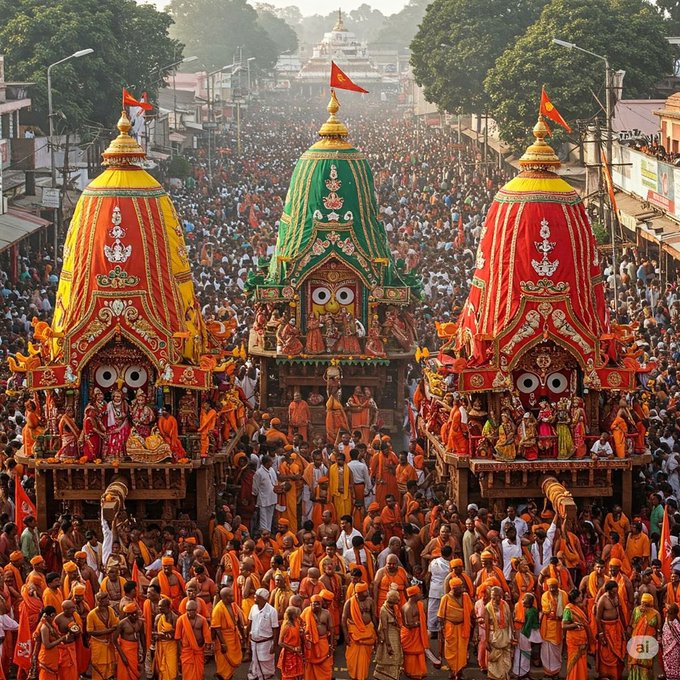
Celebrated in the temple town of Puri, Odisha, the Rath Yatra is among the most iconic religious festivals in India. It centres around Lord Jagannatha, a form of Krishna, who is ceremonially brought out of his sanctum and taken in a grand procession to the Gundicha Temple, accompanied by his siblings, Balabhadra and Subhadra.
The scale is breathtaking: massive wooden chariots, pulled by thousands of devotees with thick ropes, roll through streets teeming with emotion. The gods leave their inner sanctums and come among the people—a symbolic moment when divinity becomes accessible, when barriers between the sacred and the mundane dissolve.
More than just a religious ritual, the Rath Yatra echoes themes of seasonal change, rebirth, and inversion of power. For a brief moment, the temple deities—otherwise immobile and aloof—are mobile, vulnerable, and among their devotees. It’s an enactment of cosmic renewal, coinciding with the arrival of the monsoon, and symbolically, the rejuvenation of life.
Akitu Festival: Renewal in Ancient Babylon
Thousands of years before the Rath Yatra, the Akitu Festival was celebrated in Babylon and other Mesopotamian city-states during the first twelve days of Nisannu (April), marking both the spring equinox and the start of the new year. It was one of the oldest recorded religious celebrations, dating back as early as the third millennium BCE.
The Akitu was as deeply political as much was religious. The king would be ritually humiliated, stripped of his insignia, and made to confess any failings before the high priest—symbolically relinquishing his authority. Then, after a dramatic ritual involving processions, prayers, and public feasts, he would be restored as the chosen of the gods, reaffirming cosmic order and royal legitimacy.
It culminated in the procession of Marduk, Babylon’s chief deity, from his temple Esagila to a “house of the New Year” outside the city. The movement of the god in procession symbolised creation, destruction, and rebirth—a myth reenacted annually to maintain cosmic balance.
Opet Festival: The Divine Voyage of Thebes
In ancient Thebes (modern-day Luxor), the Opet Festival was celebrated during the second month of the Nile flood (Akhit season), linking the divine regeneration of the king with the cyclical rejuvenation of the land.
The god Amun, hidden in the inner sanctum of Karnak temple, would be carried in a sacred barque—sometimes by priests, other times floated down the Nile—to the Luxor Temple, where he would dwell for several days. The king participated in secret rituals meant to reaffirm his divine birth and legitimacy. The people, meanwhile, feasted and rejoiced in public celebrations.
Opet fused myth and monarchy, divine will and temporal power, fertility of the Nile and the stability of the cosmos. It was a reminder that the pharaoh’s authority was not merely political—it was sacred, eternal, and sanctioned by the gods.
Panathenaia: Athens Celebrates Athena
In classical Athens, the Panathenaia was a civic festival held in honour of Athena Polias, the city’s patron goddess. Every four years, the Great Panathenaia featured athletic competitions, poetry and music contests, and the famous procession to the Parthenon, where a newly woven peplos (robe) was offered to Athena.
What stands out in the Panathenaia is the emphasis on civic unity and identity. Unlike the other festivals mentioned, which centred heavily around divine-human reciprocity, Panathenaia celebrated Athenian citizenship, excellence, and shared heritage. Yet, it too was anchored in seasonal cycles and divine blessing—the peplos weaving symbolised both tradition and renewal, offering continuity amidst political change.
Shared Themes: Ritual Grammar Across Cultures
Despite the geographical and cultural distances, these festivals echo one another in profound ways:
- Procession of the Divine: Whether on chariots, river boats, or palanquins, gods are ritually moved through space. This physical movement signifies divine engagement with the world, cosmic alignment, and communal participation.
- Renewal and Cosmic Order: Each festival marks a transition of seasons, of power, of time. It is a way to reset the cosmic clock, reaffirming the pact between gods and humans.
- Integration of Ruler and Ritual: Kings and political leaders are central figures—humbled, reaffirmed, or reborn. Their legitimacy is tied to divine will, reminding us that power without ritual validation was considered profane.
- Collective Participation: From priests to commoners, these festivals involved everyone. Rituals were not confined to temples but spilt into streets, waters, and arenas—reminding us that religion in the ancient world was a communal performance.
- Seasonal and Agricultural Anchoring: These rituals often coincided with natural phenomena—floods, rains, equinoxes—showing a deep awareness of the rhythms of nature and the need to harmonise with them.
A Living Heritage of the Human Spirit
These festivals are not just relics of the past. They endure as cultural DNA, carried across generations through tradition, storytelling, and faith. The Jagannatha Rath Yatra continues to draw millions in Puri and across the globe. The Akitu echoes in modern New Year rites across West Asia. The grandeur of Opet still stirs the imagination as one sails past Karnak and Luxor. The Panathenaia lives on in Olympic ideals and civic pageantry.
When the gods descend from sanctums high,
And wheels of chariots carve the sky,
When rivers rise and temples sing,
And kings bow low before the spring—We gather not as rich or poor,
But souls who seek a sacred door.
In every chant, in every flame,
We call the gods by different names.Yet paths converge, and hearts align,
Across the sands of space and time.
For in each rite, each sacred sound,
The pulse of life is newly found.So let the drums of ages beat,
Where myth and memory gently meet.
The gods still walk, the people rise—
In every festival, the divine replies.
What unites them is not just their antiquity but their timeless relevance. In a world of rapid change, these rituals remind us of the need for pause, reflection, and re-anchoring—in the divine, in nature, and in community.
In Closing: The Universal Soul of Ritual
Beneath the diversity of civilisations lies a common spiritual grammar—a way of thinking, feeling, and celebrating that transcends language and empire. Sacred festivals, in their ritual forms and shared themes, offer us glimpses of this enduring unity.
As we reflect on these ancient traditions, one question lingers:
What other festivals, hidden in the folds of history, echo across civilisations in unexpected harmony, waiting to remind us that the divine walks not only in temples, but in processions, in kings, in seasons, and in the beating heart of humanity?

Faith moves mountains. I think it is an essential part of human existence. Unfortunately, it rarely stops with personal belief and faith. I want to foist it on others and prove my faith is better than your faith.
LikeLike
Faith can indeed move mountains, but when it becomes a tool for imposing one’s beliefs on others, it loses its true power. True faith should be a personal journey, not a weapon for dominance.
LikeLike
What a truly magnificent reflection this is—an elegant blend of history, spirituality, and cultural insight that transcends time and geography. Your comparison between the Jagannatha Rath Yatra of Puri and the ancient Akitu Festival of Mesopotamia isn’t just well-researched—it’s revelatory. You’ve shown, with striking clarity, that while civilizations may rise oceans apart and centuries apart, the essence of our human longing for divine connection remains beautifully universal.
As I read your words, I was transported into a world where gods descend into cities not as distant celestial beings, but as welcomed guests. The imagery of Lord Jagannatha gliding through the streets of Puri, and Marduk returning to Babylon, both echoing that sacred idea of divine presence amongst the people—it’s powerful. Your portrayal of kings not as mighty figures above the rest, but as humbled servants of the divine will, beautifully underlines the spiritual humility woven into these grand traditions.
And then there’s your reflection on seasonal renewal—the idea that these festivals don’t just mark the movement of gods or kings, but the turning of the Earth itself. Whether in the monsoon-soaked lands of India or the blossoming plains of ancient Mesopotamia, your writing captures the pulse of nature as an ever-present backdrop to humanity’s spiritual rituals.
But what resonated most deeply was your emphasis on collective devotion. The way you highlight how these traditions dissolve social barriers, bringing together every hand, every heart, into one act of faith—it’s not just beautiful writing, it’s deeply moving. These are not just festivals; they are living reminders of unity, resilience, and the soul of a community beating in unison.
This piece is a celebration of the shared spirit that connects all civilizations. Your voice carries both academic depth and poetic sensibility—a rare combination that turns historical commentary into something truly transcendent. In reading it, one doesn’t just learn—they feel, reflect, and marvel.
You’ve crafted more than a blog. You’ve created a bridge—between East and West, past and present, divine and earthly. And for that, this deserves not just applause, but admiration.🙏🏽🙏🏽
LikeLiked by 1 person
Thank you so much for your deeply thoughtful and generous words. Your reflection on the piece captures its essence beautifully, and I’m truly humbled by how you connected with the narrative. The parallels between the Jagannatha Rath Yatra and the Akitu Festival are, to me, not just historical comparisons but a celebration of our shared human journey—one that transcends time and place. Your response is a reminder of the power of collective devotion and the unity it fosters. I’m grateful for your kind appreciation! 🙏🏽
LikeLike
Excellent reflection ❤️
LikeLike
Thank you.
LikeLike