
The other day, in a WhatsApp group of my old school batchmates, a conversation took an unexpected philosophical turn. What began as a casual exchange spiralled into a debate on religion, belief, and the construction of places of worship.
Drawn as I’ve always been to the deeper currents beneath surface certainties, I offered a thought that felt instinctive to me: the mere construction of temples, mosques, or churches does not ensure the presence of spirituality. Rituals, after all, can ring hollow. True faith is not anchored in stone, but found in silence, introspection, and the intimate journey of personal awakening.
I followed up, almost as an extension to a comment appreciating the fluidity of Hinduism — not merely as a religion in the rigid, doctrinal sense, but as a way of life — by pointing out that Hinduism, despite the monolithic image often projected today, is anything but uniform. It is, in truth, a vast and intricate forest of philosophies — where Dvaita’s dualism coexists with Advaita’s non-dualism, where the logical enquiry of Samkhya lives alongside the ritual precision of Mimamsa, where the austere renunciations influenced by Jainism meet the emotive devotion of the Bhakti poets. Its true strength lies not in doctrinal rigidity, but in its embrace of plurality — a harmony of contradictions that breathes, not breaks.
It was then that one of my batchmates — a staunch communist and a man of sharp intellect—responded. His tone wasn’t hostile, but he pointedly remarked on what he perceived as a contradiction in my viewpoint.
From his Marxist lens — forged in dialectical materialism, steeped in the struggle between the oppressed and oppressor, thesis and antithesis — the idea of harmonious contradiction was almost unthinkable. For him, contradictions needed to be resolved through conflict, leading to a clear and superior synthesis. How could multiple truths coexist without erasing each other?
That question lingered with me longer than I expected.
Philosophy, unlike politics or ideology, often thrives on contradictions. It doesn’t fear them — it feeds off them. Over the years, I’ve come to see that truth is seldom a singular, fixed point. It is a spectrum — a mosaic shaped by time, experience, and the ever-changing lens of human understanding.
Dialectics, at its best, isn’t a war between ideas — it’s a dance. A dynamic interplay where opposites define, challenge, and transform each other.
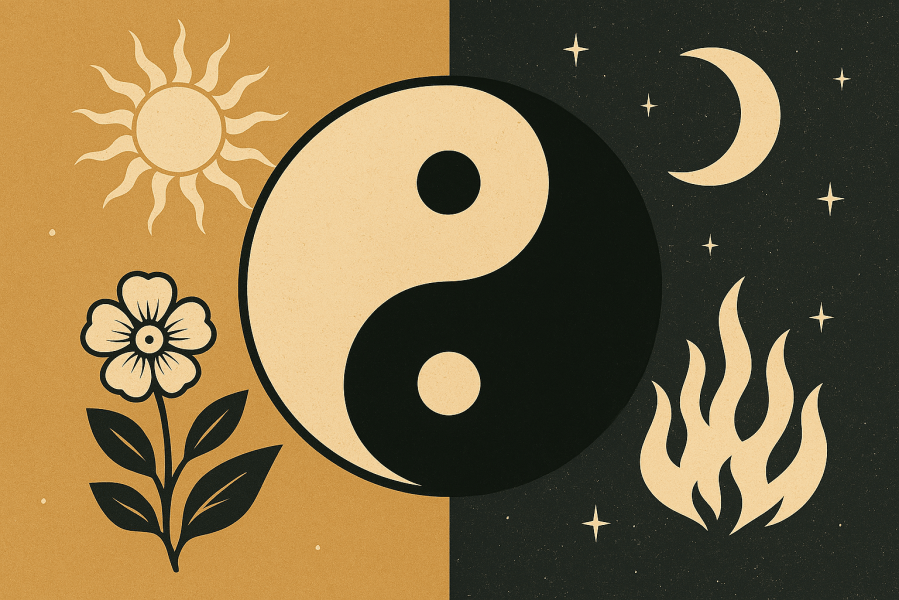
In Hegel’s dialectic, every idea (thesis) births its opposite (antithesis), and their struggle leads to a synthesis — a new idea enriched by both. In Eastern thought, contradictions are not always to be resolved but held in balance. The Yin and Yang of Taoist philosophy, the middle path of Buddhism, the cyclical dualities of Shiva and Shakti — all speak to this delicate equilibrium.
Even the Bhagavad Gita, often seen as a text of devotion and duty, is riddled with contradictions. Krishna urges Arjuna to fight and kill, while simultaneously teaching detachment, peace, and the futility of ego. The point isn’t to pick a side — the point is to understand that truth often lives in paradox.
My batchmate’s discomfort was not unusual. Ideological frameworks often seek clarity, certainty, and coherence — qualities that philosophy, especially pluralistic philosophy, tends to disturb.
But for me, this pluralism is precisely what makes certain traditions — like Hinduism — intellectually resilient. They allow for atheism and theism, ritual and renunciation, logic and love, all to exist within a single philosophical canopy. Charvaka, a materialist and sceptical school of thought, denied the existence of the afterlife and divine reward, and yet, it was still part of the broader Hindu discourse.
Can communism, or any singular ideology, make space for such contradictions without internal rupture? That’s a question worth pondering.
We often live with contradictions without noticing them. We cherish freedom but crave security. We value tradition but demand change. We seek connection but fear dependence. These tensions are not signs of hypocrisy. They are signs of being human.
Perhaps what my batchmate found hard to digest wasn’t my comment, but the larger notion that philosophical and spiritual life doesn’t have to be clean, linear, or logically sealed. It can be messy. It can be layered. It can, in fact, make peace with its own contradictions.
In my years of wandering through ideas — from the cold rationality of Western philosophy to the mystical warmth of Eastern thoughts, from the ideological convictions of youth to the tempered wisdom of experience — I’ve realised one thing:
We don’t always need to solve contradictions. Sometimes, we simply need to listen to them.
They have something to say — not in unison, but in chorus. Their very dissonance can produce the music of a deeper understanding.
So when I reflect on that WhatsApp exchange, I don’t see a clash. I see a reminder that my old friend and I are standing on different banks of the same river, watching the water of thought flow by. He sees turbulence. I see reflection. But the river doesn’t ask us to agree. It simply invites us to look, to feel, to wonder.
And perhaps, that is philosophy’s greatest gift.

Your reflection, Where Opposites Meet, reads like a philosophical mosaic—rich, layered, and quietly profound.
What begins as a WhatsApp debate among batchmates effortlessly unfolds into a deeper meditation on the nature of belief, pluralism, and the graceful paradoxes within Hindu philosophical thought. Your portrayal of Hinduism not as a rigid doctrine but as a vibrant forest of coexistence—Dvaita and Advaita, Charvaka and Bhakti—offers not just intellectual insight, but emotional depth. It’s rare to see a write-up that honors complexity without sounding evasive.
The way you hold space for opposing views—especially your communist friend’s perspective—speaks volumes about your generosity as a thinker. You don’t try to win the debate; you allow the contradictions to breathe. That, in itself, is an act of philosophical maturity. Your piece acknowledges that ideological frameworks seek clarity, while human experience often defies it.
I especially loved your metaphor of the river—that both you and your friend stand on opposite banks, witnessing the same flow with different interpretations. That image ties your entire essay together with poetic finesse.
Above all, your writing doesn’t impose a conclusion; it extends an invitation. To reflect, to hold tensions without resolving them, and to listen to the quiet music of philosophical dissonance.
Thank you for sharing something that doesn’t just express—it expands. Bravo
🙏🏽🙏🏽
LikeLiked by 1 person
Thank you so much for this deeply thoughtful response. Your words resonate like an echo of the very spirit I hoped to convey—one of openness, nuance, and shared wonder. I’m humbled that the river metaphor and the space for contradictions spoke to you. Grateful beyond words. 🙏🏽
LikeLike
Unfortunately, most humans are insecure. Ideological differences seem like a threat. And lead to wars and deaths and strife.
LikeLiked by 1 person
You’re absolutely right — insecurity linked to identity often causes fear and division, leading to defensiveness and conflict. True strength comes from maturity, empathy, and courage to embrace diverse perspectives and coexist peacefully.
LikeLike
What a wonderful post. Yes, you are right – the plurality not only in Hindu philosophy and tradition, theology and way of life or approach to life – makes us more flexible and tolerant.
LikeLiked by 1 person
Thank you! Yes, the inherent plurality in Hindu philosophy—its acceptance of diverse paths and perspectives—encourages openness, resilience, and a deep-rooted tolerance that the world can learn from.
LikeLiked by 1 person
Indrajit,
This was a deeply thoughtful piece. You’ve captured the essence of how contradiction isn’t always something to be resolved—but something to be lived with, even cherished. It reminded me that truth often lies not in certainty, but in the tension between opposing ideas.
LikeLiked by 1 person
I’m glad this piece resonated with you. It’s a reminder that life often thrives in the spaces between opposites, where ambiguity can be more enlightening than certainty. Embracing these tensions can lead to deeper understanding and a more nuanced sense of truth. Thank you for sharing your thoughts!
LikeLike
Indrajit, this was a deeply thoughtful piece. You’ve captured the essence of how contradiction isn’t always something to be resolved—but something to be lived with, even cherished. It reminded me that truth often lies not in certainty, but in the tension between opposing ideas.
LikeLiked by 1 person
Sometimes listening is better than talking I think so. Well shared 💐
LikeLiked by 1 person
Absolutely, sometimes the best way to connect is by truly listening. It creates space for understanding and empathy. Thank you!
LikeLiked by 1 person
Welcome 🤗 Hi visit my YouTube channel 🙂
LikeLiked by 1 person
👍
LikeLiked by 1 person
https://youtube.com/@pritilatanandi2010?si=Cg_fkcbEqadlNT6u.
LikeLiked by 1 person
That was refreshing ! Very well balanced thought process and the Philosophy of Hinduism explained with clarity . Thank you for sharing.
LikeLiked by 2 people
Thank you so much for your kind words! I’m truly glad you found the post refreshing and the explanation meaningful. Hindu philosophy has such depth and balance — exploring it always brings new insights. Your appreciation means a lot and encourages me to keep writing and sharing more such reflections. 🙏
LikeLike
Thanks for your like.
LikeLike