
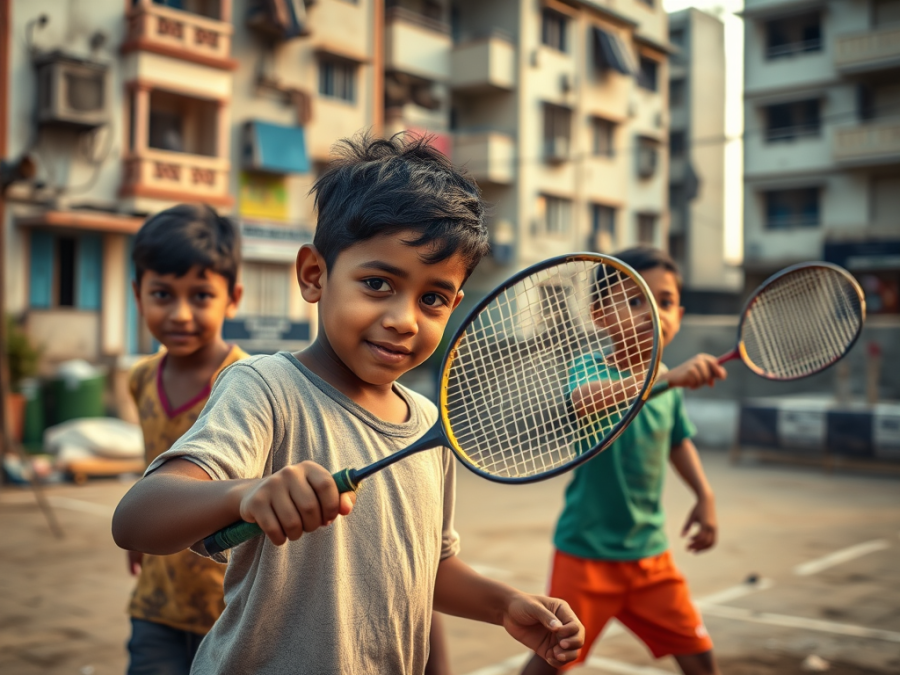
On a languid Sunday afternoon, cradling a cup of first flush Darjeeling in bone china, I found myself observing a small group of children playing near the car park of our apartment complex in Ranchi. Their makeshift badminton court—a nylon rope strung between two iron poles, racquets whose grips had long surrendered to the wear of time, and shuttlecocks frayed from countless street skirmishes—was a study in contrasts. The simplicity of their setup stood in stark contrast to the joy they exuded, their focus absolute, their laughter unrestrained.
It was a scene that tugged at something deep within me, a quiet nudge across time, transporting me to an India of yesteryears, to moments when my younger self, too, had reveled in the rhythm of shuttlecock and racquet. I was back in the crisp winter mornings of Aligarh, or in the rain-washed evenings of Delhi, where the air would come alive with the rhythmic “thwack” of shuttle meeting racquet—sounds that tied memory, motion, and meaning together.
In that moment, it struck me: the shuttlecock had flown across centuries, through empires and civilisations, to be here, in this humble lane. Badminton, as we know it today, is far more than a modern sport. It is an ancient rhythm—rediscovered, redefined, and passed down, feather by feather, swing by swing.
Long before carbon-fiber racquets and plastic grips, humans were already enchanted by the idea of defying gravity. In ancient China, there existed a game known as Ti Jian Zi, where players kept a shuttle-like object airborne, using only their feet. In ancient Greece, both children and adults played with feathered shuttlecocks, volleying them with their hands or simple paddles. It was simple, beautiful, and universal.
In India, games resembling badminton—battledore and shuttlecock—were a part of festive gatherings, village celebrations, and family reunions. These shuttle games did not demand elaborate equipment or spaces; they were often played in courtyards, under the shade of banyan trees, or even within the confines of large halls. The shuttlecock, crafted from bird feathers and a cork base, had a natural elegance to it, its flight a perfect blend of precision and poetry.
These ancient games weren’t badminton in its modern sense, but they were its soul ancestors—whispers from the past, carried across time, geography, and culture.
The Game Called Poona: A Colonial Seed
In the mid-1800s, British officers stationed in Poona (now Pune) discovered an engaging local game. This version of shuttlecock involved racquets, though it often lacked the net, but it was captivating enough to catch the attention of the officers. With a few tweaks, they introduced a defining element—a net—and thus, an informal pastime was transformed into a structured competitive sport.
The game was named “Poona,” after the cantonment town, and it quickly became a favorite pastime in British officer clubs, drawing rooms, and mess halls. The officers, always eager to carry a slice of India back home, took the game with them to England, just as they did with curry recipes, carpets, and rosewood chairs.
In England, the game found its true identity in 1873, at the grand Badminton House, the country estate of the Duke of Beaufort in Gloucestershire. It was at a garden party, amidst the stately grounds, that Poona was introduced to British high society. The game was an instant hit.
Thus, the name “Badminton” was born—christened after the Duke’s estate. Soon after, in 1877, the Bath Badminton Club codified the first official rules, and the game began its journey towards global recognition. The British Empire, with its far-reaching influence, became badminton’s first great theatre. From the English countryside to the clubhouses of Kuala Lumpur, Rangoon, Singapore, and back to India—its spiritual home—the game travelled.
Don’t be deceived by the featherweight shuttlecock. In elite play, it can reach speeds of over 330 km/h, making badminton the fastest racquet sport in the world. But it’s not just about speed.
Badminton is a sport of strategy, geometry, and rhythm. It demands anticipation, a keen sense of timing, and a meditative focus. Every drop shot, every disguised flick serve, and every lunging retrieval is part of an unspoken opera performed within the confines of a court. It is both art and sport, played in silence but felt in every movement.
What makes badminton even more fascinating is its gender neutrality. Whether it’s PV Sindhu soaring across the court with her graceful elegance or Viktor Axelsen smashing with precision, the thrill remains equally electrifying. In the dance of shuttle and racquet, gender doesn’t matter—only the game.
For many years, Indian badminton remained confined to local club circuits and a handful of national tournaments. But the sport began to change with the arrival of two golden names: Prakash Padukone and Pullela Gopichand.
In 1980, Padukone stunned the world by winning the prestigious All England Championship, bringing India its first major international badminton title. His grace, humility, and sportsmanship became the hallmark of his career, inspiring countless young players to pick up the racquet.
Then came Pullela Gopichand, who repeated Padukone’s triumph by winning the All England in 2001. But his legacy isn’t just in his victories; through his Hyderabad-based academy, Gopichand has mentored a new generation of players, ensuring that India’s shuttle destiny remains bright.
Today, India is a global powerhouse in badminton, with stars like:
- Saina Nehwal, the first Indian to top the BWF rankings and an Olympic bronze medalist.
- PV Sindhu, an Olympic silver and bronze medalist, World Champion, and one of the sport’s most recognisable faces.
- Kidambi Srikanth, HS Prannoy, Lakshya Sen, and the dynamic Satwik-Chirag in men’s doubles.
India is now a force to be reckoned with on the world stage, competing fiercely against traditional badminton giants like China, Indonesia, Japan, and Denmark.
What sets badminton apart in India is its accessibility. Unlike cricket, which requires vast fields, or tennis, with its expensive gear, badminton needs little more than a small space, a net, and some light. Whether on urban rooftops or village fields, the game has embedded itself in the rhythm of Indian life. It’s played on school playgrounds, in community halls, and in narrow lanes. It keeps children away from screens, fosters friendships, and builds physical fitness.
From the crowded bylanes of Kolkata to the wide-open spaces of Jamshedpur, from the northern reaches of Baramulla to the southern corners of Bengaluru, badminton courts light up every evening, making it a true sport of the people.
Since becoming an Olympic sport in 1992, badminton has gained prominence across Asia. Countries like China, Indonesia, Japan, Korea, and Denmark continue to dominate, but India’s meteoric rise has added new excitement to the sport.
National pride often intertwines with geopolitics on the court. The fierce rivalries between Indonesia, China, Malaysia, and India are charged with emotion and history. Meanwhile, prestigious tournaments like the BWF World Tour, the Thomas and Uber Cups, and the Sudirman Cup ensure that badminton remains a year-round spectacle, attracting sponsorships, global viewership, and a significant fan base.
Looking back on the years spent on badminton courts—whether in the energetic, competitive environment of Hansraj College, Delhi University, where I had the privilege of sparring with national champions like Vikram Singh, Anup Narang, and Anup Sethi or on the sunlit grounds of Aligarh, where I introduced colleagues to the game’s quiet elegance—I’ve come to see that badminton has always been more than just a sport for me.
Though it’s been decades since I last played, thanks to the demands of professional life and family commitments, my love for the game remains undiminished. It’s a bond that time and circumstances haven’t quite been able to erase.
It’s ancient yet modern, elite yet egalitarian. Badminton bridges cultures, shatters hierarchies, and returns us to the most human of instincts: the joy of play. So, the next time you see a shuttlecock soar into the air—whether on a dusty Kolkata lane or under the bright lights of the Olympics—know this: you’re witnessing a saga that began centuries ago, in temple courtyards and royal halls.
It’s not just a game. It’s a story in flight.

This article sheds fascinating light on the origins of badminton, tracing its roots back to the game of Poona. It’s truly remarkable to consider how a recreational pastime played in 19th-century India evolved into the dynamic and globally popular sport we know today. The transition from Poona to modern badminton highlights a compelling example of cultural exchange and sporting innovation.
LikeLiked by 1 person
Thanks, Gyan. The evolution of the sport is a brilliant example of how cultural interactions can give rise to global phenomena. Much appreciated!
LikeLike
The story blends personal memory with rich history, tracing badminton’s journey from ancient games to a global sport. It highlights the game’s cultural roots, technical artistry, and its role as a community connector in India, celebrating both elite champions and everyday players. It’s not just a history or a commentary—it’s a love letter to badminton. The storytelling is immersive, poetic, and full of admiration for both the sport and the spirit behind it. 🙏🏽🙏🏽
LikeLiked by 1 person
Thanks a lot for your lovely comment. Beautifully said! It’s more than a game; it’s a celebration of passion, culture, and community. 🙏
LikeLike
Interesting to know that the current version of badminton has its origins in Poona. As you rightly said, it is one of the few reasonably gender-neutral physical sports. My parents talked about playing badminton together in the early days after their marriage. In my generation I know of at least two people whose love-story started across the badminton net.
LikeLiked by 1 person
Badminton’s mix of fun and competition has created lasting bonds and love stories across generations, showing how shared activities build strong connections. The fact that your parents played together in the early days of their marriage speaks volumes about the role of simple activities in building lasting bonds.
LikeLike
I really did not know Badminton had humble roots in our colonial India.
LikeLiked by 1 person
Surprisingly, we have gifted many things to the world, but we are unaware of. It’s time we should start taking pride in our heritage.
LikeLiked by 1 person
Yes, true.
LikeLiked by 1 person