
Intro
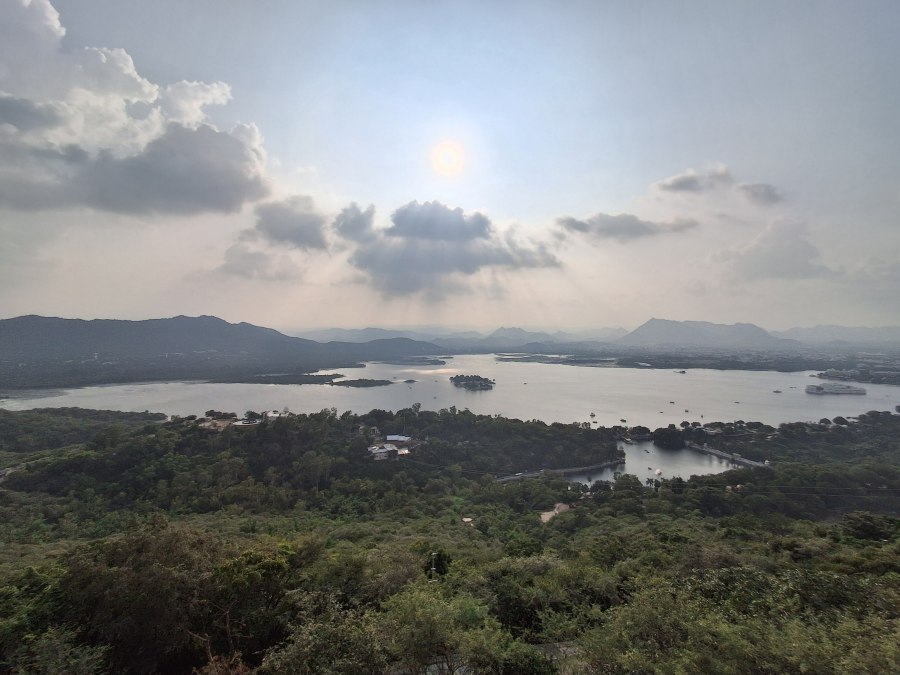
Every city has its heights, and in Udaipur, they lead you above the lakes to a hill crowned by a goddess. That evening, as the monsoon clouds parted and the sun dipped low, we found ourselves suspended in a ropeway cabin — watching the City of Lakes unfold in golden light.
The Ropeway Surprise
By evening, we made our way to Machla Magra Hill, home to the Karni Mata Temple. I had long heard about this place—some said the view was best in daylight, others swore it was magical at night, and still others recommended sunset as the perfect balance. So I had made up my mind to experience all three—day, dusk, and night. By God’s grace, we reached the base of the hill by 4:00 PM, which turned out to be perfect.

At the counter, we purchased tickets—₹660 for a two-way ropeway journey, with an added entry to something called a 3D Photo Museum. I was skeptical; in all my research, this attraction had never come up. But my wife, ever curious, insisted: “Ab aaye hain toh dekh lete hain” — “Now that we’re here, let’s see it.” I didn’t argue, and later I would realize how right she was.
The 3D Photo Museum
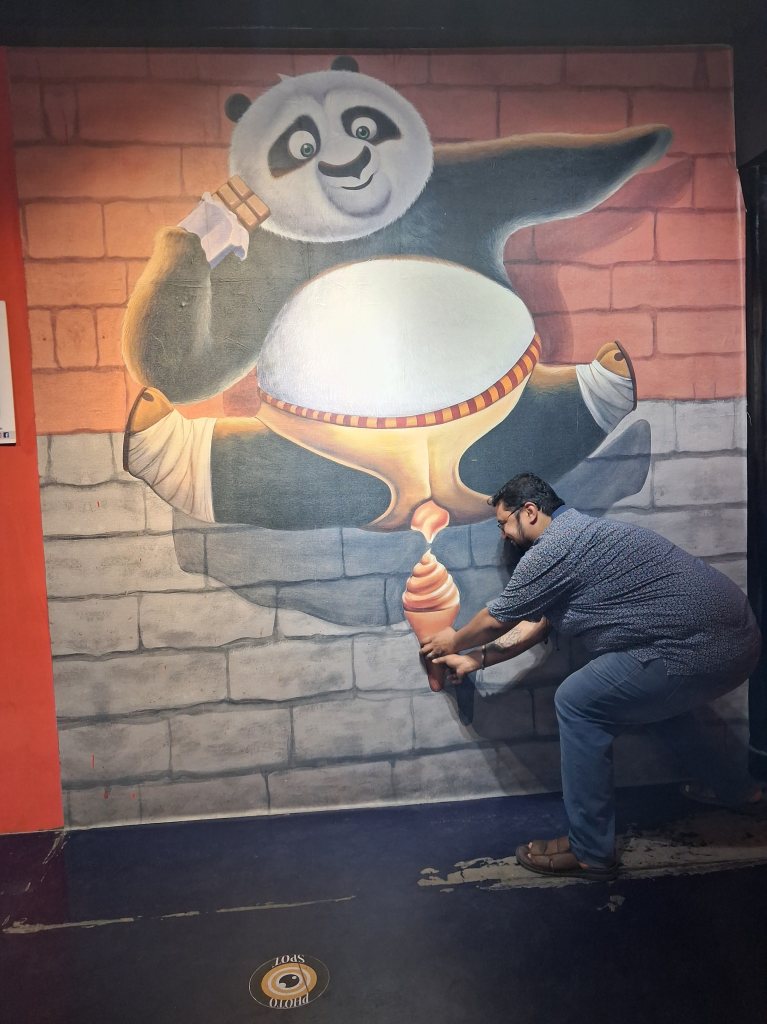
Inside, the walls came alive with beautifully painted, hyper-realistic murals. At first, we simply admired them as artworks. But soon, an attendant explained the real purpose: when posed correctly and photographed from a certain angle, the images transformed into illusions, making it appear as if we were part of the scene itself.


We laughed as we posed. There were two such rooms, and in each, we took turns photographing one another. It was playful, almost childlike fun, and to our surprise, it became one of the most memorable parts of the day.


Rising Above the City
Afterwards, we descended another floor, where the ropeway station itself was located. Here too, the management had been clever: ring-throwing games, small stalls, and shops filled the waiting area, ensuring tourists never grew impatient. Soon, three ropeway cars slid into the station, and as our turn arrived, we were given a private cabin—just the two of us, suspended in the air, about to rise above the City of Lakes.
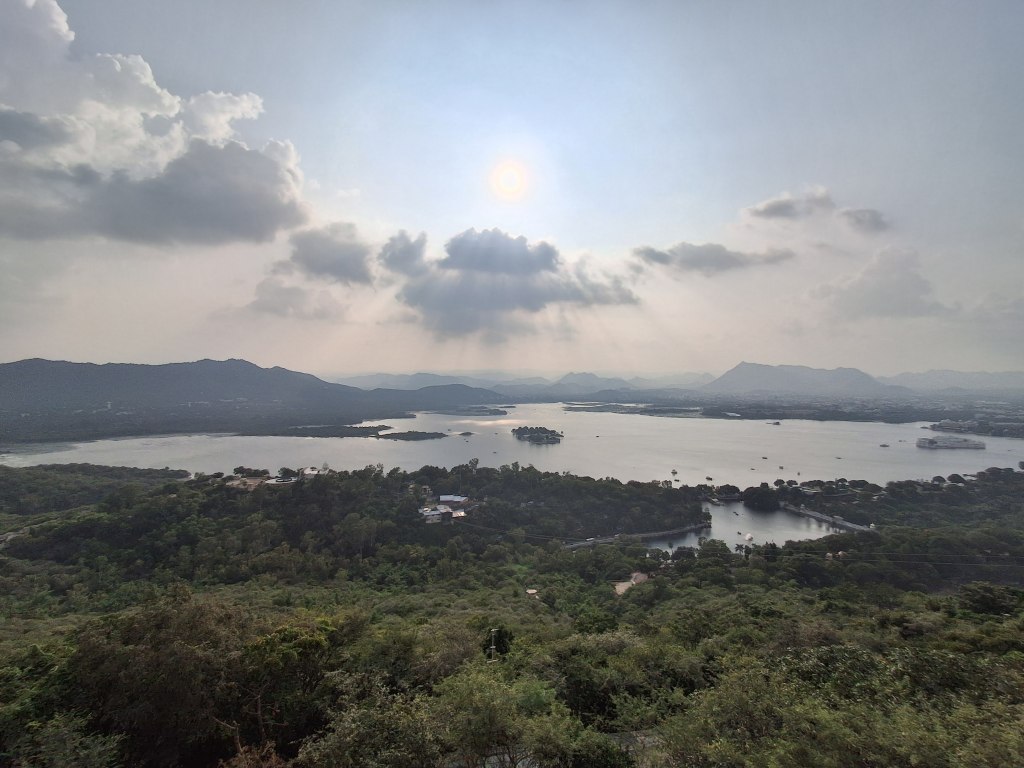
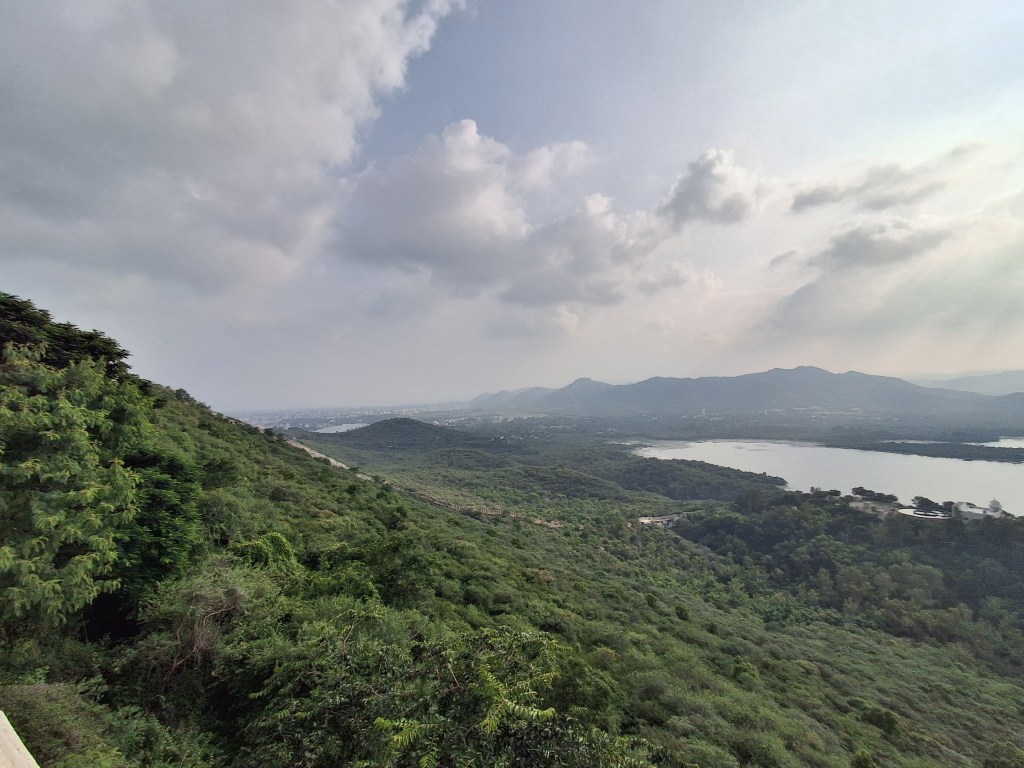
The ride up began with a gentle jolt, and suddenly we were suspended over the hillside. It had been nearly a decade since I last sat in a ropeway cabin, and the sense of childlike excitement returned instantly. Below us stretched a green patchwork of jungle and rocky slopes, while ahead, the great sweep of Lake Pichola opened in all its glory.

Sunlight shimmered on the lake’s wide expanse, turning the water into molten silver. From above, the islands revealed themselves in their full form—Jag Mandir, once a royal retreat and later a refuge for Emperor Shah Jahan before he built the Taj Mahal, and the Lake Palace, now a luxury hotel, floating dreamlike in the middle of the water. Along the lake’s edge rose the monumental City Palace, its sprawling courtyards and balconies gleaming in the afternoon light.
At the Hilltop Shrine
At the top, we stepped out and walked towards the Karni Mata Temple, the shrine that crowns Machla Magra Hill. The temple itself was modest—painted white, quiet, and serene. Inside the compound stood a small shrine dedicated to Karni Mata, revered as a 14th–15th century mystic saint and the kuldevi (family goddess) of the Rathore clan of Marwar.
Next to her shrine was a simple Shiva lingam, where devotees stopped to offer prayers. What surprised me, though, was the absence of mice. Unlike the famous Karni Mata Temple at Deshnok near Bikaner—where thousands of holy rats, believed to be her incarnated devotees, scurry about—here, there were none. The shrine stood in quiet solitude, stripped of legend but heavy with presence.
A View Worth Every Step
From the temple terrace, the view expanded again. Udaipur lay spread beneath us—Lake Pichola glowing in the golden light, palaces gleaming, forests breathing softly below. Standing there, it felt as if the city itself was offering its story, written across stone, water, and sky.
As we circled around, we noticed a narrow path behind the temple, surprisingly empty of visitors. Curiosity led us along it, and after a short walk we arrived at the mazhār of Top Wale Baba. Inside sat a maulvi, quietly attending to the shrine. He explained that Top Wale Baba had once been the commander of cannons for the Mewar rulers—his title, tope wale, meaning “master of cannons.” In life, he had defended the fortresses and palaces of Udaipur; in death, his resting place shared the hilltop with the saint. It struck me as a living symbol of harmony—Hindu temple and Muslim shrine side by side, united in quiet reverence.
The sunset was unforgettable. From the terrace, we watched the sun dip behind the Aravallis, its golden light rippling across Lake Pichola. Boats looked like toy specks in the water, palaces glowed like lanterns, and peacocks called from the forest below. With Maggi, gola, and lime soda in hand, we sat in silence, soaking it all in.


The return ropeway reminded me of just how well-planned the business model was. The station was lined with shops, gaming zones, eateries, even a fish pedicure stall. The route was designed so visitors couldn’t skip past temptations—cleverly ensuring that everyone left with not just memories, but lighter wallets too. My wife and I were both impressed—it was tourism strategy at its best.
Outro / Teaser
With sunset fading into night, we descended again towards the city. The lakes still shimmered, but now the bells of Jagdish Temple were calling, and the narrow lanes of the old city awaited us with light, music, and devotion.

A beautifully written travelogue! You’ve captured not just the sights but also the emotions—the playful fun of the 3D museum, the serenity of Karni Mata Temple, the surprising harmony of Top Wale Baba’s shrine, and the magic of the sunset over Lake Pichola. It feels like I was right there with you, riding the ropeway and soaking in Udaipur’s charm.
LikeLiked by 1 person
I wish someday soon we can enjoy it or similar together.
LikeLiked by 1 person
Nice engaging travelogue featuring a collection of short trip stories, each capturing unique experiences like a series of travel snapshots.
LikeLiked by 1 person
Thank you ma’am.
I attempted to make it more like a story and personal experience rather than a fact based bulletin notes.
I thought sharing my experience could bring more clarity of what to expect.
I hope you stay for the complete series.
LikeLike
Oh! What a thrilling ropeway ascent to the Karni Mata temple and Tope Wale Baba. Lesser known places have hidden charm. The 3D Museum was awesome!!
LikeLiked by 2 people
Yes mam. It was entertaining. I have come to know that there are more Museums as such in different tourist places in India. I wish you can enjoy one someday.
LikeLiked by 1 person