

Intro
If the ropeway had given us Udaipur from above, the old city gave it to us up close — the sound of bells, the press of devotees, and the shimmer of lamps on the lake. That evening, Udaipur revealed its heartbeat through temples and streets alive with devotion and food.
Jagdish Temple — Evening Aarti
As we rode deeper into the old city, the faint sound of bells and voices reached us—rhythmic, rising and falling. Drawn by the sound, we stopped and found ourselves before the grand steps of the Jagdish Temple.
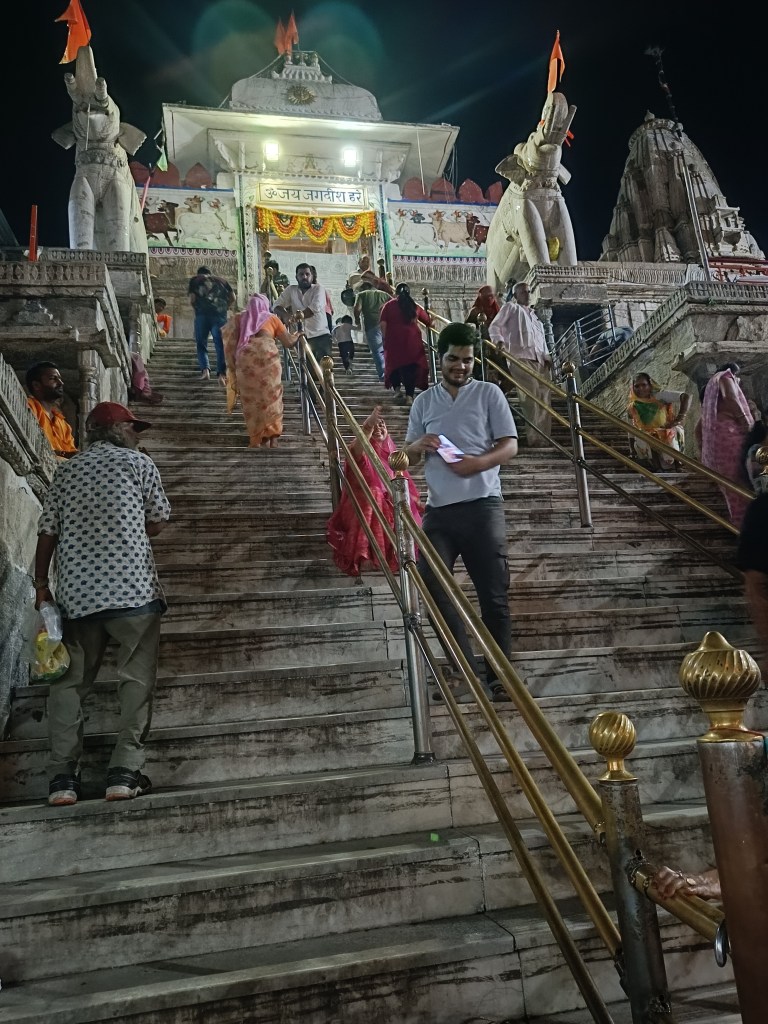
Built in 1651 CE by Maharana Jagat Singh I, this temple is one of Udaipur’s most revered landmarks. Dedicated to Lord Vishnu in his form as Jagannath, the preserver of the universe, it was constructed in the Indo-Aryan style of architecture. Its shikhara rises nearly 79 feet, visible from afar, covered with elaborate carvings of dancers, elephants, deities, and divine figures.
We climbed the steep flight of marble stairs, joining the stream of devotees. At the entrance, just before the sanctum, stood the idol of Garuda, Vishnu’s celestial mount, his wings folded in eternal service. A long queue wound from the sanctum to Garuda’s shrine, devotees swaying in rhythm as the evening aarti had begun.
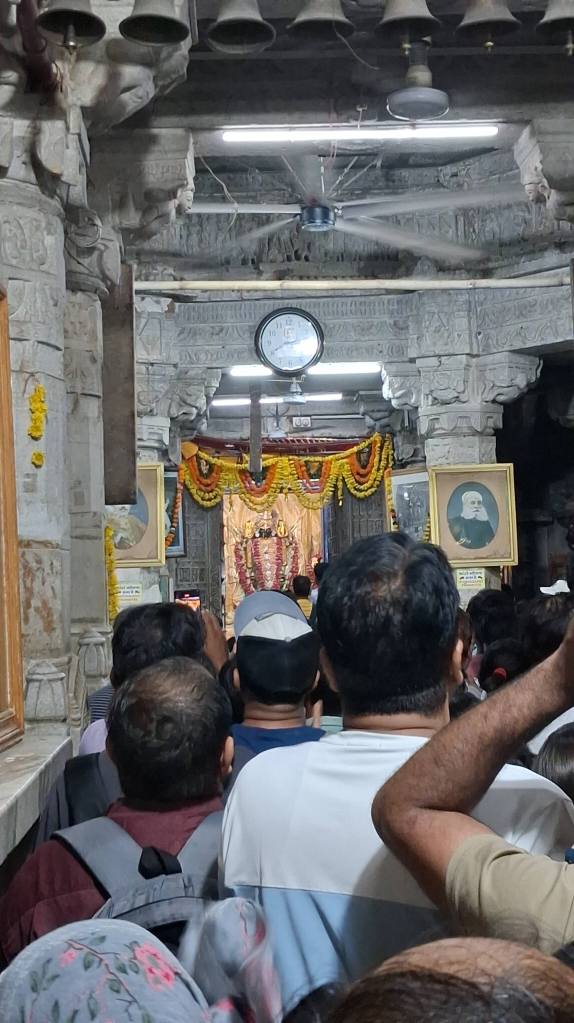
We joined the line, the air filled with the ringing of bells and the chorus of bhajans. The sanctum glowed with the light of countless diyas, the idol of Lord Vishnu radiating majesty and grace. Having felt the sting of disappointment earlier at Eklingji’s closed doors, it felt almost providential to stand here now, witnessing the aarti in full swing. Truly, God works in mysterious ways.
Mahalaxmi Temple — A Complete Blessing
Afterward, we wandered around the temple compound. Smaller shrines stood dedicated to Shiva, Ganesh, Surya, and Goddess Shakti, each adorned with their own carvings and lamps. We lingered for a while before stepping back into the night air.
As we descended, my wife reminded me of another shrine we had passed earlier—the Mahalaxmi Temple. “If we have offered prayers to Lord Vishnu,” she said, “we must also worship Mahalaxmi, his consort. Visiting both together is always auspicious.” I agreed, and so we walked on foot through the narrow lane until we reached the temple.
The Mahalaxmi Temple was far smaller and more modest than Jagdish, yet no less revered. Its architecture bore hints of the South Indian style, unusual in Udaipur, with gopuram-like features marking its facade. Inside, the goddess of wealth and prosperity sat in quiet dignity, worshipped daily by locals seeking blessings for their homes and businesses. We offered our prayers and sat for a few moments in the peaceful sanctum.
The Dinner Hunt — From Hype to Hidden Charm
By the time we left the Mahalaxmi Temple, night had settled fully over Udaipur. Shops were closing, vendors were packing up, and the clatter of shutters echoed down the lanes. But hunger was back, and it led us on a search.
Our first stop was Ambrai, famed for its postcard-perfect views of the City Palace and Jag Mandir glowing across Lake Pichola. Reviews had called it the place to dine in Udaipur. But when we arrived, reality greeted us—seventeen couples already waiting ahead. A seat tonight was impossible.
Undeterred, we tried our luck at Upré by 1559 AD, another renowned rooftop restaurant overlooking the lake. Its exclusivity was evident immediately—entry strictly by reservation only. With no prior booking, we didn’t even make it past the gate.
What surprised us, however, was the sheer energy in the old city. Even in the so-called “off-season” of the monsoon, Udaipur’s streets were buzzing with tourists. Cafés spilled warm light into the alleys, vendors sold trinkets, and restaurants brimmed with chatter. It struck me then that this city had truly become an all-season destination.
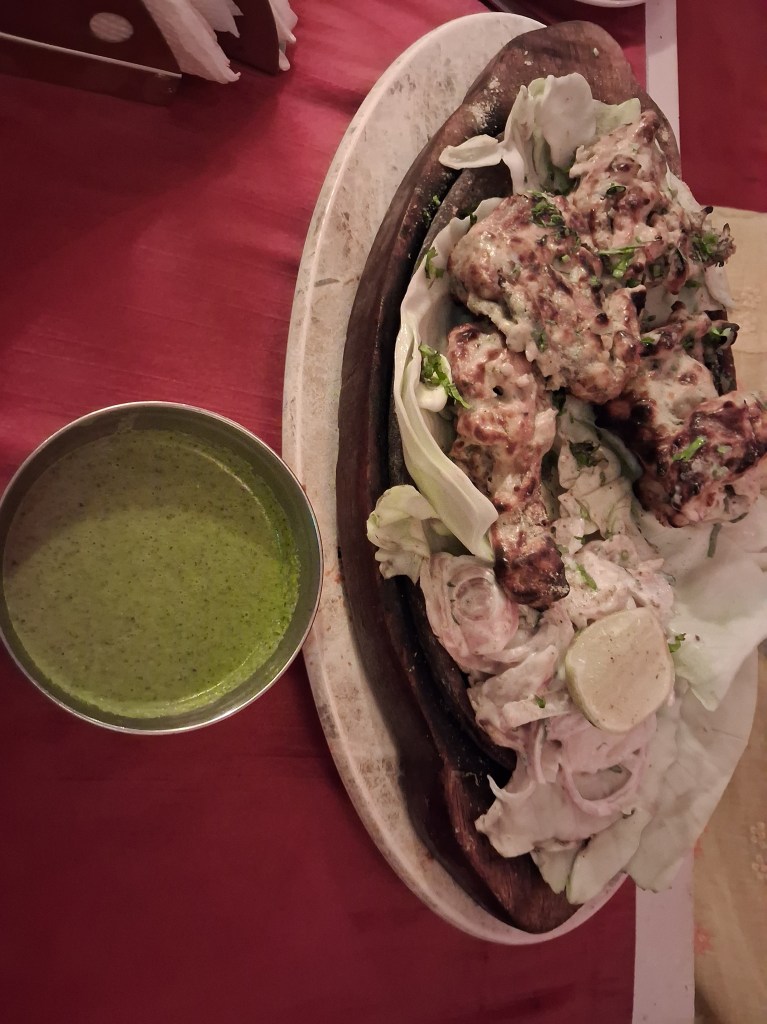
Finally, almost by chance, we wandered into Hari Garh Restaurant, tucked near the lakeside. To our surprise, it too was packed. Luck, however, favored us—we managed to secure a low baithak-style seat, close to the water. Cushions, low tables, and the soft glow of candle lamps created a cozy, almost royal atmosphere. The reflection of lights on Lake Pichola shimmered beside us, making the wait feel less like an inconvenience and more like part of the experience.
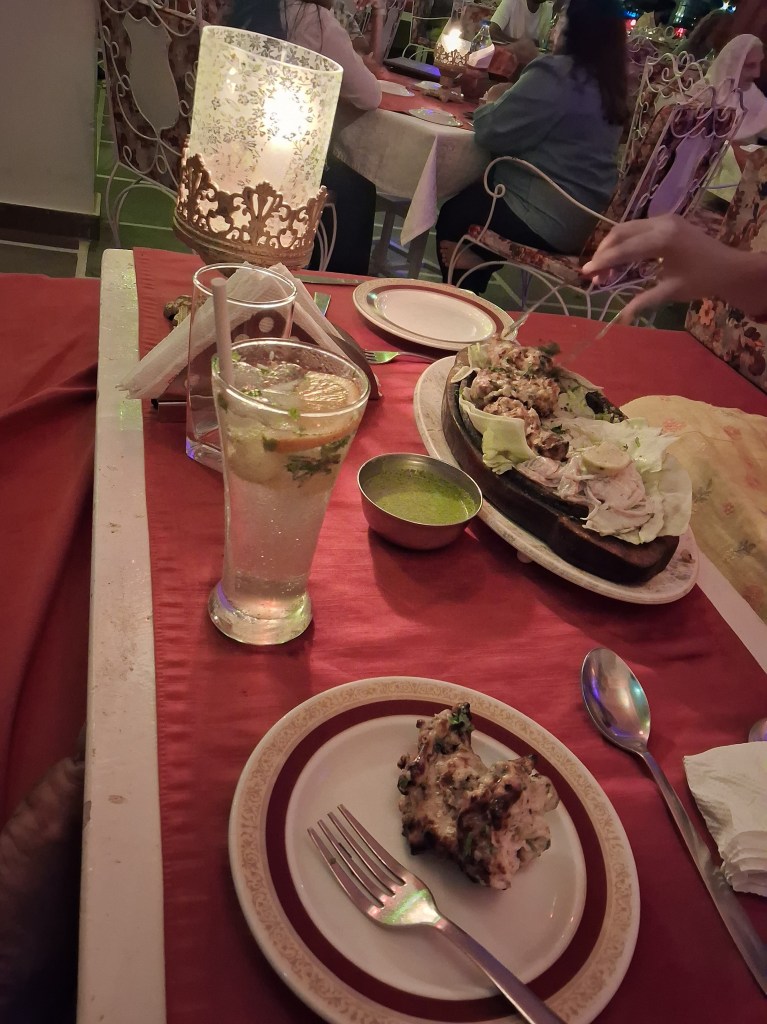
Service was understandably slow with such a crowd. At one point, growing restless, I suggested we leave and try somewhere else. But my wife, patient and firm, insisted: “Let’s wait. The place feels right.” I yielded, and soon enough, the food arrived—virgin mojitos, chicken afghani, naan with tikka masala, and malai kofta. Each dish was rich and flavorful, made better by the setting and our hunger.
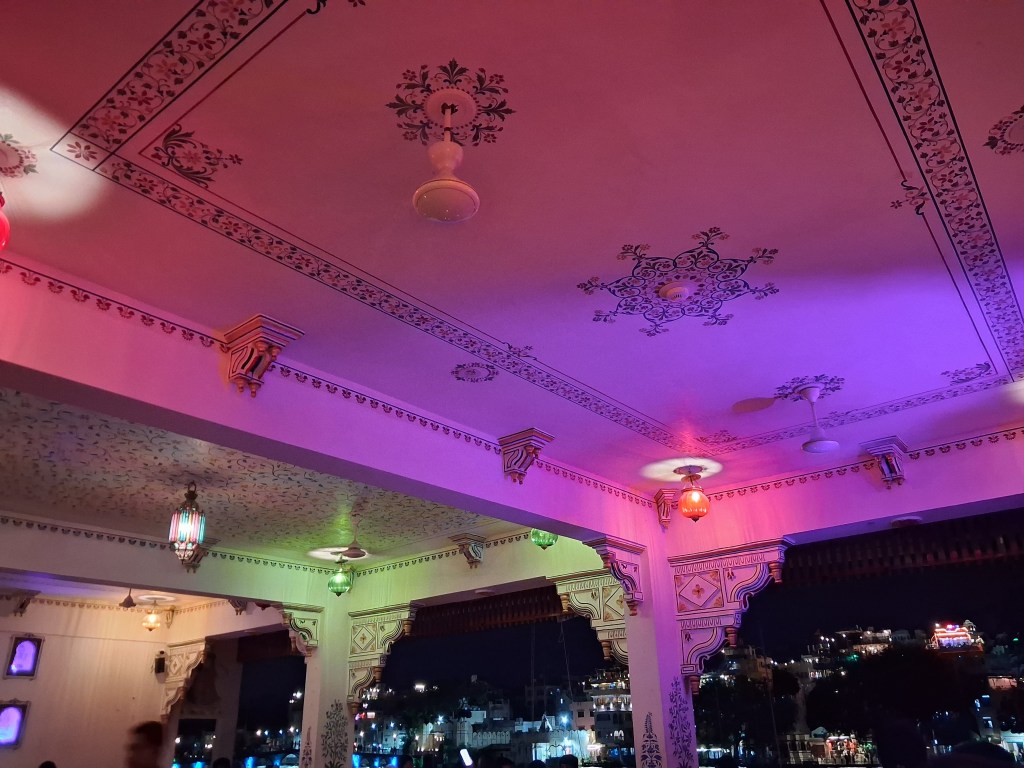
Hari Garh may not carry the hype of Ambrai or the exclusivity of Upré, but that night it gave us exactly what we needed: good food, a lively crowd, and the quiet magic of dining by the lake under candlelight.
The Quiet Streets at Night
Dinner left us content and a little drowsy, but the night still had one last gift to offer. As we rode back through the old city, the streets had emptied, shutters pulled down, and the bustle of the day replaced by silence. We passed through Hathi Pole and Chand Pole, landmarks that had been crowded and chaotic earlier, now standing in complete solitude.
Circling around them at night, with only the hum of the Hunter beneath us and the occasional bark of a stray dog in the distance, felt strangely calming—as if the city was showing us a quieter, more intimate face.
From there, we rode slowly back towards our hotel. The streets grew wider, the traffic sparser, until at last the familiar gates of Jagat Hotel appeared. By the time we entered our room, the day’s adventures had caught up with us in full. We changed into our night clothes, sank into bed, and were asleep almost instantly—our minds still replaying temples, rains, sunsets, and songs from a day that had given us everything we had hoped for and more.
Outro / Teaser
The old city had pulsed with devotion and flavor, but one temple still awaited us. The next morning, we would return to Eklingji — this time determined not to leave without darshan.

Such a beautiful narrative! You’ve captured the rhythm of Udaipur perfectly—from the spiritual aura of Jagdish and Mahalaxmi temples to the lively chaos of hunting for dinner in the old city. The contrast between divine calm and buzzing streets makes the post feel alive. Loved how Hari Garh turned into the unexpected highlight—it felt like a blessing in disguise, much like the aarti itself.
LikeLiked by 1 person
Thank you dad.
HARI GARH was like a silver lining , a true hidden gem.
LikeLiked by 1 person
Thank you
LikeLiked by 1 person
Your nocturnal hunts prove that God really has different propositions for each one of us. Very well narrated.
LikeLiked by 1 person
Thank you mam. God does works in mysterious ways.
LikeLike