

Intro
Some temples you plan to see, and some temples call you back until you do. Eklingji was one such. Denied entry the first time by monsoon rains and strict temple hours, we returned the next morning with determination — and found not just darshan, but an experience that felt like grace itself.
The Early Start
Early in the morning, we rose with purpose. Skipping breakfast, we set out straight for Eklingji Temple, for my wife had firmly decided the day before that we would not miss it again. The skies had not relented—the familiar drizzle accompanied us, on and off, the whole way. Yet this time, determination carried us forward. We made no stops until the temple stood before us.
On the way, I teased my wife lightly: “Yesterday, Eklingji denied me darshan. Perhaps today He will not show Himself again.” It was only a joke, but as always, the Lord works in mysterious ways.
Entering the Temple
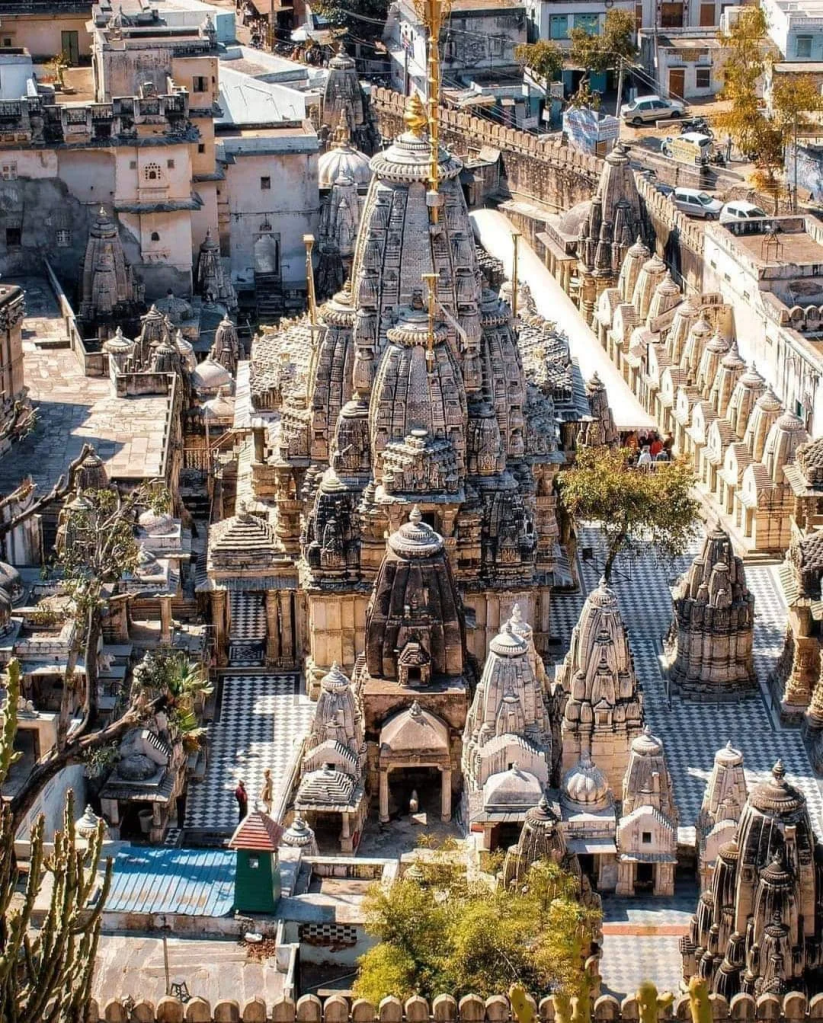
Before entering, we bought puja samagri from a shop, leaving behind our leather items, mobile phones, and footwear, as per temple rules. A light frisking followed before we were allowed entry. The discipline here was unmistakable—Eklingji is no ordinary public temple. For more than 1,200 years, it has been the private family temple of the Maharanas of Udaipur, the rulers of Mewar. The Sisodia dynasty has always considered themselves Diwan (regent) of Eklingji, while Lord Shiva, in the form of Eklingji, is regarded as the true Maharana of Mewar. The kings ruled only as His servants, bowing their crowns before Him.
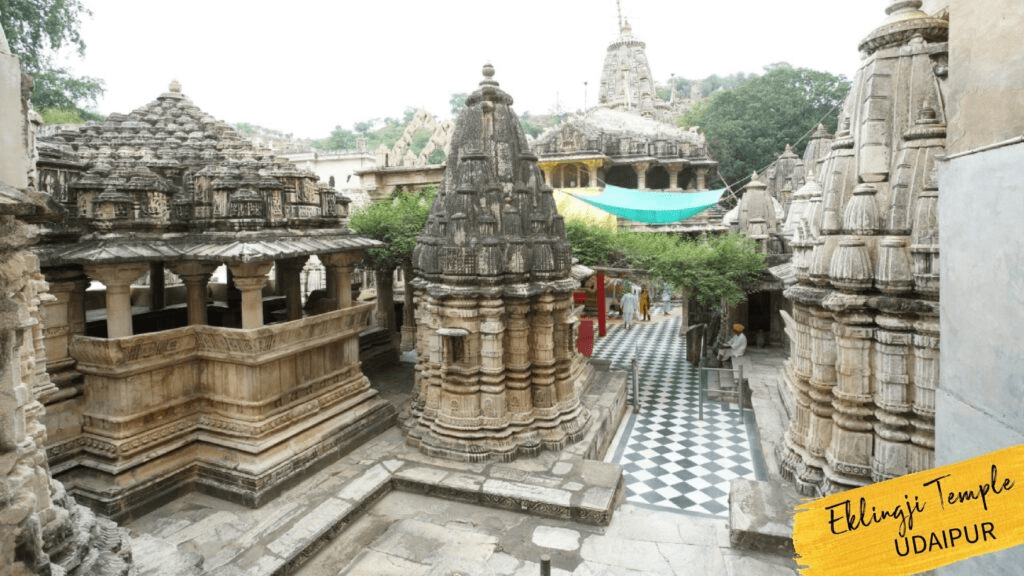
Passing through the main gate, we entered a vast courtyard, lined with shrines—over a hundred small and medium temples, each housing Shivlings of different sizes. Some shrines were dedicated to Parvati, Ganesha, Kartikeya, and even forms of Vishnu, for Eklingji is regarded as the cosmic protector of all Mewar. The air smelled of incense and wet stone, heavy with centuries of worship.
The Missed Glimpse
Following the line of devotees, we came before a shrine dedicated to Nandi, the sacred bull, standing solemn and majestic in front of the sanctum, his gaze eternally fixed on his Lord.
Past Nandi, we entered the sanctum of Eklingji Mahadev. There stood the magnificent four-faced lingam of Shiva, carved from black marble, each face gazing in a cardinal direction—symbolizing creation, preservation, destruction, and liberation. The idol, dating back to the 10th century, is said to embody Shiva’s role as the eternal protector of Mewar.
Inside, the atmosphere was thick with silence. I closed my eyes and slipped into dhyan, repeating jap softly. The queue moved slowly, but time itself seemed suspended. Without realizing it, I had drifted past the sanctum and stepped outside.
My wife looked at me, doubtful. “Did you see Him?” she asked. A chill ran down my spine—I hadn’t. My light words from earlier now felt like a curse.
A Second Chance
Desperate, I turned to her. “Let us enter again. Please.” At first, she scolded me for my careless tongue, but then, seeing my sincerity, she agreed.
This time, I entered humbled, apologetic. The crowd had thinned, as entry was being restricted for the upcoming aarti, and so I found myself before the deity longer than before. I gazed upon Him now—the four-faced Shiva, radiant and still, a presence that felt alive. I bowed deeply, grateful for the second chance.
We stayed inside for the aarti. Bells clanged, conches blew, and the flames of the lamps lit the sanctum in a golden glow. The priests chanted hymns that echoed against the stone, a tradition said to have continued unbroken for centuries. Watching the aarti within the sanctum itself felt like a blessing. I felt as though the Lord had not only forgiven my thoughtless words but embraced me with His grace.
Lingering in History
Afterward, we sat quietly in the courtyard, admiring the temple’s architecture. The original shrine, tradition says, was founded in the 8th century by Bappa Rawal, the legendary warrior-saint who established the Mewar dynasty after receiving Shiva’s blessings. Since then, each Rana of Mewar has served Eklingji faithfully, rebuilding and expanding the temple whenever invaders damaged it. The present complex, walled and fortified, holds over 108 shrines, each a whisper of devotion layered across generations.
Some areas were restricted, holding smaller lingams and shrines, their presence hidden from the public. Even from outside the barriers, the sense of sanctity lingered.
Satisfied and at peace, we finally exited the premises. Hunger now called us back to earth. Just outside, we found a stall serving mirchi bada and kachori, piping hot and crisp. Paired with tea, it was the perfect offering after such a spiritual morning.
Outro / Teaser
Eklingji had revealed Himself, and with His blessing, we were ready to face the grandeur of Udaipur’s royal heart — the City Palace.

A beautiful travelogue, rich with devotion and history. Your narration captures not just the grandeur of Eklingji but also the deeply personal, almost mystical experience of darshan and the second chance you received. The blend of legend, architecture, and your own emotions makes me feel I am walking beside you through the temple courtyards. The ending with mirchi bada and kachori is the perfect earthy touch after the spiritual high.
LikeLiked by 1 person
thank you very much for your appreciation
LikeLiked by 1 person
Thank you dad
LikeLiked by 1 person
Absolutely surreal.
LikeLiked by 1 person
Thank you
LikeLiked by 1 person