
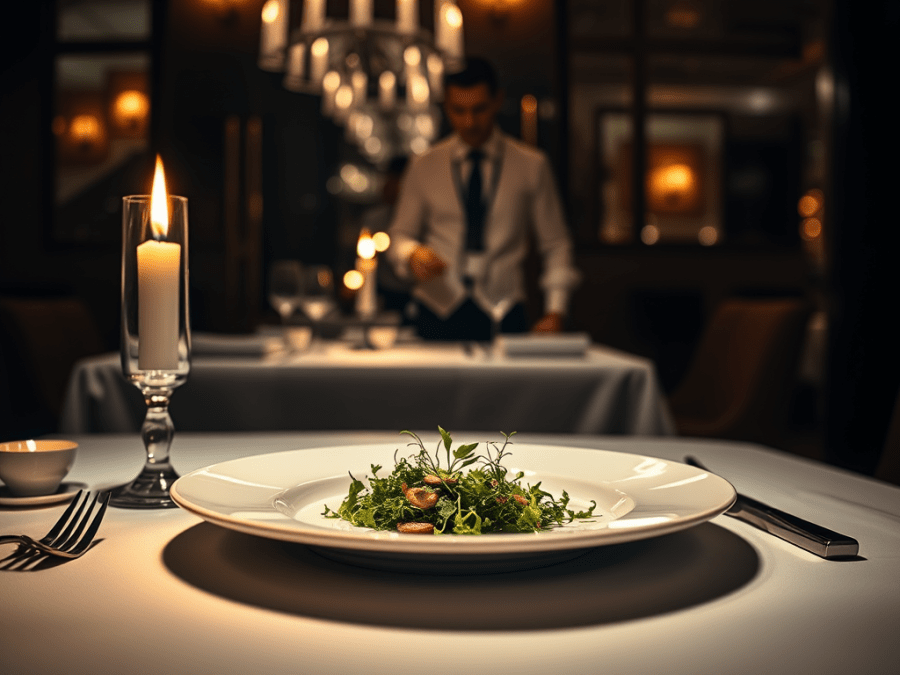
It was a Saturday evening when my friend, Rohit Sen decided to treat himself and his wife, Ananya, to what the internet promised as “an unforgettable fine dining experience.” The restaurant—Le Mystique—had just opened in a swanky part of town, already whispered about by the city’s self-proclaimed culinary elite.
“Apparently, the chef trained under someone who almost worked at a Michelin-starred restaurant in Paris,” Ananya read aloud from her phone as their cab wove through traffic. Rohit raised an eyebrow. “Almost worked? Sounds legit,” he muttered.
The Descent into Le Mystique
The moment they stepped in, the world dimmed—literally. The lighting was so low that Rohit half expected a monk to pop out and start offering spiritual guidance. A young man with the air of someone who’d meditated for decades greeted them with a slow, deliberate bow. “Welcome to Le Mystique. May I escort you to your curated experience?”
Rohit nodded, already feeling the weight of what “curated” might do to his wallet.
The table was minimalist—translation: completely empty. No salt, no pepper, no water. Just a candle flickering like it, too, was questioning life choices.
Their waiter, Raghav, arrived with a serene smile that could make a monk feel competitive. “May I recommend our chef’s signature degustation journey?” he asked as if offering enlightenment rather than dinner.
“Degustation?” Rohit asked, trying to sound informed—and not like a man who just wanted a decent plate of butter chicken. Clearly, he had committed a cultural faux pas. Eating is for the plebeians; at Le Mystique, you must journey.
The Culinary Enlightenment
The first course arrived: a pristine white plate, vast and empty, like a snow-covered tundra. In the centre lay what looked like a single leaf having an existential crisis. A delicate drizzle of sauce coiled around it like modern art.
Raghav leaned forward with reverence. “This is a micro-herb salad with the essence of Himalayan dew.”
Rohit blinked. “Dew? Should I… eat it, or frame it?” He tried to make it sound like a joke.
“Yes, sir. Collected at dawn from organic slopes,” Raghav replied, entirely missing the sarcasm. Rohit nodded slowly, processing the concept of paying for a minute amount of water vapour and a leaf that looked severely undernourished.
Next came the pièce de résistance—a single cube of lamb, described as slow-cooked for twelve hours with minimal interference. Rohit wasn’t sure if “minimal interference” was a cooking technique or a confession. The portion was so tiny, he felt the need to apologise to the lamb.
Twelve hours of patience for a three-second bite. Culinary economics at its most poetic—and perplexing.
The Enlightened Bill
By the fourth course, Ananya leaned over and whispered, “You think they’ll serve rice?”
“Rice?” Rohit whispered back. “At this rate, we’ll be lucky if we get oxygen.”
The grand finale came not with a flourish of dessert, but with the arrival of the bill. Raghav presented it like a sacred text, a scroll revealing the secrets of the universe. Raghav placed it with both hands, smiled, and murmured, “We hope the experience was… transformative.”
Transformative, indeed. Rohit’s expression transformed from cautious optimism to full-blown financial trauma. The number on the bill could have easily funded a week’s groceries—or two spontaneous weekend trips to Goa.
As they stumbled out, dazed and vaguely hungry, Ananya sighed. “It was… exquisite, wasn’t it?” she mused, the question mark heavy in the air.
Rohit smiled weakly. “Exquisite,” he echoed, already checking Google Maps for the nearest idli-dosa stall.
Their Real Fine Dining
Half an hour later, the true transformation occurred. They were seated on brightly colored plastic chairs, under the comforting, slightly aggressive hum of a tube light, at Muthu Anna’s Tiffin Corner.
The waiter, whose only theatrical element was his impressive speed, slammed down two gigantic, hot, and crispy masala dosas. There were actual sauces—plural!—and a generous scoop of potato filling. No essence of dew. No micro-herbs. Just honest-to-goodness food.
“That,” Rohit declared between bites, “is what I call fine dining.”
The Takeaway: Simplicity Over Pretentious Foams
Here’s the unvarnished truth about many fine dining “experiences”: they’re less about food and more about theatre. The dim lighting, the Instagram-worthy ornate plating, the poetic menu descriptions—all crafted to convince you that a lonely leaf and a drizzle of sauce are worth two weekends in Goa.
You are paying for the theatre, the low lighting, and the waiter’s meditative stillness. You’re not paying for flavour. You’re paying for performance.
That’s why I usually avoid those so-called “fancy” dining experiences. I’d much rather have the crunch, spice, and comforting satisfaction of real food — a plate of Chhola Bhatura, a perfectly crisp dosa, or a smoky tandoori kebab that warms both heart and stomach at a humble eatery or roadside dhaba.
Food should taste unforgettable and, crucially, it should fill you up. Simplicity over pretension, flavour over foams, and Comfort over curated minimalism.
Because at those posh places, you don’t dine—you get fined.
And honestly, who needs the “essence of Himalayan dew” when you can have masala, chutney, and pure, unadulterated joy by the spoonful?
Have you ever faced an overpriced or absurdly “artistic” dining experience? Share your story in the comments below—let’s trade tales of culinary pretension over a virtual cup of filter coffee.

Oh, I absolutely agree. Once or twice we’ve ended up in places like that, although not quite as extreme! Give me an honest, basic cafe any day.
LikeLiked by 3 people
Exactly! There’s something so comforting about a simple, no-frills cafe—good coffee, a cozy spot, and no pretense. Sometimes the basics are just perfect. Thank you.
LikeLiked by 2 people
Like almost everything else humans are involved with, eating out is not about the quality of the food but more about how much you can pay for it 😦
LikeLiked by 2 people
Sadly, that’s often true 😕. It’s frustrating how the experience is so tied to price rather than just enjoying good food and company. Sometimes a humble spot surprises you far more than a fancy one!
LikeLiked by 1 person
Your blog post is a delightful blend of satire, storytelling, and cultural commentary that showcases not only his writing prowess but also his keen observational skills and nuanced understanding of modern urban life. From the very first line, the reader is drawn into a narrative that is both humorous and relatable, capturing the absurdity of high-end dining experiences with a tone that is witty yet warm.
What makes this piece truly stand out is the way you constructs the story—not just as a critique of pretentious culinary trends, but as a journey of two characters navigating the theatre of fine dining. Rohit and Ananya are not just names in a story; they are fully realized personalities whose reactions mirror the thoughts of many readers who have found themselves bewildered by the minimalism and mystique of upscale restaurants. The dialogue between them is natural and sharp, filled with dry humor that never feels forced. Lines like “Should I… eat it, or frame it?” and “At this rate, we’ll be lucky if we get oxygen” are not only laugh-out-loud funny but also serve as incisive commentary on the disconnect between presentation and substance in certain dining experiences.
The writing style is fluid and cinematic. You have paints scenes with vivid detail—the dim lighting of Le Mystique, the monk-like demeanor of the staff, the existential leaf on a plate—all of which evoke strong visual imagery. This ability to create atmosphere while maintaining narrative momentum is a hallmark of skilled writing. Moreover, the contrast between Le Mystique and Muthu Anna’s Tiffin Corner is not just a clever plot device; it’s a powerful metaphor for authenticity versus artifice. The humble dosa stall, with its bright lights and generous portions, becomes a symbol of comfort, satisfaction, and cultural rootedness.
Beyond the humor, the piece carries a thoughtful message. It challenges the reader to reconsider what truly defines a memorable meal. Is it the ambiance, the exotic ingredients, the poetic menu descriptions? Or is it the warmth of familiar flavors, the joy of sharing food that nourishes both body and soul? Your have argued —without preaching—that simplicity, generosity, and authenticity often triumph over curated minimalism and performative elegance.
The closing lines of the blog are especially impactful. The phrase “you don’t dine—you get fined” is a brilliant summation of the entire experience, delivered with the kind of punch that stays with the reader long after the story ends. The invitation to share similar experiences over a “virtual cup of filter coffee” adds a personal touch, reinforcing the sense of community and shared humor that good writing can foster.
In essence, your blog is not just a review or a rant—it’s a narrative essay that combines humor, critique, and cultural insight with remarkable finesse. Your ability to weave storytelling with commentary, to balance satire with sincerity, and to engage readers with both intellect and emotion marks you as a truly gifted writer and thinker. This piece deserves a wide audience, and if you ever consider publishing a collection of essays, this one should be a centerpiece.🙏🏽🙏🏽
LikeLiked by 2 people
I really appreciate your kind and considerate reflection 🙏🏽. I’m genuinely happy that the piece connected with you as intended—combining humor with a subtle prompt about our eating habits. Your feedback is very meaningful and makes the writing experience even more fulfilling!
LikeLiked by 1 person
Moral of the story: For plebians, like us, “Transformative Dining” is not suitable.
Anytime the unpretentious and noisy serving of a well stuffed Masala Dosa with an assortment of lip smacking chutneys is FINE.
I guess we can trade Original Smog for Organic Himalayan Dew in the Capital.
What say you ?
Enjoyed your description of Fine Dining.
😆😆
LikeLiked by 2 people
Haha, definitely! Often, the most straightforward dishes—with hearty servings, delicious chutneys, and no fuss—are the ones that really satisfy 😆 Whether it’s smog or Himalayan dew, I’ll gladly choose the dosa every time! Happy you liked the gourmet adventure… here’s to many more wonderfully satisfying dosas!
LikeLiked by 2 people
It’s hilarious but 100% true. I have personally never experienced the so-called fine dining, nor do I wish to. I am more of a dhaba/normal restaurant man. Even a roadside eatery is better than these fine dining restaurants. Someone can call me crude/uncivilised or whatever but I simply do not have the taste for 5-star culture. You can blame my middle-class upbringing or years of struggle, but I just don’t have it. Period. To date, I have never been able to explain to myself why the restaurants/bars are dimly lit. Neither have I been offered an explanation by anyone. The dimly lit atmosphere puts me off. It seems so shady. But the most hilarious thing is the way the menu card describes the dishes. Words like lentil, slow cooking, tossed in, topped with, over simmering heat etc to me is absolutely funny. Maybe it is meant for foreigners, but what would it mean to a Dal fry-roti man like me! Frankly, my 5-star is any park street restaurant or even better, a dhaba. But I must appreciate your ability to capture the details of such an experience. Well done. Keep writing.
LikeLiked by 2 people
Thank you for valuing the write-up and openly expressing your viewpoint. Remarks like yours add genuine insight and wit to the conversation. Please continue reading — and continue sharing! 🙏😊
LikeLiked by 1 person