
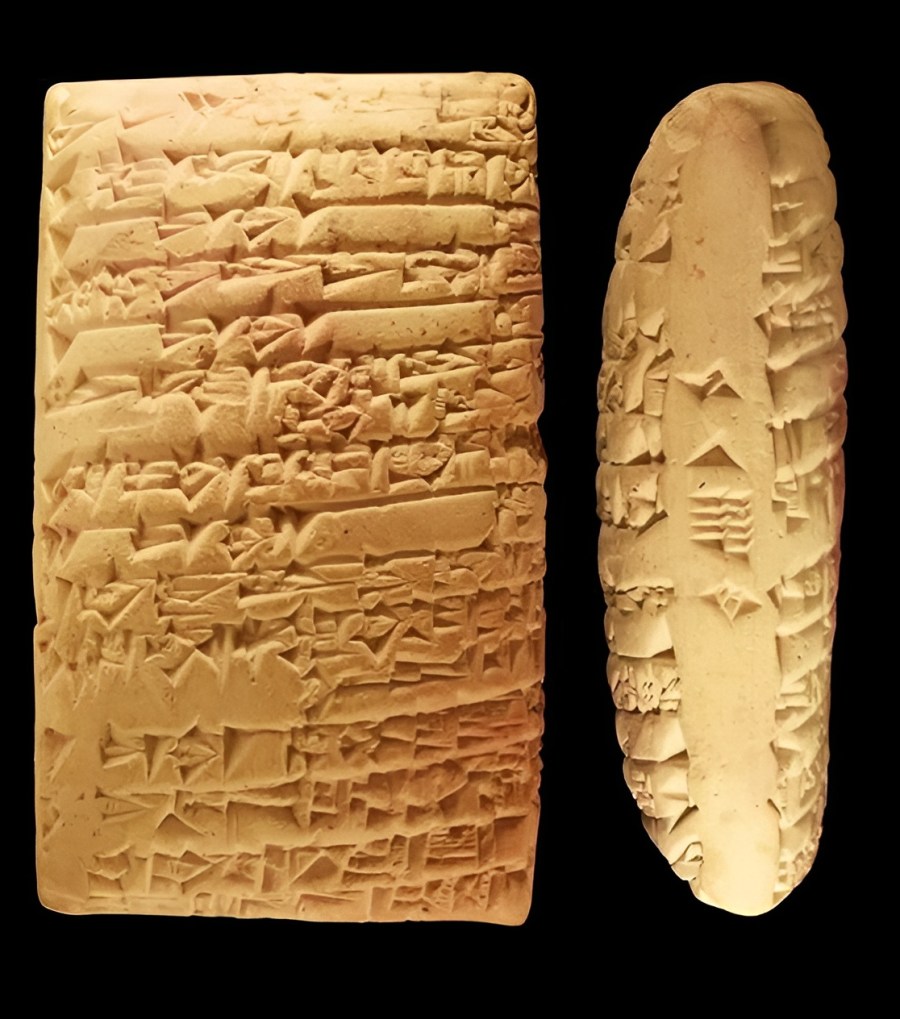
Sometimes, history doesn’t announce itself with grand architecture or monumental inscriptions. Sometimes it arrives softly—quiet as dust, humble as earth—resting in the cradle of your palm. A pillow-shaped clay tablet, barely the size of a hand, yet pulsing with the hum of a world that disappeared more than four thousand years ago.
This is the story of one such whisper: a small Sumerian receipt from the city of Iri-Saĝrig, dated precisely to 2027 BCE. At first glance, it is an ordinary administrative record—rations issued to royal messengers. Nothing more than a tally of “soup and fish.” But like so many ancient objects, its power lies not in its simplicity, but in what it reveals when you lean in and listen closely.
This tablet becomes a doorway—not to kings and conquests, but to the astonishingly human machinery that kept one of the world’s earliest empires alive.
A Kingdom of Clay & Canals
The year is 2027 BCE, deep into the twilight years of the Ur III dynasty, ruled by Ibbi-Sin, the last of its Sumerian kings. The empire was vast, stitched together by canals instead of highways, powered by scribes instead of servers, and sustained by one of history’s earliest sophisticated bureaucracies.
In this world, information did not travel through fiber optics—it travelled on foot.
Royal messengers, the silent sinews of the state, crisscrossed the kingdom carrying the king’s words in one direction and the pulses of distant cities in the other. Every mission mattered. Every arrival or departure was a page in the empire’s living logbook. And every ration they received—meticulously recorded on clay—was part of a governance system that remained unsurpassed for centuries.
And so, the tablet becomes more than clay—it becomes a snapshot of an empire held together by people who walked.
The Tablet Speaks: A Day in the Life of Sumerian Bureaucracy
On this particular clay receipt, four men appear briefly—like silhouettes crossing an ancient stage. Their names and purposes are inscribed in the angular strokes of cuneiform:
| Messenger/Official | Rations Issued | Purpose/Mission |
| Ur-šu-suen, chancellor’s assistant | 1 roasted mutton, 5 sila soup | “when he came for the ‘secretary’ of Nana’s field” |
| Laqipum, cup bearer, royal messenger | 3 sila soup, 2 fish | “when he went for royal offerings” |
| Suškin, royal messenger | 1 sila soup, 1 fish | “when he came from Der to the king’s place” |
| Šugatum, royal messenger | 2 sila soup, 2 fish | “when he came to capture fugitive soldier-workers…” |
(For perspective, one sila was roughly 0.8 liters.)
And then comes the quiet closing line—the kind of detail only a civilization obsessed with order would carve into clay:
“A disbursement for the month Nigenlila, 19th day.”
This was ancient accountability. Ancient logistics. Ancient governance—in its purest, humblest form.
What These Rations Reveal
1. The Subtle Hierarchies of Food
Ur-šu-suen, a higher-ranking official, receives a hearty, almost luxurious ration of roasted mutton and a substantial serving of soup. The messengers, meanwhile, receive the basics: soup and fish—fuel for the long miles ahead. Even food becomes an index of status.
2. Administration Beyond the Palace Walls
Each man’s mission tells a different story:
- Religious Statecraft: Laqipum’s journey “for royal offerings” reinforces how deeply governance and divinity were intertwined.
- Law Enforcement: Šugatum is charged with capturing deserters—suggesting an organized workforce under strict supervision.
- Diplomatic Reach: Messengers shuttling to and from Der reveal the impressive span of Ur III’s communication network.
This is a world where governance flowed not just from temple to palace, but across dusty roads and canal paths, carried on human legs.
Bureaucracy: An Ancient Human Achievement
We often treat bureaucracy as a burden of modernity—a maze of forms, signatures, approvals. But four thousand years ago, bureaucracy was a miracle. It was the glue that held civilization together.
And so, this small tablet becomes more than a receipt. It becomes evidence of:
• Financial discipline: Every sila, every fish, every mutton—recorded, accounted, justified.
• Logistical precision: Names, missions, origins, destinations—like a 4,000-year-old travel log.
• Civic responsibility: Proof that administration—in all its quiet, meticulous glory—is one of humanity’s most enduring achievements.
This is not the story of a king. It is the story of a clerk. Of a messenger. Of a footstep. Of a bowl of soup carefully measured and recorded. It is the story of how the ordinary kept the extraordinary alive.
Did You Know?
- Older Than the Pyramids: This little tablet predates even the mighty Great Pyramid of Giza.
- Communication Was an Endurance Sport: Messengers walked across the empire with messages literally tucked under their arms.
- The Ur III Archives Are Astonishingly Vast: Tens of thousands of tablets—covering everything from barley allotments to textile inventories—form the most detailed administrative archive of the ancient world.
The Quiet Heartbeat of a Lost Civilization
History loves its heroes, its conquerors, its monumental architecture. But civilisations also depend on quieter actors—the clerks who record, the messengers who carry, the administrators who track every ration with precision.
This tiny clay tablet, humble as it is, carries the heartbeat of a world sustained by such people. A world where order was not enforced by monumental stone but etched delicately into clay with a reed stylus.
It reminds us that history doesn’t survive only in the loud and the grand. Sometimes, it lives in the quiet work of people we never see, stepping across dusty paths, bowl of soup in hand, carrying a king’s message to the edge of his world.
And in their footsteps, an empire once walked.

‘History loves its heroes, its conquerors, its monumental architecture’ – I love the history of the ordinary people, the history not often recorded.
LikeLiked by 1 person
Absolutely! The grand narratives of emperors and empires often overshadow the lives of the ordinary people who actually shaped the rhythms of daily history. I’ve always felt that the real soul of any era lies in its unnoticed stories — the workers, the travellers, the artisans, the families who lived, dreamed, and endured. Their histories may not fill monuments, but they fill our understanding of humanity.
LikeLiked by 1 person
And those are our stories, of course. The stories of our ancestors.
LikeLiked by 1 person
Yes, Mick. Thanks.
LikeLiked by 1 person
Reading “When History Whispers: The Story of a Clay Tablet From the Edge of an Empire” was like stepping into a time machine guided by your words. What struck me most was not just the subject itself, but the way you approached it — with reverence for the ordinary details that often go unnoticed, and with the ability to transform a small clay tablet into a living heartbeat of an ancient civilization.
Your writing shows a rare gift: the ability to balance scholarship with storytelling. You weave historical facts — dates, dynasties, administrative systems — into a narrative that feels almost poetic. The way you describe the tablet as “quiet as dust, humble as earth” immediately sets the tone, reminding the reader that history is not always loud or monumental, but often whispered through the simplest artifacts.
What impressed me deeply was your thought process. You didn’t stop at describing the tablet; you asked what it reveals. You saw beyond the tally of “soup and fish” to uncover hierarchies of food, the machinery of governance, and the human effort that sustained an empire. This shows not only profound knowledge of the subject but also a sensitivity to the human dimension of history — the clerks, messengers, and ordinary workers who rarely get remembered.
Your story also reflects a philosophical depth. By calling bureaucracy a “miracle” rather than a burden, you challenge modern assumptions and invite readers to see administration as one of humanity’s greatest achievements. That kind of reframing is powerful — it makes the past relevant to the present.
Finally, the “Did You Know” section reveals your instinct for engaging readers. You know how to anchor scholarship in memorable facts — older than the pyramids, messengers as endurance athletes, archives vast enough to rival modern databases. These details make the piece not only informative but also delightful.
In short, your writing is a blend of historical precision, narrative elegance, and human empathy.- You don’t just tell us what happened; you help us feel why it mattered. That is the mark of a profound thinker and a gifted storyteller.
🌸 Your blog doesn’t just recount history — it makes history whisper to us again.
🙏🏽
LikeLiked by 2 people
I deeply appreciate your kind and generous words. I am genuinely humbled. When I write about history, particularly its quieter aspects, my goal is always to allow the small details—a shard, a tablet, a forgotten name—to tell their story, as they often reveal truths that grand monuments miss. Knowing that this approach connected with you means more than I can say. Your reflection perfectly captures the essence I aimed to convey: that history is preserved not only through kings and conquests but also through the steady hands, humble tasks, and daily routines that sustained civilizations. I am thankful that you sensed the life within the clay, the human element behind the bureaucracy, and the poetry within the dust. Remarks like yours remind me why I cherish writing for Indrosphere. Thank you sincerely for reading with such care.
LikeLike
This is a wonderful post on the wonders of history.
The first written clay tablets were records of meticulous administration and transactions. Human civilizations have survived on such details through passage of time. Details which may seem drab and inconsequential actually tell greater stories of how people lead their lives, bureaucracy was layered and how labour intensive administration was.
The messengers whose stories are not chronicled in history must have made a huge contribution in the efficient and effective running of systems.
This post is rich in history and ancient information. Kudos to you.
LikeLiked by 1 person
Thank you so much for your thoughtful reflection. Indeed, the smallest administrative details often unlock the biggest stories about how societies functioned, worked, and evolved. The unsung roles — like those tireless messengers — remind us that history is shaped as much by ordinary people as by great rulers. I’m glad the post resonated with you, and I truly appreciate your generous words.
LikeLiked by 1 person