
Airports are usually places of haste. Of rolling suitcases, boarding calls, transient conversations, and eyes fixed on departure screens. Yet, during my recent passage through Hamad International Airport (HIA) in Doha, I found myself slowing down—almost against instinct. Not because of a delay or fatigue, but because art intervened.
In the vast, immaculate expanse of HIA, where architecture already aspires to museum-like grandeur, Gillie and Marc’s Wildlife Wonderscapes rises not merely as an installation but as a quiet summons. It asks the traveler—often suspended between destinations and identities—to pause, look inward, and reflect on a world far larger than one’s itinerary.
An Unexpected Sanctuary in Transit
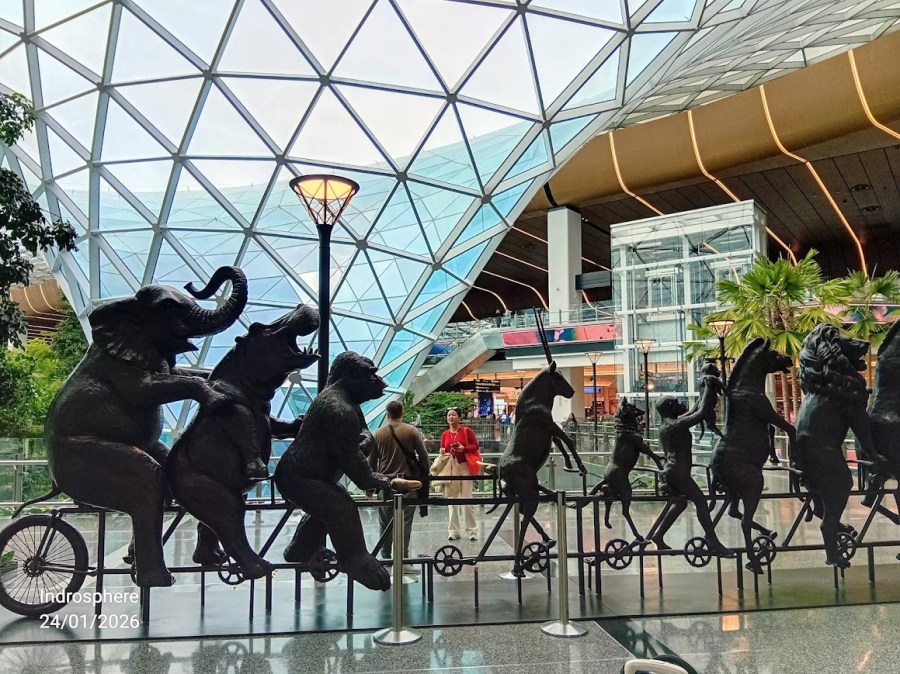
The first encounter is disarming. Bronze sculptures—life-sized, tactile, and emotionally arresting—stand amid the flow of global travelers. Children instinctively reach out to touch them. Adults, initially distracted, find their steps slowing. Cameras emerge, but so do questions.
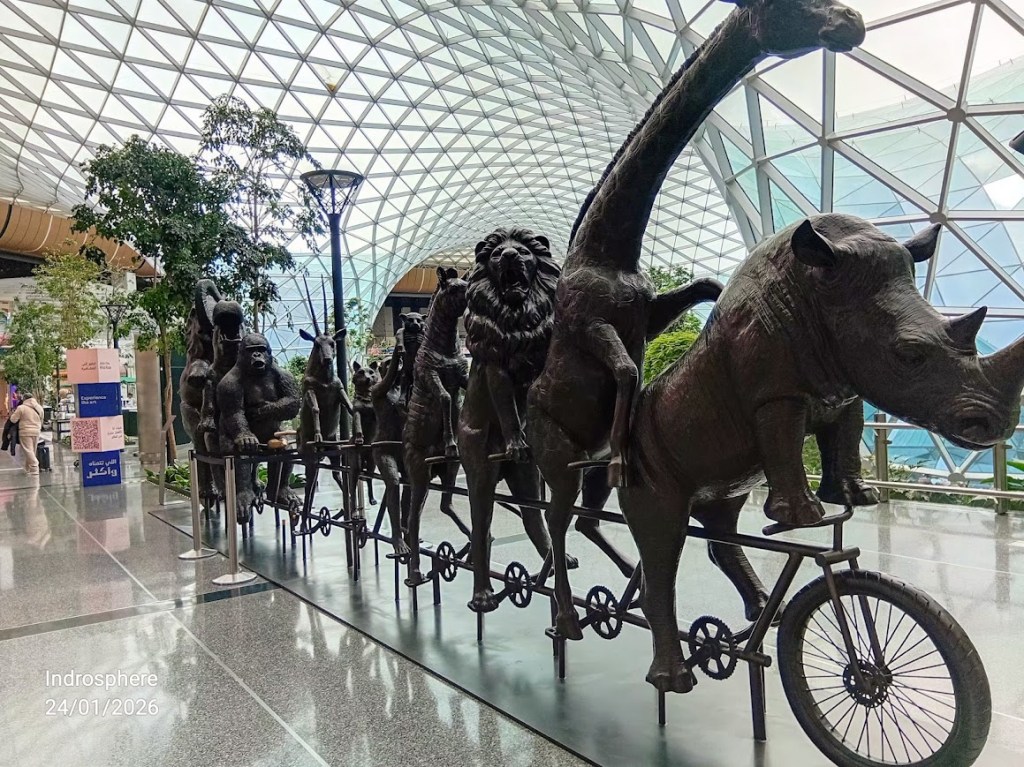
These are not decorative objects meant to beautify a terminal. They are sentinels.
Gillie and Marc have long used public art as a vehicle for environmental storytelling, and at HIA, their vision finds a particularly powerful stage. Wildlife Wonderscapes transforms the airport into an unexpected sanctuary, reminding us that even in hyper-modern, climate-controlled spaces, the fate of the natural world remains deeply intertwined with human choices.
Global Message, Local Soul
What makes the Doha installation especially resonant is its Qatari adaptation. Alongside globally endangered animals, the works subtly incorporate references to native species and regional cultural motifs, grounding the universal conservation message in local identity.
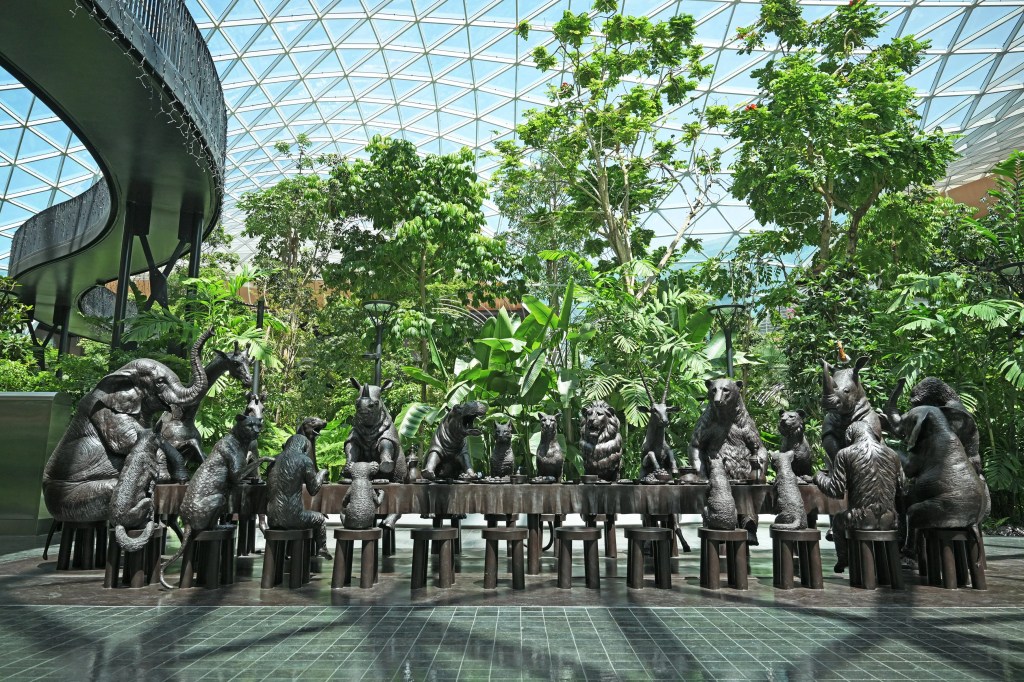
This localization matters. It reinforces the idea that wildlife preservation is not a distant concern relegated to rainforests or polar regions—it is a shared responsibility that transcends borders, cultures, and economies. Much like an airport itself.
As someone accustomed to frequent travel, I was struck by the symbolism. Here we are—citizens of an increasingly mobile world—moving effortlessly across continents, while countless species struggle simply to survive within shrinking habitats.
Art That Asks, Not Preaches
There is no didactic tone here. No placards heavy with guilt. Instead, Wildlife Wonderscapes communicates through presence and posture—animals depicted with dignity, vulnerability, and quiet resilience. Some sculptures invite interaction, encouraging viewers to sit beside them, pose with them, and in doing so, share space.
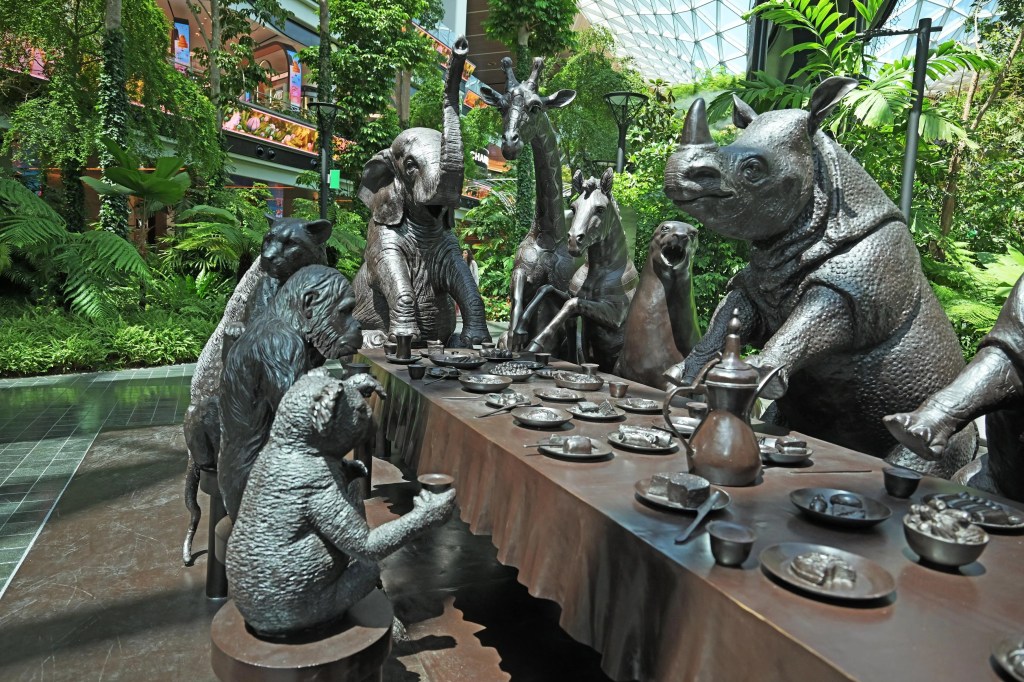
That act—sharing space—is perhaps the most profound metaphor of all.
The artists’ recurring human-animal figures reinforce the idea of coexistence rather than dominance. The message is subtle but firm: the future of wildlife is inseparable from human action, empathy, and restraint.
A Moment of Reckoning
One statistic lingers, impossible to ignore: over 70% of global wildlife has been lost in the last fifty years. Read in isolation, it shocks. Encountered amid bronze animals standing silently in one of the world’s busiest airports, it unsettles.
As I stood there, passport in pocket, destination ahead, I felt a familiar travel-induced introspection deepen into something more urgent. Travel exposes us to the beauty of the world—but also to its fragility. Airports, paradoxically, may be the perfect place for such reflection: crossroads where privilege, progress, and responsibility intersect.
Hope Cast in Bronze
Yet Wildlife Wonderscapes is not an elegy. It is a declaration of hope.
Hope that awareness can lead to action.
Hope that art can still interrupt indifference.
Hope that humans will choose stewardship over exploitation.
By embedding this message permanently within HIA, Qatar makes a powerful statement—that sustainability and conservation are not peripheral concerns, but central to how we imagine the future.
Leaving Doha, Carrying the Question
As my journey continued, the sculptures stayed with me—not as images on a phone, but as questions carried forward.
What can I do? What can we, as travelers, consumers, decision-makers, do differently?
Perhaps that is the greatest success of Wildlife Wonderscapes. It ensures that even as we move on, something remains rooted within us—a seed of awareness, a quiet song of responsibility.
And in a world where we are always rushing to the next destination, that pause may be the most meaningful journey of all.

wonderful pictures.
true wildlife conservation is a shared responsibility.
nicely penned.
LikeLiked by 1 person
Thanks, my son. ❤️
LikeLike
A Journey Within a Journey
What strikes me most about your piece is how you’ve captured the irony of the “liminal space.” We usually think of airports as places where we lose our sense of self in the rush to be somewhere else, but you’ve described a moment where Gillie and Marc’s art actually forces a traveler to find themselves again. Your observation that these bronze figures act as “sentinels” rather than mere decorations is profound—it shifts the narrative from the airport being a triumph of human engineering to a place of reckoning for our environmental impact.
Your prose mirrors the very “slowing down” you describe. The transition from the clinical, immaculate expanse of Hamad International to the “tactile and emotionally arresting” presence of the sculptures felt incredibly vivid. I particularly loved the way you bridged the global with the local; it reminds the reader that conservation isn’t just a grand, abstract idea, but something rooted in the soil and soul of specific places like Doha.
The closing thought—that the most meaningful journey might be the pause itself—is a beautiful takeaway. You’ve managed to take a statistic about wildlife loss that usually feels paralyzing and turned it into a “seed of awareness” that feels hopeful and urgent all at once. This isn’t just a review of an art installation; it’s a meditation on stewardship that stays with the reader long after they’ve finished the last sentence. Thank you for sharing such a reflective and moving perspective.🙏🏽🙏🏽
LikeLiked by 1 person
Thank you so much for this deeply generous reading. I’m truly moved by how attentively you engaged with the idea of the liminal—and how you articulated the pause as a form of reckoning rather than mere transit. Your reflection adds another layer to the piece, especially in reframing the sculptures as catalysts for awareness rather than static art.
LikeLike