
There are moments in life when you discover that someone you once knew as a classmate has quietly evolved into a remarkable force in an entirely different world. Such moments bring a unique sense of pride, nostalgia, and wonder. For me, that person is my old school friend, Ranajit Sinha.
Ranajit and I studied together at Vinay Nagar Bengali Senior Secondary School in Sarojini Nagar, New Delhi, until Class VIII. Those were carefree years filled with friendships, shared classrooms, school events, and youthful dreams. Life eventually took us on different paths. My family moved to the Gole Market area, and I joined Raisina Bengali School at Mandir Marg. Like many school friendships, ours drifted into the background as careers, families, and continents separated us.
Yet some connections never truly disappear.
Today, Ranajit Sinha is a distinguished multidisciplinary visual artist based in Ottawa, Canada, whose work is attracting attention across continents. Born and raised in New Delhi, his artistic journey has taken him through India, the United Arab Emirates, the United States, and Canada, giving him a rare cross-cultural perspective that profoundly influences his creative vision.
His academic credentials alone reflect an extraordinary dedication to art. After earning a Bachelor of Fine Arts from the Delhi College of Art, he pursued a Master of Fine Arts in Printmaking at Visva-Bharati University, Santiniketan. Later, he obtained a second Master’s degree in Painting from Central Washington University in the United States, where he was awarded a teaching assistantship. Before moving to Canada, he also built a successful career in advertising, working with global agencies such as Saatchi & Saatchi and Young & Rubicam in the UAE.
Over the years, his works have been exhibited in prestigious galleries and institutions around the world, including the National Gallery of Modern Art in New Delhi, the National Academy of Fine Arts in Kolkata, the Dubai Art Centre, the Sarah Spurgeon Gallery in the United States, the Varley Art Gallery in Canada, the Canadian Sculpture Centre in Toronto, the Ottawa Art Gallery, and Ottawa’s Wall Space Gallery, which currently represents him.
Yet beyond the awards, exhibitions, and international recognition, what truly captivated me was a conversation in our WhatsApp group.
Ranajit mentioned an ongoing body of work called Parallel Dimensions. The title itself sparked my curiosity.
As he shared his thoughts, I realized that this was far more than an art series. It was a profound exploration of identity, migration, memory, spirituality, and belonging. It was, in many ways, a visual autobiography of a person living between worlds.
Living Between Two Worlds
Born in India and now settled in Canada, Ranajit inhabits two geographies simultaneously. India remains embedded in memory, ritual, and cultural consciousness, while Canada shapes his present experiences and perspectives. Rather than viewing these identities as separate, he explores the space where they intersect.
This duality forms the foundation of Parallel Dimensions.
His work examines the human being as a living junction where histories, migrations, memories, and spiritual forces converge. Identity is not portrayed as fixed or singular; instead, it emerges as fluid, constantly evolving through movement, inheritance, and lived experience.
In today’s increasingly interconnected world, this idea resonates deeply. Many of us carry multiple homes within us. We belong to places we no longer live in and adapt to places we now call home. We are, in a sense, all inhabitants of parallel dimensions.
Fire, Ashes, & Renewal
One of the most fascinating aspects of Ranajit’s artistic practice is his use of materials. He works extensively with burnt wood, oil and acrylic paints, digital prints, and drawing-based media. Surfaces are charred, layered, erased, and reconstructed. The process itself becomes a metaphor for transformation.
His approach draws inspiration from Hindu philosophical traditions, particularly cremation rituals, where the physical body returns to ash while the spirit continues its journey toward another form of existence.
In Ranajit’s studio, ideas undergo a similar cycle. They burn. They fragment. They disappear. And then they re-emerge in new forms.
The resulting artworks embody both destruction and renewal, suggesting that creation is not the opposite of loss but often its continuation.
Unexpected Cultural Connections
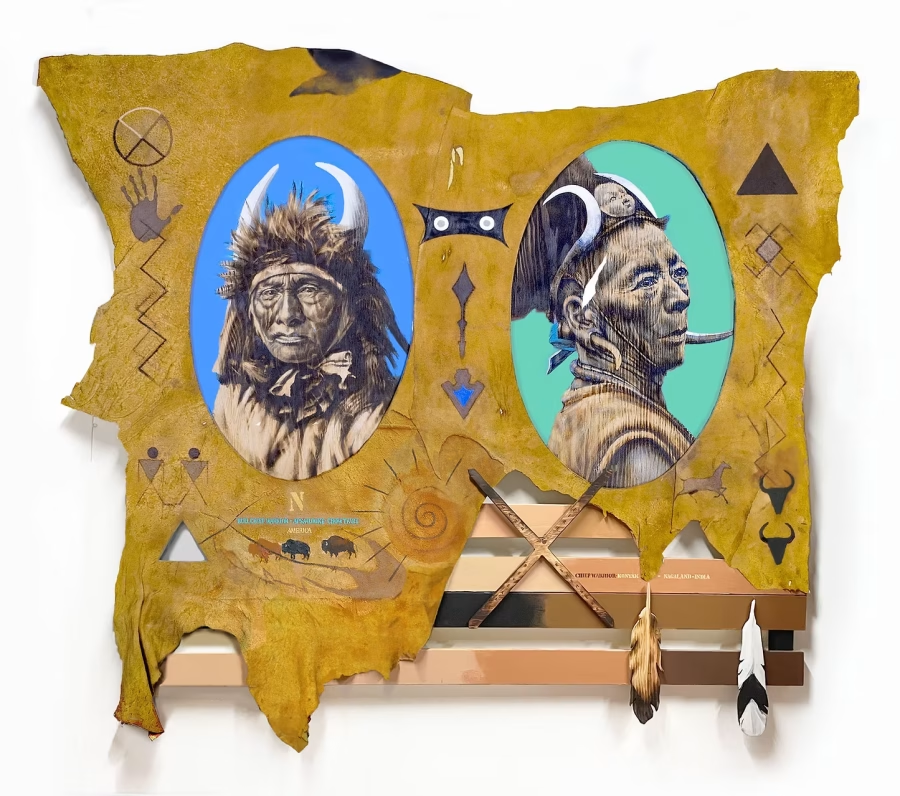
What makes Parallel Dimensions especially compelling is its exploration of similarities between South Asian and North American Indigenous traditions.
Prompted by his own experiences of migration and occasional cultural misrecognition, Ranajit began researching shared spiritual practices, ritual gestures, healing traditions, and cosmological beliefs that appear across seemingly distant cultures.
His work proposes that cultural memory often survives beyond geography. Symbols, stories, rituals, and archetypes travel with people across generations and continents. They remain embedded within collective consciousness, waiting to be rediscovered.

Through images of shamans, sacred fires, smoke, ancestral symbols, and healing figures, he explores the role of the spiritual guide as a bridge between worlds—the visible and the invisible, the historical and the contemporary, the living and the ancestral.
A Constellation of Histories
What I find most powerful about Ranajit’s work is that it challenges conventional ideas of identity. Rather than viewing identity as a single narrative, he presents it as a constellation of interconnected stories, histories, and experiences. Each layer adds complexity. Each migration leaves a trace. Each memory creates another dimension.
His art reminds us that we are all products of journeys—some geographical, some emotional, some spiritual. The boundaries we often perceive between cultures, histories, and identities may be far more porous than we imagine.
A Friend’s Pride
Recently, Ranajit launched his personal website, showcasing many of his remarkable works and offering visitors a window into his evolving artistic universe.
As I explored the images and read about the ideas behind Parallel Dimensions, I found myself transported back to our school days in Sarojini Nagar. It is extraordinary to think that a boy who once sat beside me in a classroom in New Delhi is now creating thought-provoking art that speaks to audiences across the world.
For me, this is more than an artist’s success story.
It is a reminder that friendships endure across decades, that creativity knows no borders, and that the dreams nurtured in childhood sometimes blossom in ways we could never have imagined.
Ranajit Sinha’s Parallel Dimensions invites us to look beyond geographical boundaries and cultural labels. It encourages us to see identity as an ongoing journey—one shaped by memory, migration, transformation, and the invisible threads connecting us to our ancestors and to one another.
And as I reflect on his work, I cannot help but feel immensely proud that this internationally acclaimed artist is also my old school buddy.
Some friendships, like great works of art, continue to reveal new dimensions with time.
Image Credit: Artwork image appearing in this article is courtesy of Ranajit Sinha’s official website <https://www.ranajitsinha.com/> and remains the intellectual property of the artist. All rights reserved. Used here solely for editorial and non-commercial purposes. Readers are encouraged to visit his website to explore his complete portfolio and ongoing projects.
Discover more from Indrosphere
Subscribe to get the latest posts sent to your email.
My friend, thank you for this wonderful surprise. Reading your article felt like seeing my work through your eyes, and that means a lot to me.
I’m especially grateful because you didn’t just write about the artworks, you understood the thoughts, memories, and emotions behind them. As artists, we spend so much time creating in solitude, so having a friend who truly connects with the work is something special.
Thank you for your friendship, your support, and for taking the time to share my journey with your readers. I’m genuinely touched and honored.
Much love and gratitude.
Thank you, Ranajit, for your kind and heartfelt words. Writing about your work was a pleasure because your art speaks with honesty, depth, and emotion. Wishing you continued inspiration and many more beautiful artistic journeys ahead.
Your article weaves nostalgia, pride, and discovery together. What stood out was how memory and art interact—the childhood classrooms in Sarojini Nagar echoing in Ranajit’s Ottawa studio. This blend of past and present makes the story both personal and universal.
Ranajit’s art—burnt wood, ashes, renewal—feels ritualistic, reflecting impermanence and continuity. I appreciated how you linked his process to Hindu philosophy and connected it to Indigenous cultures in North America, showing how identities evolve yet stay rooted in ancestral memory.
The lasting impression is friendship as its own dimension. The boy you knew is now a celebrated artist, but your bond remains strong, unfolding like great art. Your writing honours Ranajit’s journey and reminds us all of the many histories and selves we carry, highlighting the unseen connections between us. 🙏🏽🙏🏽
Thank you so much for this thoughtful and generous reflection. I am grateful that the article spoke to you so profoundly. 🙏🏽