
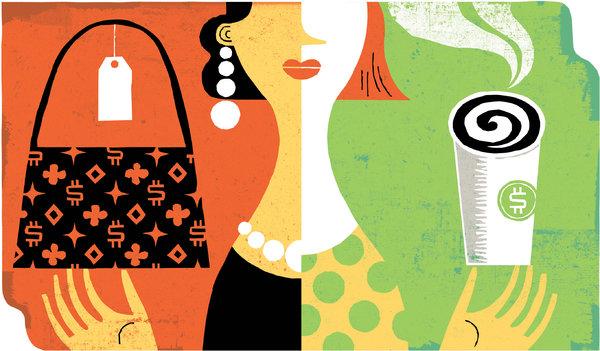
What a delightful surprise to wake up to a thought-provoking story from my batchmate, Aranjit, about the Veblen Effect! As luck would have it, today’s my off day, leaving me ample time to dive deep into this intriguing economic phenomenon and share my musings with you all. So, grab a cup of your favourite brew, settle in, and let’s explore why some things become more desirable the more expensive they get.
Have you ever been utterly bewildered by the astronomical price tags on certain luxury items? A handbag that costs more than a small car, or a pair of shoes that could fund a decent vacation – what truly drives people to part with such vast sums of money for these goods? The answer, my friends, often lies in a concept known as the Veblen Effect.
The Curious Case of Counter-Intuitive Demand
Named after the brilliant American economist Thorstein Veblen (1857-1929), the Veblen Effect describes a seemingly counterintuitive economic phenomenon: the demand for a product actually increases as its price rises. Yes, you read that right. In the realm of luxury, a higher price can paradoxically make a product more attractive to consumers.
This stands in stark contrast to the fundamental Law of Demand, which dictates that as the price of a commodity increases, its demand will typically fall, and vice versa. Think about it: when the price of onions soared from ₹30 to ₹200 per kilogram, demand plummeted. Hotels scaled back on their onion usage, and some even removed onion-based dishes from their menus. This is the normal, expected consumer reaction. The Veblen Effect, however, is one fascinating exception to this universally accepted economic principle.
Why Do We Fall for the Veblen Effect?
So, what psychological and societal forces are at play that lead individuals to succumb to this intriguing effect? There are several compelling reasons:
1. Status Symbolism: Signalling Success to the World
Perhaps the most prominent driver of the Veblen Effect is the role of luxury goods as status symbols. Owning an exorbitantly priced handbag, a limited-edition watch, or a high-performance sports car isn’t just about utility or even aesthetics; it’s about broadcasting a message. These items loudly and clearly signal to others that the owner is successful, affluent, and belongs to a certain social stratum. In societies where wealth and social standing are highly valued, the desire to display these markers of success becomes a powerful motivator.
2. Perceived Quality and Exclusivity: The Allure of the Rare
Another significant factor is the association of luxury goods with superior quality and exclusivity. When a product commands a premium price, consumers often infer that it must be crafted with exceptional materials, meticulous attention to detail, and unparalleled artistry. Luxury brands strategically leverage this perception by using rare resources, employing highly skilled artisans, and often producing items in limited quantities. The idea that you own something rare, something not everyone can have, significantly enhances its desirability.
3. The Human Desire for Social Comparison: Keeping Up (and Ahead) of the Joneses
Let’s be honest: humans are inherently wired for social comparison. We often gauge our own success, happiness, and status by contrasting ourselves with others. Owning a luxury item can provide a potent psychological boost, creating a sense of superiority over those who do not possess similar levels of wealth or refined taste. It’s a subtle yet powerful mechanism that fuels the perpetual cycle of aspiration and acquisition.
Conspicuous Consumption: Veblen’s Enduring Legacy
It was Thorstein Veblen himself, in his seminal 1899 work, “The Theory of the Leisure Class: An Economic Study in the Evolution of Institutions,” who coined the term “conspicuous consumption.” Veblen argued that this form of consumption was primarily engaged in by the upper classes – men, women, and families – as a means of openly displaying their vast wealth. This display, whether of real or perceived affluence, served as a powerful tool to assert and maintain their social power and prestige. Veblen’s genius lay in his ability to illuminate the intricate and often overlooked connections between economics, society, and culture.
The Double-Edged Sword of Desire
While the Veblen Effect illuminates a fascinating aspect of human behaviour and market dynamics, it’s not without its drawbacks. One significant downside is its potential to fuel a vicious cycle of conspicuous consumption. Individuals can feel an incessant pressure to constantly upgrade their possessions, to acquire newer, more expensive items, simply to maintain or elevate their perceived status. This relentless pursuit can lead to significant financial strain, accumulating debt, and a never-ending treadmill of acquisition that ultimately fails to deliver lasting satisfaction.
Julius Caesar: An Ancient Master of the Veblen Effect
The Veblen Effect, it turns out, is not a modern invention. Its roots run deep into human history, as evidenced by a truly remarkable anecdote from the 1st century BCE, involving none other than Julius Caesar. This story, recounted by Britannica, perfectly illustrates the timeless nature of conspicuousness.

In 75 BCE, the Mediterranean Sea was plagued by rampant piracy. A 25-year-old Roman nobleman, Julius Caesar, on his way to study oratory in Rhodes, was captured by a band of Cilician pirates in the Aegean Sea. What transpired next is the stuff of legend.
Caesar, astonishingly, refused to play the part of a typical captive. When the pirates, likely seasoned in their trade, set his ransom at a respectable 20 talents (approximately 620 kg of silver), Caesar laughed. He then, with an audacity that must have dumbfounded his captors, suggested that 50 talents (a staggering 1550 kg of silver) would be a far more appropriate amount, given who they had captured. He then calmly sent his entourage to gather the money, settling in for his period of captivity as if it were a planned sabbatical. The pirates, utterly bewildered, had never encountered a hostage who negotiated up their own ransom!
During his 38-day captivity, Caesar made himself at home. He bossed the pirates around, shushed them when he wanted to sleep, and even made them listen to his speeches and poems, berating them as illiterates if they weren’t sufficiently impressed. He participated in their games, yet always addressed them as their commander. From time to time, he would casually threaten to have them all crucified. The pirates, misinterpreting his confidence as a quirky eccentricity, took it all as a joke.
It wasn’t a joke. The ransom was delivered, and Caesar was freed. But the story doesn’t end there. With incredible speed and resourcefulness, Caesar, despite holding no public or military office, managed to raise a naval force in Miletus and set out in pursuit of his former captors. He found them still camped on the island where he had been held, captured them, and brought them back. When the governor of Asia hesitated about punishing them, Caesar took matters into his own hands. He went to the prison where they were held and, true to his word, had them all crucified. He then reclaimed his 50 talents of silver, along with all their possessions.
In 75 BCE, Julius Caesar, through his audacious demand for an inflated ransom, created his own Veblen Effect. He understood, instinctively, that his value, his status, and his very identity were enhanced by the sheer expense associated with him. Conspicuousness, it seems, has been a potent force throughout human history.
Making Informed Choices
The Veblen Effect is a truly fascinating phenomenon that offers profound insights into the psychology of consumption, particularly in the realm of luxury. While there’s undeniable appeal and even genuine pleasure in owning beautiful, high-quality luxury goods, it’s crucial to be aware of the underlying motivations that drive our purchasing decisions. By understanding the forces at play – the desire for status, the allure of exclusivity, and the subtle pressures of social comparison – we can make more informed choices, avoid the pitfalls of endless conspicuous consumption, and ultimately lead more fulfilling lives that aren’t solely defined by the price tags of our possessions.

Hahaha! Well, I don’t spend money on iPhone or high-end Samsung phones. I always prefer mid-priced mobiles, which performs whatever I want. So, I am not under the influence of Veblen Effect. Nice Post.
LikeLike
Thanks, Nilanjana. You’re smart. 😉
LikeLike
It is also called a marketing maneuver in other words the perceived value of the product/ brand is disproportionately higher than the cost+ mechanism of pricing. A classic example is our simple Tea… you can buy it as low as ₹1 a cup at a roadside stall and also pay ₹200 + taxes at a 5star restaurant.
In today’s Times of India, there’s an ad of Titan Edge wristwatch…the USP of the brand (Edge) is that it is perhaps the thinnest (2mm approx) watch… I have two of them and was curious if the new offering… I remember the ones I have do not cost more than 5K, therefore, was taken aback at the price of ₹1.85 Lac quoted (for the limited edition!!)…
Will you call this Veblen effect??? 😊
LikeLiked by 1 person
Veblen effect is a relative term. So long, there is a willing buyer to buy at the quoted price, the price demanded by seller is justified. After all, the seller has also put in something to create the Veblen effect. 🙂
LikeLike
Yes, read about it earlier. However, the story of Ceasar was not known, until it was narrated by Aro, which is elaborated further by you. Nice post. Cannot afford Veblen effect affect me…haha…
LikeLiked by 1 person
Hahahaha, thanks, Mano.
LikeLike