
The open road has always been generous to those who listen. What begins as distance measured in kilometres often ends as an inward journey measured in silence, memory, and grace. For my son Judhajit and me, a seemingly ordinary drive from Ranchi to Prayagraj — undertaken for the solemn Vatsarik Shraddha of my late father-in-law — became one such unexpected turning.
We were travelling along NH 19, the old Grand Trunk Road — once NH 2 — that ancient artery of India which has carried traders, emperors, pilgrims, colonisers, and dreamers for centuries. This road is familiar to me, almost intimate. I have driven it countless times, watched its seasons change, watched myself change upon it. Somewhere near Sasaram, I had always known, lay a Shakti Peetha — a place of power and presence — but knowledge without coordinates is like faith without direction. The temple had remained a rumour in my mind, never a destination.
Until the road decided otherwise.
Hunger announced itself near noon, and instinct pulled us into a familiar refuge — Ashirvad Punjabi Dhaba. The smell of fresh rotis, the clatter of steel plates, the reassuring predictability of highway food. As we ate, my eyes lingered on a small detail on the signboard: “Near Tara Chandi Dham.”

The words stayed with me longer than the taste of the dal.
Almost casually, I asked one of the staff about it. His answer was disarmingly simple — “Bas do sau meter aage… Prayagraj ki taraf.” Just two hundred metres ahead.
Two hundred metres. Sometimes, the distance between ignorance and grace is that small.
We resumed our drive, this time at a slower pace, our eyes alert. And then it appeared — a modest gateway on the left, unpretentious, almost shy. We parked, stepped out, and crossed the threshold with that quiet anticipation that precedes something meaningful, though unnamed.

A Sanctuary on the Hilltop: Where History Meets Divinity
We had arrived at Maa Tara Chandi.
The temple rises gently, perched atop a hill, as if it has grown out of the land rather than been built upon it. Sasaram unfolds below in muted tones, while the air above feels older, heavier with memory. This is not merely a place of worship — it is a confluence of time, belief, and accumulated longing.

Dedicated to Goddess Tara — also worshipped as Chandi or Durga — the temple embodies the fierce tenderness of Shakti. She is creation and destruction, protection and challenge, mother and warrior. Devotees believe her presence here is not symbolic but alive, responsive, healing. Thousands come seeking relief — from illness, from fear, from unanswered prayers.
The temple complex is expansive yet serene: shrines nestled alongside one another, a sacred pond reflecting the sky, shaded gardens, even a small museum quietly guarding fragments of the past. From the hilltop, the view stretches wide — as if the Goddess herself insists that one must see beyond immediate suffering.
At the heart of it all is the main shrine.
The idol of Maa Tara Chandi, carved from black stone, stands adorned in gold and silver, radiant without ostentation. She is believed to be swayambhu — self-manifested — and behind her form are carved the nine manifestations of Durga, an exquisite reminder that divinity is never singular. Strength has many faces.
Architecturally, the temple whispers of the Gupta era, bearing a subtle confluence of Hindu and Buddhist aesthetics. Stone here does not divide traditions; it unites them. Even the sacred pond carries layered meanings — pilgrims bathe not merely to cleanse the body, but to lighten the weight they carry within.
The Veiled History & Enduring Legends of a Shakti Peetha
Legends cling to this place the way moss clings to ancient rock.
One speaks of King Harishchandra, whose unwavering devotion to truth pleased Goddess Chandi herself. Another recalls Raja Vikramaditya, who, aided by the Goddess, defeated the demons Shumbha and Nishumbha on this very ground. Yet the most enduring belief binds the temple to the cosmic grief of Shiva and Sati — that Sati’s right eye fell here when her body was scattered across the earth, consecrating this spot forever as a Shakti Peetha.
Some stories travel even further back.
It is said that Gautam Buddha himself visited this shrine after enlightenment, and that the Goddess appeared before him as a young girl, blessing his mission of compassion and dharma.
Another legend brings Parashuram here — after his battle with Sahasrabahu — worshipping Tara Chandi as both penance and power.
History, too, leaves its mark. A 12th-century inscription by Khayaravala king Pratapdhavala survives nearby — a quiet, chiselled affirmation that this temple has endured not merely through faith, but through time itself.

A Pilgrimage of Peace and Devotion
We purchased a coconut and pedhas for prasad and entered the sanctum. It was afternoon, mercifully uncrowded. Weddings were being solemnised within the complex — life beginning anew under the gaze of the eternal feminine. Massive railings stood ready for the crush of Navratri crowds, though for us, the Goddess offered solitude.

The garbha griha is a cave — dark, ancient, womb-like. Here, Maa Tara Chandi appears in balika swaroopa — as a young girl. The effect is profound. Power without aggression. Authority without intimidation. Innocence that commands reverence.
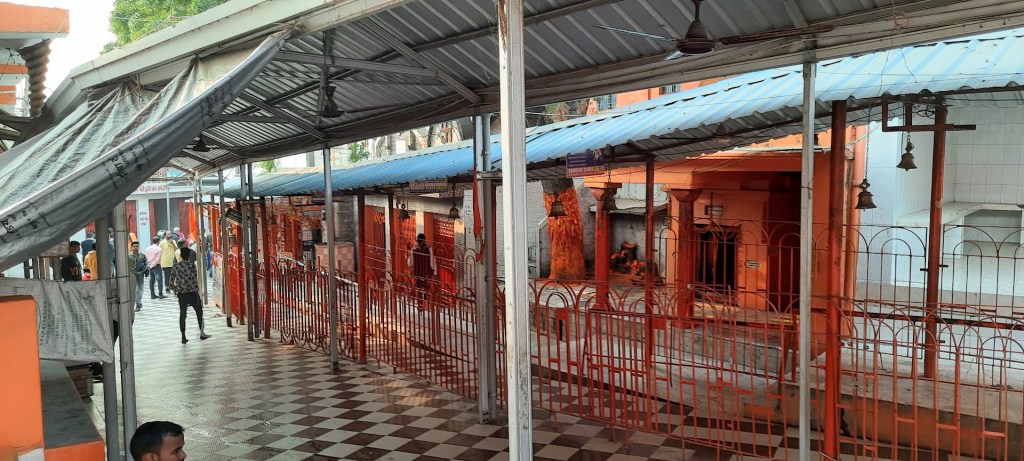

Standing there, I felt a stillness descend — the kind that silences internal noise. Not joy exactly. Not sorrow. Something quieter. A sense of being momentarily aligned.
Beyond the Divine
When we stepped back into daylight, it felt as though we were carrying something intangible with us — a softness, a steadiness. We resumed our journey to Prayagraj, but the road felt altered. Or perhaps, we were.

Today, Maa Tara Chandi is not only a sacred site but also a cultural anchor for Sasaram. During Navratri, the temple transforms — lights, flowers, music, devotion pouring in from every direction. It becomes a living celebration of faith, resilience, and collective memory.

Yet even outside the festivals, the temple offers something rarer — presence. A pause. An invitation to listen.
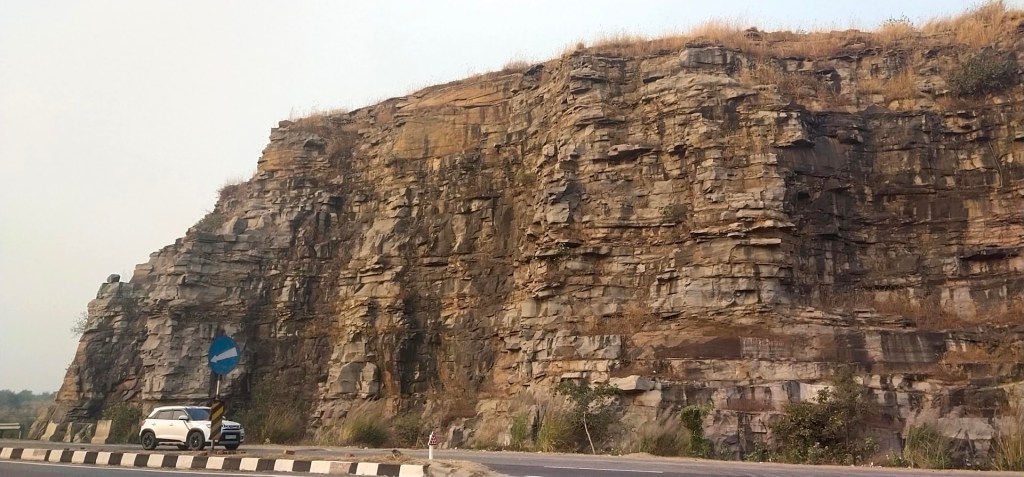
If your travels ever take you along NH 19, resist the urge to merely pass through Sasaram. Look for the quiet gate. Trust the small signboard.
Some journeys are not planned. They are received.
And some places do not announce themselves loudly — they wait, patiently, for the road to whisper their name.

जय माँ तारा ।
LikeLiked by 2 people
जय माँ तारा!
LikeLike
Nice, informative post. I wasn’t aware of the history/legend of this temple near Sasaram.
LikeLiked by 1 person
Thanks, Nilanjana.
LikeLiked by 1 person
Informative post. Nice, Indrajit.
LikeLiked by 1 person
Thanks, Sanchita.
LikeLike
You are right… There is some divine loving energy which still makes me think of this place.
Very well drafted post….
LikeLiked by 1 person
Thanks, Sucharitha.
LikeLike