
Kolkata. The name alone evokes a sensory symphony—rickshaw bells, the scent of phuchka mingling with the smoky aroma of kathi rolls, and the timeless rhythm of a city that never truly sleeps. A few years ago, I found myself in the heart of this vibrant metropolis, staying at the Peerless Inn on the iconic Chowringhee Road. Recently, while flipping through old photographs, those moments came rushing back, compelling me to revisit and reflect on this storied neighbourhood
A Room with a View
From my hotel window, the Esplanade unfolded like a living canvas. The scene was electric—cars honking in chaotic harmony, trams gliding past colonial facades, and vendors calling out in melodic cadence. It was here, perched above the pulse of the city, that I began to grasp the layered significance of Chowringhee—a place where history and modernity dance in tandem.

From Jungle to Grand Avenue
Chowringhee, now partially known as Jawaharlal Nehru Road, flanks the eastern edge of the Maidan—a vast green expanse stretching nearly three kilometres. It’s hard to imagine that this bustling artery was once a tiger-infested jungle. In the 18th century, German scholar Henry Ferdinand Blochmann described the area as rural, dotted with puddles and sparse settlements.

The transformation began with a road built by the Sabarna Roy Choudhury family, connecting Barisha to Halisahar. Along this route emerged small hamlets, one of which bore the name Chowringhee. The etymology remains elusive, but legend speaks of a Nath yogi, Chouranginath, who discovered an image of Kali and built the first Kalighat temple. Could the name be a tribute to this spiritual pioneer?

Colonial Grandeur & Cultural Legacy
During the British Raj, Chowringhee rose to prominence as the epicentre of power and prestige. Majestic structures like the Victoria Memorial, Raj Bhavan, and St. Paul’s Cathedral became architectural anchors. These buildings weren’t just monuments—they were statements of imperial authority and cultural aspiration.


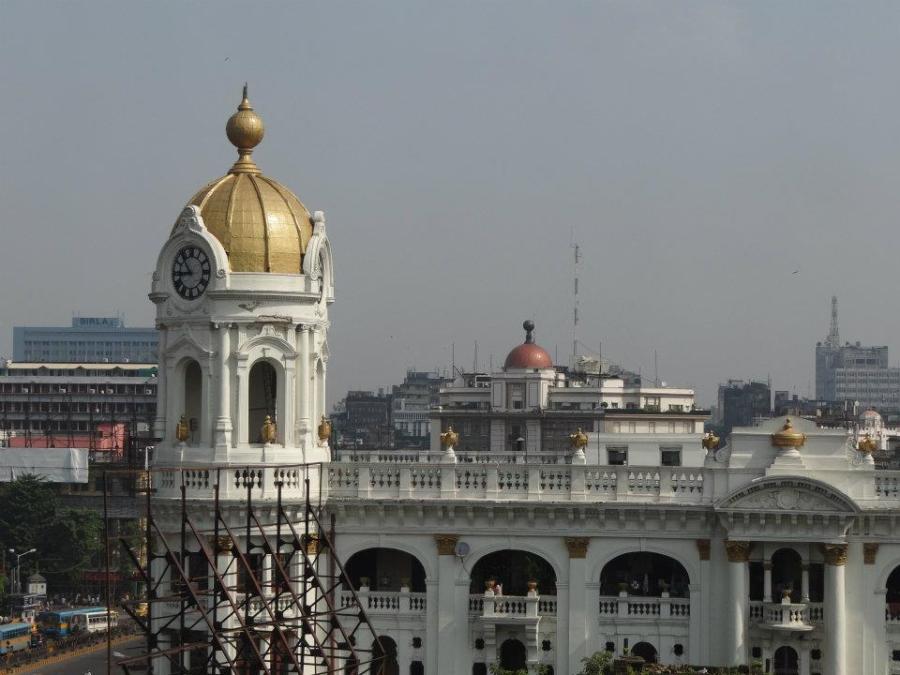
Across from my hotel stood the Metropolitan Building, once Whiteway Laidlaw, a net-baroque emporium built in 1905. With its domes, clock tower, and arched windows, it was the epitome of colonial elegance. Even today, restored by the Life Insurance Corporation of India, it retains its old-world charm, whispering tales of fashionable shoppers and social elites.

Chowringhee was more than just bricks and mortar; it was a symbol of elegance and sophistication, home to elite clubs, grand hotels, and vibrant theatres where the city’s who’s who mingled and were entertained. My hotel, the Peerless Inn, itself carried a sense of history, having witnessed decades of Kolkata’s evolution.


Shahid Minar: A Tower of Memory
Another landmark that caught my eye was the Shahid Minar. Originally erected in 1828 to honour Major-General Sir David Ochterlony, it was rededicated in 1969 to commemorate the martyrs of India’s freedom movement. Standing tall against the backdrop of Eden Gardens, it embodies the city’s resilience and its journey from colonial subjugation to self-determination.

However, in a powerful act of reclaiming history, it was rededicated in 1969 to the martyrs of the Indian freedom movement, its name changing to Shahid Minar – the Martyrs’ Memorial. Seeing it stand tall against the backdrop of Eden Gardens evoked a sense of patriotism and the city’s enduring spirit.

Pilgrim Road & Spiritual Resonance
Chowringhee’s spiritual significance is deeply rooted in its proximity to Kalighat. Historian P. Thankappan Nair noted that in the 18th century, this stretch was known as ‘Pilgrim Road’—the path taken by devotees to the sacred temple.

An 1889 article in the National magazine even speculated that the name “Chowringhee” might derive from a Hindustani phrase meaning “many-coloured,” perhaps alluding to the vibrant diversity of the area’s architecture and people.
Where Past Meets Present
Today, Chowringhee is a dynamic blend of heritage and modernity. Skyscrapers and shopping malls rise beside colonial relics. The streets are alive with flavours—from humble street stalls to upscale restaurants. Cultural events, festivals, and exhibitions infuse the area with creative energy, while institutions like the Indian Museum, Government Art College, and the Asiatic Society anchor its intellectual spirit.
Despite the official renaming of a section to Jawaharlal Nehru Road in 1964, the name “Chowringhee” endures in the hearts of Kolkatans. It’s more than a name—it’s an emotion, a legacy, a living archive of the city’s soul.
A Personal Epilogue
My brief stay at the Peerless Inn offered more than comfort—it offered perspective. Looking out at the distant Raj Bhavan, I could almost hear the clip-clop of horse-drawn carriages and see the silhouettes of elegantly dressed figures strolling beneath gas lamps. Chowringhee wasn’t just a neighbourhood—it was a narrative, unfolding in real time.
So, if you ever find yourself in the City of Joy, take a walk down Chowringhee. Let the architecture speak to you, let the food seduce your senses, and let the stories—both whispered and shouted—guide your steps. Because Chowringhee isn’t just a place on the map. It’s a living, breathing experience.

Thoroughly enjoyed it. Chowringhee, whatever the origin, is an impressive sounding name, much better than that of any neta.
LikeLiked by 2 people
Very true.
LikeLike
Interesting travelogue, Indrajit. I intend to travel to Calcutta this year, if the pandemic permits. What are some of the places you recommend shouldn’t be missed?
LikeLiked by 1 person
Thanks, Asha. Kolkata has many British era legacy. It’s a street food paradise. You may visit Victoria Memorial, Howrah Bridge, Tagore’s house, Princep Ghat, Esplanade, Park Street and some traditional zamindar’s house in North Kolkata. Of course, Kalighat and Dakshineshwar Kali Mandir are two most popular temples in Kolkata. Kalighat is a Shaktipeeth, while Sri Rama Krishna was a priest at the Dakshineshwar Kali temple.
LikeLiked by 1 person
I’ve made a note of it all, Indrajit. Thank you very much. Been planning to travel there for 2 years now, but thanks to Covid, haven’t been able to. I wish to come down during Durga Puja in Navratri. Would you recommend that to be a wise decision or otherwise?
LikeLiked by 1 person
Kolkata is in full festive mood during Durga Puja. It’s steets and pandals are very crowded then. Please be prepared to walk to enjoy the Durga Puja pandals. It’s a lifetime experience. Also, then don’t miss the “Bonedi Barir Pujo”, the Durga puja at the houses of old zamindar families. They maintain the tradition.
LikeLiked by 1 person
Well, I don’t have friends there so Idoubt I might get a taste or view of ‘Bonedi Barir’ but I still intend to enjoy the actual furore around Durga Puja, the best in the country. I love walking so that’s a pleasure amidst a pleasure. I’m glad you took the time to help with your suggestions. 🙂
LikeLiked by 1 person
There are some heritage walk organised in Kolkata. They also have a walk for “Bonedi Barir Pujo”. You may get in touch with them online beforehand.
LikeLike
Wow. That sounds super. Ill surely do that. Thanks a heap, again, my friend.
LikeLiked by 1 person
Very interesting and detailed information about the famous landmark of Kolkata. Thanks a lot for bringing it to us.
LikeLiked by 1 person
Thanks, Mousumi.
LikeLike
Its my pleasure!
LikeLiked by 1 person
A great tribute to the place.
LikeLiked by 1 person
Thanks, Durga Prasad.
LikeLike
Very informative…
LikeLiked by 1 person
Thanks, Aro.
LikeLike
Very Nice. I love this Blog. Thanks for sharing.
LikeLiked by 1 person
Thanks!
LikeLike