

It was during a contemplative visit to the Bhadrakali Temple at Itkhori that I first heard the name spoken in hushed, almost reverential tones — Ugratara. The word stayed with me long after the bells had faded, like a half-remembered chant. Maa Ugratara — fierce yet maternal, ancient yet alive. Somewhere deep within Jharkhand’s forests, she waited.
I knew, instinctively, that I would one day seek her out.
That moment arrived on our return journey from Betla National Park. Instead of retracing the familiar road back to Ranchi, we chose a quieter divergence — a left turn from Chandwa toward Balumath. The road ran close to railway tracks near Tori station, bending gently through fields and forested stretches. Then, unassumingly, a modest gate appeared on the left — an entrance that did not announce grandeur, only presence.
Along the way, wedding processions crossed our path — joyous, colourful, deeply rooted in local tradition. It struck me then that the Ugratara Temple is not merely a shrine visited on holy days; it is woven into the everyday rhythm of life — a silent witness to unions, vows, and continuities.
A Temple Rooted in Centuries
Located nearly 90 kilometres from Ranchi, the Ugratara Temple is believed to date back to the 15th century. Regarded as a Shakti Peeth, the site carries an unmistakable spiritual gravity. Architecturally, the temple is simple, almost austere. Yet the energy it holds is immense — the kind that does not demand attention, but commands stillness.
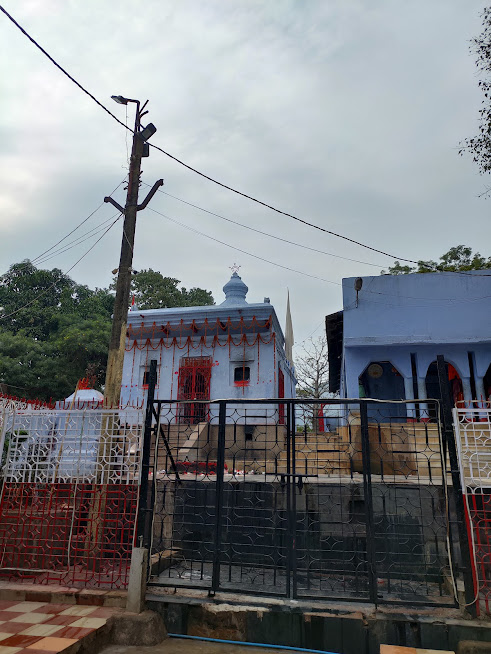
During Ramnavmi and Durga Puja, this quiet sanctum transforms. Pilgrims arrive not only from across Jharkhand, but also from West Bengal, Odisha, Chhattisgarh, Bihar and Madhya Pradesh. For a brief period each year, Latehar becomes a living corridor of devotion.
And yet, what truly distinguishes Ugratara is not its scale, but its steadfast fidelity to tradition.
The Sixteen-Day Navratri: A Royal Legacy
At Ugratara, Navratri does not unfold over the conventional nine days. Here, it extends to sixteen — a practice believed to have originated with a king who once worshipped the Goddess for sixteen continuous days. That act of royal devotion became a ritual, preserved and passed down by generations of Jharkhand’s royal families.
Navratri begins not on the first day of Ashwin, but on Ashwin Krishna Paksha Navami, coinciding with the second day of Jitiya Parva. The Kalash is installed, and Ashtabhuji Mata is worshipped. The cycle concludes on Ashwin Shukla Paksha Dashami, completing a sixteen-day arc of prayer, music, rituals and cultural performances.
For devotees, this is not merely an extended festival — it is an immersion into time-honoured discipline and devotion.
A Manuscript That Refuses to Age
Perhaps the most astonishing aspect of the Ugratara Temple is its reliance on a 500-year-old handwritten manuscript. This sacred text governs every ritual performed at the shrine. Its pages — remarkably intact — still bear ink that has defied centuries.
More than a ritual manual, the manuscript is a living archive. It even contains instructions on how it should be replicated: the preparation of ink, the method of transcription, the care required for preservation. In an age obsessed with digital permanence, this fragile book stands as a quiet rebuke — proof that devotion, when tended carefully, can outlast time itself.
When Visarjan Waits for the Goddess
Durga Visarjan at Ugratara is unlike anything I have heard before. On Vijayadashami, devotees offer paan — betel leaves — to the Goddess, placing them upon her seat. And then, they wait.
Sometimes for ten hours. Sometimes for twelve.
Only when the leaves fall on their own is the immersion ceremony permitted to begin. If they do not, the Visarjan is postponed.
This simple act transforms ritual into surrender. The devotees do not decide when the worship ends — the Goddess does. It is patience elevated to faith, and faith tempered by humility.
A Sanctuary of Shared Faith
Behind the temple lies the tomb of Madar Shah, a Muslim devotee of Bhagawati. During Vijayadashami, five flags are raised at the temple, and a sixth — white in colour — is sent to be hoisted over Madar Shah’s tomb. The drums that accompany the temple rituals are organised by members of the Muslim community.
There is no spectacle here, no declaration. Just a seamless interweaving of belief systems, sustained not by ideology, but by lived tradition. In Ugratara, harmony is not preached — it is practised.
Of Kings, Dreams and a Goddess Revealed
Legend speaks of a king journeying through the dense Mankeiri Jungle — present-day Latehar — who stopped by a pond to drink. As he cupped the water, an idol appeared in his hands. That night, the Goddess visited him in a dream, asking to be enshrined in his palace.
Thus, the temple came into being.
History, too, lends weight to legend. Queen Ahilyabai Holkar of Indore is said to have stopped here during her journey to Bengal, performing a grand puja. Even today, villagers recount her visit with quiet pride, as if her presence still lingers in memory.
Prasad, Every Day of the Year
One of the most moving traditions at Ugratara is its daily offering of rice and lentils as prasad — not on festival days alone, but throughout the year. Devotees are served this simple meal without distinction, a reminder that divine grace is not seasonal.
A Moment of Stillness
When we arrived, the temple was wrapped in silence. No crowds. No urgency. The sanctum had just been cleaned; preparations for the bhog were underway. I sat quietly, letting the stillness seep in.
Soon, the pujari beckoned us forward and placed dal and rice bhog in sal leaf containers into our hands. It was humble, nourishing, and profoundly sacred. In that moment, Prasad felt less like ritual and more like benediction — offered gently, received gratefully.

We left the temple with hearts full and spirits steadied. The road back felt lighter, as though something unseen had been set down along the way.
The Ugratara Temple is not merely a destination. It is a pause in time — a place where history, faith and humanity converge, and where devotion speaks most eloquently in silence.
I have always believed that travel is not about ticking destinations off a map, but about listening to landscapes, to memory, to the quiet stories places choose to reveal. The Ugratara Temple at Latehar offered no spectacle, no clamour for attention. Instead, it gifted something rarer: a moment of stillness, a reminder that faith can be fierce yet tender, ancient yet inclusive. Long after the road curved away and the forest closed behind us, Maa Ugratara remained — not as an image, but as a feeling. And perhaps that is the true grace of such places: they do not ask to be remembered; they simply stay with you.

Reading through your Betla National Park experience, I was wondering that “भक्त ने इस्बार कोई मंदिर में नही गया, ऐसा कैसे हो सकता है” ‼️
Very interesting read with lots of otherwise unknown info.
LikeLiked by 1 person
😂😂 Thanks, Aro.
LikeLike
I keep learning more from your travels _/_
LikeLiked by 1 person
Thanks, sir. 🙏
LikeLike
Very informative post, again. I never knew of 16-day Navratri! We have such diverse rituals in our country.
LikeLiked by 2 people
Thanks, Sanchita.
LikeLike
Festivals of Bihar weave a tapestry of tradition, spirituality, and cultural diversity. Each festival holds a unique place in the hearts of the people, fostering a sense of unity and communal harmony. As the people of Bihar celebrate these festivals with unwavering devotion, they not only preserve their cultural heritage but also contribute to the rich tapestry of India’s diverse and pluralistic traditions.
https://www.indianetzone.com/4/festivals_bihar.htm
LikeLiked by 1 person
The festivals of Jharkhand reflect the state’s rich cultural heritage and religious diversity. Whether it’s the exuberant celebrations of Holi and Diwali or the traditional rituals of Chhath Puja and Sarhul, each festival holds a special place in the hearts of the people, fostering unity and harmony among communities.
https://www.indianetzone.com/4/festivals_jharkhand.htm
LikeLiked by 1 person