
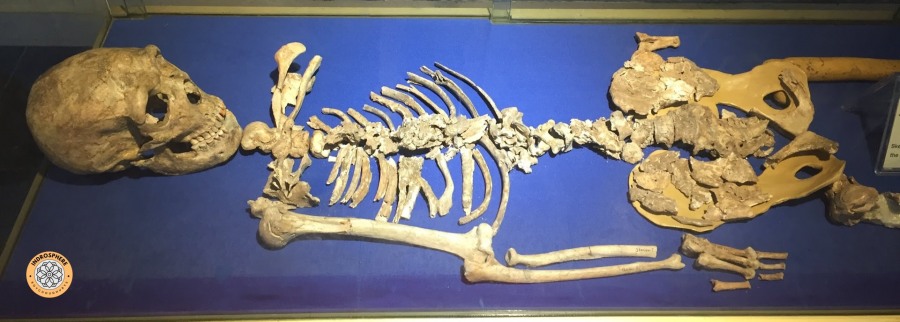
The air inside the Iraq Museum was thick with the scent of antiquity, every corner of the building resonating with whispers of a distant past. As I wandered through the exhibit halls, each display felt like an invitation—an invitation to journey back through time. It was International Museum Day, a fitting occasion for me to explore a treasure trove of relics from a world long gone. Mesopotamian tablets, meticulously carved sculptures, and remnants of empires faded into memory adorned the walls. But amidst these treasures, one exhibit drew me in with an almost magnetic pull: the remains of Shanidar 1, the Neanderthal affectionately known as “Nandy.”
The bones of this ancient being, dating back to 60,000–45,000 BCE, offered more than just a glimpse into the Palaeolithic past. They revealed a story—a story of survival, resilience, and, perhaps most importantly, compassion. As I stood before Nandy’s remains, a deep connection stirred within me. It felt as though the distant past and the present were meeting in this space, reminding me of the enduring bonds that unite us as humans, regardless of time.
A Face from the Distant Past
Navigating the dimly lit corridors of the museum, I was overwhelmed by the weight of human history. Each artifact seemed to carry with it a unique narrative, an untold story waiting to be uncovered. But it was Shanidar 1—this fragile collection of bones—that stopped me in my tracks. At first glance, his remains appeared unremarkable—just another skeleton, weathered by the passage of millennia. Yet, as I stood there, I felt an unexpected closeness, as if Nandy was reaching across time to share his story with me.
This was no ordinary exhibit. Shanidar 1 was not merely a relic of the past but a testament to the survival of the human spirit. His bones bore the marks of a life that had faced unimaginable hardships, yet one in which the compassion of a community had played an instrumental role in his survival. As I stood in front of him, I could not help but feel that I was standing on the threshold of a moment in time—one that connected me to a long-forgotten world where survival was not just about strength but about solidarity and mutual care.
The Story of Shanidar 1
The rugged Zagros Mountains of Iraqi Kurdistan cradle Shanidar Cave, a place that has become central to our understanding of Neanderthal life. In the 1950s, American archaeologist Ralph Solecki led a series of excavations at the site, uncovering a treasure trove of Neanderthal skeletons. Among these, Shanidar 1—discovered in 1957—stands out, not only for the exceptional preservation of its remains but also for the insights it offers into the life of our ancient relatives.
What makes Nandy’s story so remarkable is the evidence of his physical hardship. His skeleton bears the scars of an eye socket crushed beyond repair, a withered right arm, and severe damage to his right leg—likely sustained during his youth. These injuries, which left him with limited mobility and possibly blind in one eye, would have been a death sentence in a world where survival often depended on physical prowess. And yet, Shanidar 1 lived for years after these injuries, challenging the preconceived notions of Neanderthal life.
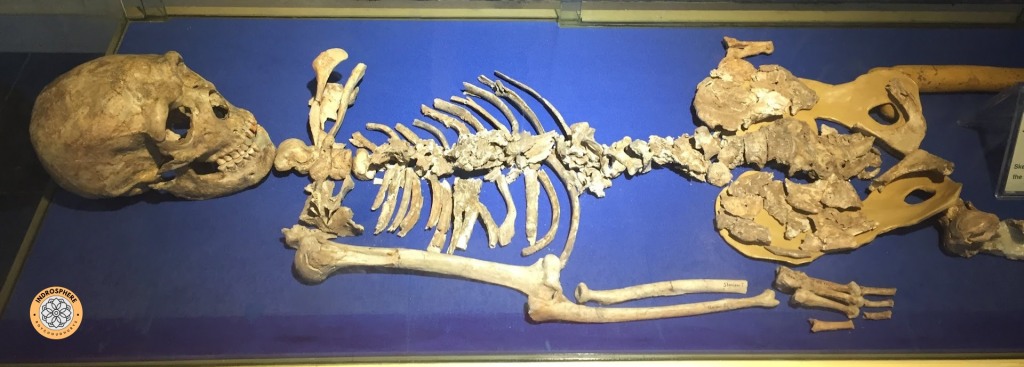
In a world where survival was a daily struggle, Nandy’s injuries should have been fatal. But instead, they tell a different story—a story of a community that refused to abandon one of their own. The care Nandy received from his group was not just an act of survival; it was a profound demonstration of social bonds and compassion. This was not the brutish, isolated existence often depicted in popular culture. Instead, Nandy’s story reveals a society that was capable of cooperation, empathy, and mutual support—a society that, despite its hardships, valued the individual.
A Glimpse of Neanderthal Humanity
As I stood before Shanidar 1, I felt an overwhelming sense of kinship. Though tens of thousands of years separated us, there was something deeply human about his story. The compassion that had sustained him resonated with me in ways I hadn’t expected. His injuries were not just marks of pain and suffering; they were also symbols of the enduring strength of human connection. The bonds that held his group together—bonds of empathy, care, and cooperation—allowed him to survive in a world that, by all rights, should have claimed his life.
Nandy’s story doesn’t end with his survival, however. His burial in Shanidar Cave offers additional clues about Neanderthal culture. Solecki’s team discovered that Shanidar 1 was intentionally buried, a practice that hints at a ritualistic or spiritual dimension to Neanderthal life. What’s even more intriguing is the discovery of pollen grains around his grave, suggesting that flowers were placed with his body—perhaps as an offering, or as part of a burial ritual. This simple yet profound gesture raises the possibility that Neanderthals, like us, may have believed in something beyond the physical world, perhaps even an afterlife.
These findings challenge the long-held assumption that ritualistic behaviour and spiritual beliefs were the sole domain of Homo sapiens. Instead, they paint a picture of Neanderthals as complex beings with deep emotional lives, capable of expressions of care, belief, and ritual.
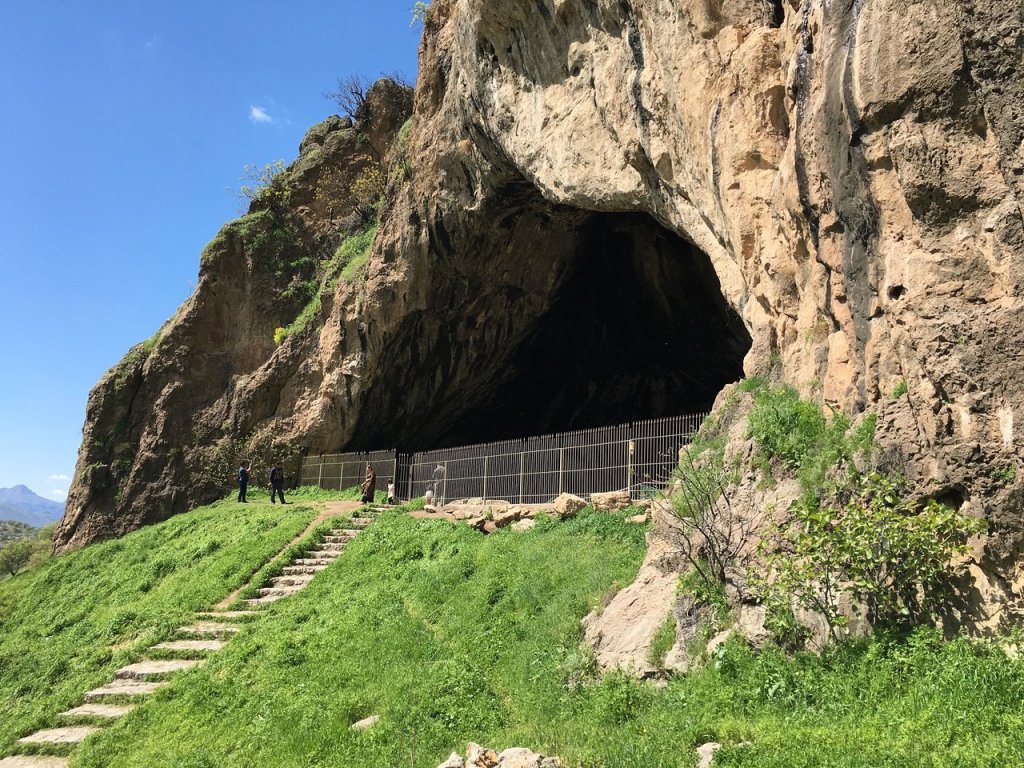
Recent excavations at Shanidar Cave continue to deepen our understanding of our prehistoric ancestors, offering fresh insights that add layers to the rich narrative of Neanderthal life. Each new discovery serves to strengthen the legacy of Shanidar 1, or Nandy, and the other Neanderthals who once roamed this harsh, rugged terrain.
I’ve often imagined what it would be like to stand in that very cave in the Kurdistan region, in northern Iraq—a place that holds such profound significance in the story of humanity. Perhaps one day I will find myself there, but when that will be, I cannot say.
A Personal Connection to the Ancient World
My visit to the Iraq Museum was not merely a passive tour through the past. It was a deeply personal journey—one that made me reflect on the roots of humanity itself. Standing before Shanidar 1, I was reminded of the resilience of those who came before us and the enduring qualities that make us human. Nandy’s life was not just about surviving in a harsh world; it was about the love, care, and community that enabled his survival. The compassion of his fellow Neanderthals, preserved in the silent language of his bones, spoke to me across the millennia—a reminder that these qualities are not modern inventions, but foundational elements of our shared humanity.
As I left the museum, the chaotic energy of Baghdad’s streets seemed distant, my mind still lingering on Shanidar Cave. Nandy’s story transcended time and space, and it stayed with me like a talisman, reminding me of the enduring spirit of humanity. In a world that often seems divided and fragmented, Shanidar 1’s life is a testament to the threads that have always bound us together—threads of compassion, resilience, and community that have woven a tapestry of human existence stretching from the Paleolithic to today.
On this International Museum Day, as I reflect on the treasures of the Iraq Museum, I feel a renewed sense of wonder. The museum, with its remarkable collection of artefacts, is not just a repository of ancient objects. It is a storyteller, preserving the voices of those who lived long before us. And in the story of Shanidar 1, I found a powerful connection to a shared humanity that will remain with me forever.

Very nice and informative
LikeLiked by 2 people
Thanks, Sanchita!
LikeLike
Fascinating!
LikeLiked by 1 person
Thanks 🙏
LikeLike
Recently I read about some human type skeleton discovered in the mountainous regions of China in late 19th century. However, it has mysteriously disappeared while being transported to the USA for further studies.
Any thoughts on that?
You are a lucky bastard to have experienced such treasure trove… 😜😜
LikeLiked by 1 person
Thanks, Aro, for the compliment. Yes, I am blessed for that.
The story you mentioned intertwines history, mystery, and perhaps even elements of folklore. Throughout the years, numerous strange or unexplained discoveries have sparked legends and conspiracy theories.
One such discovery, as per my knowledge, is the “Dragon Man” skull, scientifically known as Homo longi, which stands as one of the most significant paleoanthropological finds in recent history. This skull was reportedly unearthed in 1933 in China, during the Japanese occupation. To prevent the artefact from being taken by the occupying forces, a Chinese laborer who found the skull while working on a bridge construction project decided to hide it in a well. The skull remained concealed for approximately 85 years, until the laborer’s family finally retrieved it in 2018, leading to its formal description in 2021.
LikeLiked by 1 person
Thanks, may be it’s an award for being in places like Iraq. 😂
LikeLike
True, in this era of social media, people with good imagination weaves stories that sound real enough to get deceived.
LikeLiked by 1 person
Yes, indeed. We need to check every information from multiple and reliable sources.
LikeLike