
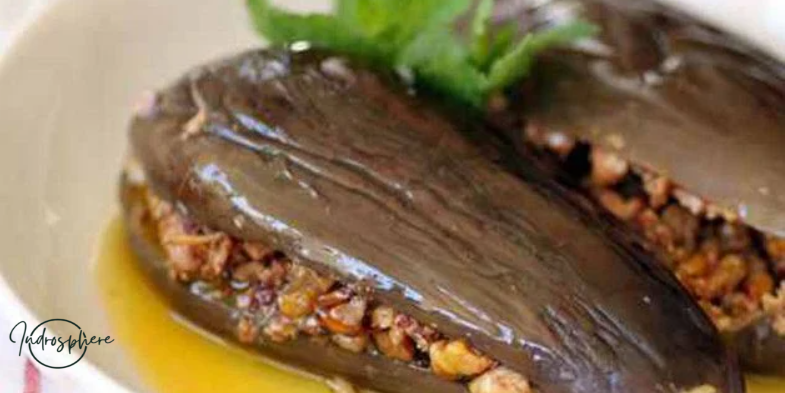
It began in Baghdad, 2007. The city was a symphony of contradictions—armored vehicles humming past roadside tea stalls, helicopters slicing through the sky while vendors hawked dates and cigarettes below. In the heavily fortified residential zone, where bank premises stood like bunkers and the air buzzed with tension, I found warmth in the most unexpected place: a jar of pickled eggplants.
It sat quietly on a colleague’s desk, unassuming and unapologetic. I didn’t know its name then. I only knew its taste—fiery, nutty, unapologetically garlicky, soaked in golden olive oil. The eggplant, though small, packed a punch that lingered longer than some of the more dramatic moments of those early days in Iraq.
Makdous: A Levantine Classic, Discovered in Mesopotamia
Makdous al-Batinjan, as I later learned, is a traditional preserve from the Levant—Syria, Lebanon, Jordan, Palestine, and yes, Iraq. But for me, it will always carry the scent and memory of Baghdad.
Made from baby eggplants stuffed with crushed walnuts, garlic, and chili, then submerged in olive oil, Makdous is a culinary marvel born of necessity and love. Its name, derived from the Arabic kadous (to press), captures its essence: gentle pressure, patient waiting, and deep flavor. Each jar is a compact archive of summer’s bounty, designed to nourish long after the harvest. It’s not just food—it’s folklore in brine.

Makdous is the kind of dish that doesn’t announce itself. It waits. It matures. It becomes. And when it’s ready, it tells stories—of grandmothers in Damascus kitchens, of Beirut breakfasts, of family tables where silence is broken only by the crunch of walnuts and the hum of satisfaction.
Khichdi Meets Makdous: A Cross-Cultural Affair
Back then, I hadn’t imagined that Makdous would one day find a permanent place on my own table, thousands of kilometers away. But as the years passed, and as my pantry evolved with pickles from across cultures, I found myself seeking that sharp, spicy edge that only Makdous can provide.
And then came the unlikely pairing—Makdous with khichdi.
Call it fusion. Call it nostalgia. Call it culinary diplomacy. But the union of the humble, comforting khichdi with the bold assertiveness of Makdous was nothing short of revelatory. It was East meeting West Asia on a single plate.
The creamy lentils and rice—mellow, nurturing, familiar—danced with the sharp tang of garlic, the crunch of walnuts, the gentle heat of red peppers nestled inside the pickled eggplant. It was a duet of comfort and complexity. What began as an experiment is now a ritual. On days when I make khichdi—whether the moong dal version of my childhood or the Bengali bhuni variety—a slice of Makdous completes the meal.
A Pickle’s Journey Across Borders
Today, Makdous is enjoying a global moment. From Levantine breakfast spreads to modern Mediterranean fusion on pizzas and salads, it has become a global ambassador of its region’s rich culinary heritage. But for me, its magic lies in its modest beginnings, its patience, and the way it quietly became a part of my personal food story.
A Jar of Stories: The Makdous Legacy
Makdous is more than just a pickled eggplant; it’s a jar of stories, a vessel of tradition, a taste of the Levant’s soul. It’s a reminder of the enduring power of food to connect us to our roots, to our history, to each other.
So the next time you encounter a jar of Makdous, pause. Remember the hands that prepared it. The stories it holds. The journey it has taken—from sun-drenched courtyards in Aleppo to a quiet kitchen in Erbil, where khichdi simmers and memories stir.
Each bite is a celebration of tradition. A taste of history. A moment of pure culinary magic.

Lovingly described 🙂
LikeLiked by 1 person
Thanks, sir. 👍😊
LikeLike
Can you share the ingredients, I would love to try it out (both making as well as savouring).
LikeLiked by 1 person
I will send you the recipe. Thanks.
LikeLiked by 1 person
It’s almost like pickling mangoes and lemons but of course different because of the vegetable, spices and oil used. In all Asian cuisines side dishes seem to be preserved/fermented like Kimchi of Korea and pickles in India. Am I correct?
LikeLiked by 2 people
Yes. Pickling is a widespread preservation technique found in many cultures around the world, including South Asia, where vegetables, fruits, and chutneys are pickled in spices, oil, and vinegar. Similarly, East Asia has its own pickling traditions using soy sauce, ginger, and garlic, while the Middle East and Mediterranean regions have dishes like Lebanese Makdous, Turkish turşu, Iranian torshi, and Greek piperies. Europe also has its own pickling traditions, and the Americas have their pickles, each with unique methods, ingredients, and flavour profiles reflecting local tastes and cultural influences.
LikeLiked by 1 person