

In the world of Indian cheese, the name “paneer” often steals the spotlight. But hidden among the bustling lanes of Kolkata lies a rare, artisanal cheese with a fascinating colonial history—Bandel cheese. A forgotten gem that tells the story of Bengal’s rich past, Bandel cheese has roots in Portuguese influence, dating back centuries. Its bold, smoky aroma and intense saltiness make it unlike anything else found in India.
As the world celebrates International Cheese Day on March 27, 2025, let’s take a journey into the past, tracing the origins of Bandel cheese and its enduring legacy.
The Portuguese & Bengal’s Cheesemaking Tradition
The story of Bandel cheese begins in the 16th century when the Portuguese, ever the adventurers, established colonies along the Bengal coast, including the town of Bandel. They brought European cheesemaking traditions, which they adapted to local conditions. This was the same period when they introduced chhana—the foundation of Bengali sweets like rosogolla and Sandesh—to the region.
Bandel cheese, however, was not made with the typical European technique of rennet-coagulation. Instead, it was crafted using acid-coagulation, a method more familiar to us through the making of paneer. But with a twist—after the cheese was formed from cow’s milk into small rounds, it was brined and smoked to preserve it. This smoking process, which gives Bandel cheese its signature earthy aroma, was practical for Bengal’s humid climate, where refrigeration was scarce.
The most distinctive feature of Bandel cheese is its smoking process. The cheese was often smoked over firewood or dried leaves, infusing it with a deep, rustic flavor. This not only helped preserve it but also gave it an aromatic, earthy profile unlike any other cheese in the region. It was a bold, earthy taste that resonated with the rich cultural fusion of Portuguese influence and Bengali culinary ingenuity.
Though Bandel cheese originated in Bandel, a small town in West Bengal, its production eventually shifted to Kolkata as demand grew. Today, it is still made in small family-run operations, with the old-world methods being passed down through generations. But as is often the case with artisanal traditions, these makers are few, and the practice is endangered.
The Lost Art of Indian Cheesemaking
India has a long history with dairy, but its cheesemaking culture has often been overshadowed by other culinary traditions. Unlike in Europe, where cheese has been an integral part of the diet for centuries, Hindu dietary customs historically discouraged the fermentation of milk. Yet, with the arrival of Europeans, some regions of India adapted their cheesemaking techniques, particularly in areas where the Portuguese, Dutch, and British had a strong influence.
Bandel cheese is one of the rare examples of this fusion of European methods and local tastes. Alongside it, there are a handful of other unique Indian cheeses that stand as relics of this tradition:
- Topli Na Paneer – A Parsi soft cheese, set in tiny baskets.
- Kalimpong Cheese – Developed by Swiss Jesuit Father Andre Butty in the 1950s in a Kalimpong dairy.
- Kalari (Dogri Cheese) – A stretchy, pan-fried cheese from Jammu and Kashmir. I tasted it during my visit to the Kashmir valley.
- Chhurpi – A hard yak cheese from the Himalayas, commonly chewed like gum. I chewed it during my visit to Sikkim.
But Bandel cheese stands apart due to its bold, salty, smoky profile, making it an essential piece of India’s overlooked cheesemaking heritage.
From New Market to Global Curiosity
For decades, Bandel cheese remained a hidden gem, known only to locals in Kolkata, often found in select shops like the iconic J. Johnson & Co. in New Market. But in recent years, it’s gained newfound recognition. The West Bengal government has now started selling Bandel cheese at Biswa Bangla outlets, helping to popularize this historic delicacy.
Food historians, chefs, and culinary enthusiasts are rediscovering Bandel cheese, bringing it to the forefront of the artisanal food movement. It’s now available in gourmet stores, upscale restaurants, and online platforms specialising in regional Indian products. Its re-emergence is a win for those who believe in the power of food to tell stories—stories of a place, its people, and its history.
However, Bandel cheese is still at risk. As fewer artisans continue the traditional production methods, the cheese faces an uncertain future. Its preservation is now in the hands of cheese lovers, food historians, and local artisans who are passionate about keeping this culinary tradition alive.
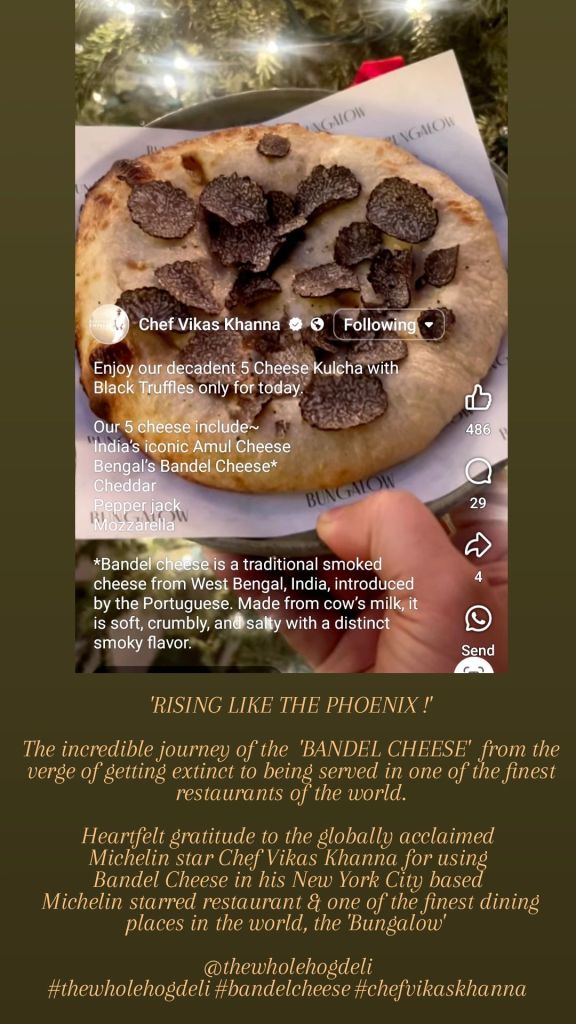
In a testament to its enduring culinary excellence, 400-year-old Bandel Cheese was recently showcased by Michelin-starred chef Vikas Khanna at his acclaimed New York City restaurant, ‘Bungalow’, reaffirming its global reputation.
How to Enjoy Bandel Cheese: Pairings and Recipes
Bandel cheese is as versatile as it is unique. Its crumbly texture and smoky flavor make it an excellent ingredient in a variety of dishes. Here are a few ways you can enjoy it:
- Salads: Crumbled Bandel cheese adds a punch of saltiness and smokiness to fresh greens and vegetable salads.
- Soups: Its earthy, smoky notes can elevate creamy soups or broths, giving them depth and complexity.
- Bandel Cheese Bharta: Mash Bandel cheese with mustard oil, onions, and green chilies for a smoky, tangy delight served with hot rice.
- Spiced Bandel Cheese Stir-fry: Stir-fry cubes of Bandel cheese with garlic, tomatoes, and capsicum for a quick, smoky side dish.
- Cheese Platters: Pair Bandel cheese with crackers, nuts, figs, or even a drizzle of honey to balance its intense saltiness.
When it comes to drinks, Bandel cheese pairs beautifully with wines or cocktails that can hold their own against its robust flavors. Try a smoky whiskey or a bold red wine with the smoked variety, while the un-smoked version works wonderfully with light white wines or sparkling options.
Preserving a Culinary Treasure
Bandel cheese is more than just a food; it is a living piece of history. Each crumbly bite carries the legacy of Portuguese traders, colonial markets, and Bengali artisans. As modern dairy products become more prevalent, the future of Bandel cheese hangs in the balance.
If we do not actively seek out, share, and celebrate these forgotten treasures, they may be lost to time. So, this International Cheese Day, let’s not only celebrate the cheeses of Europe but also honor the unsung cheesemaking traditions of India. Seek out Bandel cheese, savour its complex flavours, and most importantly, share its story.
Cheese lovers, unite! Here’s a question for you: Have you ever tried Bandel cheese? Do you remember the first time you tasted it? Let’s gather these memories, these flavours, and these experiences before they slip away, like the last crumble of cheese on a well-loved plate.
Image from the Internet

Wish I had known two weeks back when we were in Kolkata 😦
LikeLiked by 1 person
Oh! Keep this info for next time.
LikeLike
Have you tried the Bandel Cheese? What was the experience of Foodie Indrobodon?
Unfortunately, I don’t think I can get it in Delhi given the low awareness of the product in general.
LikeLiked by 1 person
Yes, I had the pleasure of savoring it during my training days at PNB in Kolkata. Back then, we often enjoyed it as salads and chakna alongside whisky.
Heard that online delivery has started in limited scale. Check if it’s delivered in Delhi.
LikeLike
It was very nice, I really enjoyed your writing It was even better to know that you are also a food lover. I tried to write as much as I know.
As we celebrate International Cheese Day today, let’s dive into the rich history of Bandel cheese, a lesser-known cousin of the famous Bengali sweet, chhena. This cheese has a fascinating story that spans centuries, with its origins dating back to the Portuguese colonization of Bengal
In the 15th century, Vasco da Gama arrived in India, marking the beginning of Portuguese influence in the region. As the Portuguese settled along the rivers, they introduced their culinary techniques, including cheese-making, to the local population The art of curdling milk, which was initially considered taboo by orthodox Hindus, was adopted by local cooks who worked under Portuguese supervision
The result was Bandel cheese, named after the town of Bandel, which was a major center of Portuguese trade and commerce. This cheese is made by separating curd from whey using lemon juice, then molding and draining it in small baskets, and finally smoking it to give it a distinctive flavor
Bandel cheese has a dry, crumbly texture and a smoky, salty taste, making it a perfect accompaniment to sandwiches, salads, and pasta ³. What’s more, this cheese is also the precursor to famous Bengali sweets like sandesh and rosgolla
Despite its rich history and cultural significance, Bandel cheese is now a rare find, with only a few shops in Kolkata’s New Market selling authentic versions However, efforts are being made to revive this traditional cheese, with researchers and chefs working together to obtain a GI tag and promote its production
As we celebrate International Cheese Day, let’s raise a toast to Bandel cheese, a true culinary treasure that deserves to be savored and preserved.
LikeLiked by 1 person
Thanks, Dipen, for your input. It is going to enhance my post. Much appreciated.
LikeLike
It looks very interesting, almost like a smoked Gouda.
LikeLiked by 1 person
Thank you!
LikeLike
Yes, my favorite as I am in kolkata.
LikeLiked by 1 person
It’s good to know that. Thanks.
LikeLiked by 1 person
I have always loved Bandel Cheese. So happy to read so much about it.
LikeLiked by 1 person
Thank you!
LikeLiked by 1 person