

We like to believe we are good decision-makers. In fact, most of us pride ourselves on it. The banker who trusts his instincts, the traveller who swears by “local knowledge,” the executive who claims to have a sixth sense for people—each of us carries a quiet confidence that when it matters, we get it right.
But what if that confidence itself is the first illusion?
I remember a long train journey many years ago, somewhere between Lucknow and Aligarh. A fellow passenger, well-read and articulate, was confidently explaining why a particular stock would “definitely double” within months. He had facts, figures, past trends, and a compelling narrative. I listened, mildly impressed, and almost convinced. Months later, the stock collapsed spectacularly. When I met him again by chance, he laughed it off: “The market is irrational.”
Perhaps. Or perhaps it was the mind that was playing tricks.
The Quiet Puppeteers of Our Thinking
Modern psychology tells us something deeply unsettling: we are not as rational as we think. Our decisions—big and small—are constantly shaped by cognitive biases: systematic errors in thinking that arise from faulty memory, flawed assumptions, emotional shortcuts, or social conditioning.
These biases don’t announce themselves. They work silently, confidently, often convincingly. And because they feel like common sense, we rarely question them.
What makes this even more intriguing is that not all cognitive biases are villains. Some are surprisingly useful.
When Belief Becomes Medicine
Consider the placebo effect, one of the most fascinating examples of cognitive bias working in our favour. Patients who are told that a pill will make them better often do improve—even when the pill contains no active ingredient.
I once spoke to a doctor who half-jokingly said, “My confidence cures almost as many patients as my prescriptions.” There is profound truth in that statement. The brain, convinced of healing, initiates real physiological change. Entire drug trials have been derailed because sugar pills performed too well.
Here, bias is not deception—it is hope harnessed as healing.
Can Memories Be Manufactured?
If belief can heal the body, what can it do to memory?
In a thought-provoking forum session titled “What If Your Mind Can Be Read”, Duke University professor Nita Farahany described research that feels almost like science fiction. Through careful persuasion and suggestion, researchers have been able to create false memories—not vague impressions, but emotionally vivid recollections of events that never actually occurred.
This is not about sinister mind control. In fact, the implications are surprisingly compassionate.
Take propranolol, a drug originally used for heart conditions. Researchers discovered that it can dampen the emotional intensity of traumatic memories. For victims of violent crime or severe accidents, it doesn’t erase what happened—but it loosens the grip of terror attached to the memory. The event remains; the suffering softens.
Memory, it turns out, is not a video recording. It is a story we retell ourselves—each time with subtle edits.
The Unreliable Narrator in Our Head
What we know is often no more reliable than what we remember. And memory, as science repeatedly shows, is malleable.
Have you noticed how two people recall the same incident very differently? Or how your own recollection of a childhood event changes depending on who you last discussed it with? This is not dishonesty—it is the brain filling gaps, smoothing edges, and creating coherence.
We are, each of us, living with an unreliable narrator in our head.
A Mullah, a Rumour, and the Power of Belief
There is a delightful story about the legendary Mullah Nasreddin that captures the absurd brilliance of the human mind.
One morning, the Mullah was sitting under a tree when he noticed villagers walking toward the city. In a playful mood, he casually remarked, “Why are you all going today? Haven’t you heard—the Amir has invited everyone for a grand dawat at his palace this evening.”
He said it purely in jest—and promptly forgot about it.
Later that afternoon, Nasreddin noticed a steady stream of people heading toward the Amir’s palace. Curious, he stopped a few and asked the reason. “The Amir has invited everyone for a shahi dinner,” they replied confidently.
At that moment, the Mullah realised—with a smile—that he himself had planted the story that morning.
And yet, when he saw another group walking purposefully in the same direction, he quietly joined them. “After all,” he thought, “with so many people going, perhaps it is true.”
Twenty Ways the Mind Trips Itself
A chart compiled by Business Insider neatly captures this reality by listing 20 common cognitive biases that routinely sabotage our decision-making. From confirmation bias (seeking only what agrees with us), to hindsight bias (“I knew it all along”), to the sunk cost fallacy (throwing good money after bad because we’ve already invested), these mental shortcuts quietly steer our choices. What makes them dangerous is not their existence—but our blindness to them.
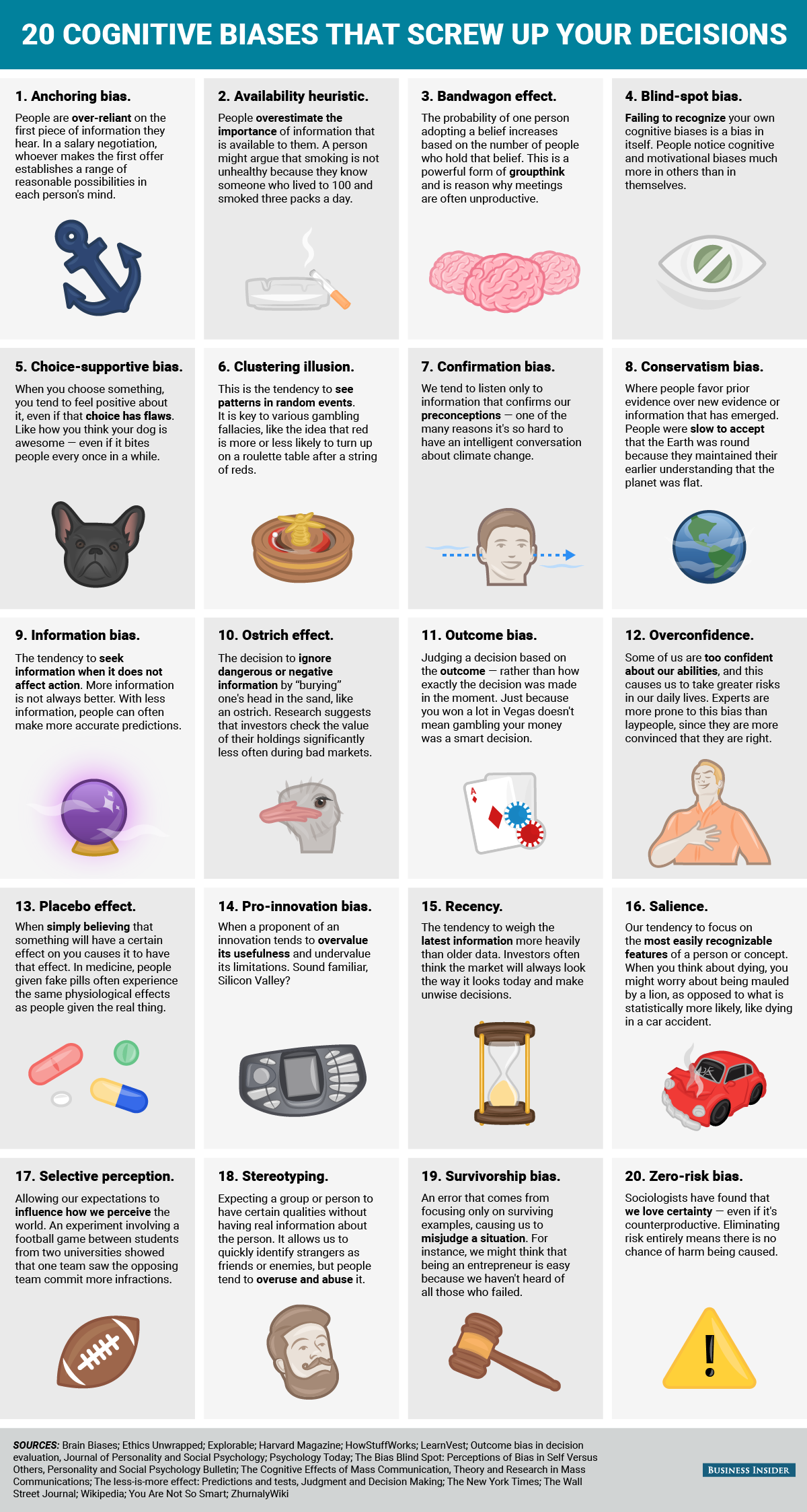
I’ve seen brilliant professionals defend failing projects simply because they had championed them early on. I’ve seen travellers dismiss new experiences because they didn’t match preconceived expectations. I’ve even caught myself rationalising decisions long after evidence suggested I was wrong.
Awareness comes late. Often too late.
Wisdom Begins with Doubt
Perhaps true wisdom does not lie in sharper intelligence or faster analysis, but in humility about our own thinking.
To pause and ask:
- What assumptions am I making?
- What evidence am I ignoring?
- Am I remembering this accurately—or conveniently?
The mind is powerful, creative, and deeply flawed. It can heal bodies, reshape memories, and build convincing realities from thin air. Understanding its biases does not make us immune—but it makes us gentler with others and more cautious with ourselves.
And maybe that is the real takeaway. Not that we should distrust every thought—but that we should stop being so sure of them.
A Closing Reflection: Learning to Live with an Imperfect Mind
If there is one uncomfortable truth this journey through cognitive bias leaves us with, it is this: certainty is seductive, but rarely trustworthy.
The mind wants closure. It wants patterns, explanations, and neat stories. In doing so, it often trades accuracy for comfort. We remember what flatters us, believe what reassures us, and defend what we have already invested in—time, money, emotion, or ego.
Yet recognizing this imperfection is not a cause for despair. On the contrary, it can be liberating.
When we accept that our decisions are shaped by invisible biases, we become less rigid and more reflective. We listen a little longer. We ask an extra question. We hesitate before passing judgment—on others and on ourselves. Leaders make better choices when they invite dissent. Travellers experience more when they let go of expectations. Even in everyday life, relationships soften when we acknowledge that memory and perception are deeply personal, not absolute truths.
Perhaps the goal, then, is not to eliminate bias—an impossible task—but to build rituals of pause. To step back before deciding, to seek alternative viewpoints, to write things down before memory rewrites them, and to treat our own convictions with gentle suspicion.
In an age of overwhelming information and instant opinions, this may be one of the most valuable skills we can cultivate.
Not sharper judgment. But quieter confidence.
Not absolute certainty. But thoughtful doubt.
Because sometimes, the wisest decision we can make is simply to admit: my mind, remarkable as it is, does not always tell me the truth.

Great write up… quite right!
LikeLiked by 1 person
Thanks a lot!
LikeLiked by 1 person
🙂
LikeLiked by 1 person
Nice piece…very accurate!
LikeLiked by 1 person
Liked the graphics
LikeLiked by 1 person
Yes cognitive bias + emotions influence our decision making, at times much more than we realize or accept. Similarly how information is presented to us also impacts our decision making.
Sir, sharing with you my post on Decoding the Power of Emotions on Decisions http://wp.me/p3RQLD-EC
LikeLiked by 1 person
Nicely explained with the graphics. Decisions are often biased and situation specific….
LikeLiked by 1 person
Superb! I wish if you can explain all points in little detail in upcoming blogs. Everyday we make a good or bad decision, but never thought it can be categorized or algorithmised.
LikeLiked by 1 person
I’ve always thought to be a decision maker, not bad or good. If I make a bad decision, it becomes apparent eventually. If I make a good one, I’m golden. But if I make no decision, nothing good or bad happens.
LikeLiked by 1 person
Doing nothing is also an action; not making a decision is making a decision! 🙂 Thanks for stopping by.
LikeLiked by 1 person
True, but often I have found myself stuck in the analysis of a decision rather than simply making one.
LikeLiked by 1 person
In such cases, I trust my instincts, and make judgements on what my heart tells me believing that the heart will not betray me. 😉
LikeLike
I found myself nodding multiple times as I went through your article, remembering the time when we had to hire our first key employees. In fact, we have penned our thoughts on the same. Do check it out!
http://blog.aasaanjobs.com/2016/01/28/7-problems-hiring-key-people-startup/
And do keep coming out with infographics such as this one!
LikeLiked by 1 person
Thanks Dinesh for dropping by.
LikeLiked by 1 person
Pingback: How to Become a Powerful Negotiator Overnight
Pingback: How to Become a Powerful Negotiator Overnight – WordPress Initiate
Pingback: How to Become a Powerful Negotiator Overnight | Easy blog networks
Pingback: How to Become a Powerful Negotiator Overnight – socialmediamalaysia.com
Pingback: How to Become a Powerful Negotiator Overnight | ZMARKETING
Pingback: How to Become a Powerful Negotiator Overnight | | MAJORPRESS
Pingback: Como Aprender a Negociar Melhor e Fechar Mais Negócios
Pingback: Cómo Convertirte En Un Poderoso Negociador De La Noche a La Mañana
Pingback: Wie man über Nacht das Verhandeln lernt
Pingback: How to Become a Powerful Negotiator Overnight | w3a1.com