

In today’s world, we are constantly bombarded with information from various sources. With the rise of social media, it has become easier than ever to access news and opinions from all over the world. However, this abundance of information has also led to the spread of false information, which can have a detrimental impact on society.
The term “post-truth” has been used to describe a situation where objective facts are less influential in shaping public opinion than appeals to emotion and personal belief. In other words, people are more likely to believe something if it aligns with their preconceived notions, regardless of whether or not it is true.
The rise of post-truth has been attributed to several factors, including the proliferation of social media, the decline of traditional news sources, and the increasing polarization of political discourse. In a post-truth world, misinformation and propaganda can spread quickly and easily, often with little or no fact-checking or critical analysis.
While this has been described as a contemporary problem, there is a possibility that it has long been a part of political life but was less notable before the advent of the Internet. In the novel Nineteen Eighty-Four, George Orwell casts a world in which the state is daily changing historic records to fit its propaganda goals of the day. Orwell based much of his criticism of this on Soviet-Russian practices. Post-truth is a close cousin of relativism, where my truth and your truth might well collide, but we’re not going to get into any informed arguments or debate, out of which truth might emerge.
After much discussion, debate, and research, the Oxford Dictionaries Word of the Year 2016 is post-truth — an adjective defined as ‘relating to or denoting circumstances in which objective facts are less influential in shaping public opinion than appeals to emotion and personal belief’.
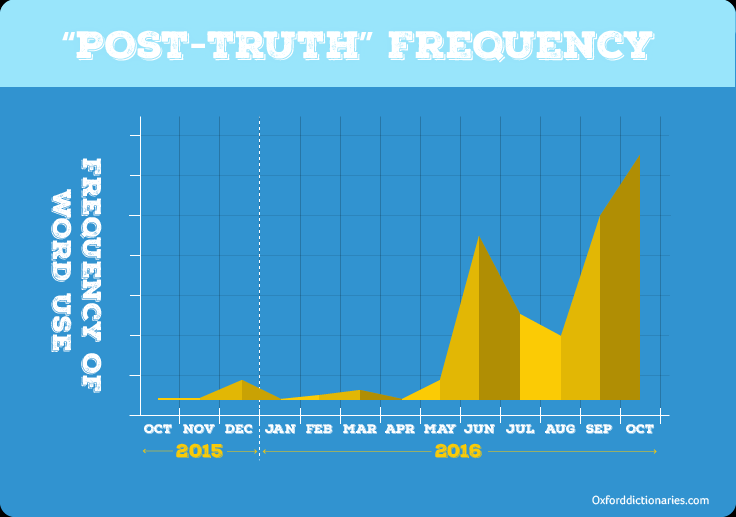
The concept of post-truth has been in existence for the past decade, but Oxford Dictionaries has seen a spike in frequency this year in the context of the EU referendum in the United Kingdom and the presidential election in the United States. It has also become associated with a particular noun, in the phrase post-truth politics.
Post-truth has gone from being a peripheral term to being a mainstay in political commentary, now often being used by major publications without the need for clarification or definition in their headlines. Think of Brexit, the rise of Donald Trump, or even some of the political storms in India: the facts were out there, but emotional narratives carried the day. What sways the masses isn’t always evidence—it’s often a clever play on sentiment, grievance, or fear.
Post-truth politics eats away at the very foundation of trust. When institutions—media, government, science—are constantly undermined by misinformation, cynicism takes root. People stop believing in anything. That skepticism, while healthy in small doses, can become corrosive when it hardens into mistrust.
Public health gives us stark examples. False claims about vaccines have fueled the return of diseases like measles and whooping cough. The COVID-19 pandemic saw an explosion of conspiracy theories, some of which endangered lives by promoting untested cures or blaming entire communities.
The danger here isn’t just misinformation—it’s that facts lose their weight. Debate becomes less about reason and more about who shouts the loudest or appeals to the deepest fears.
Here’s where it’s useful to bring in another concept: Zohnerism. The term comes from a 1997 science fair project by 14-year-old Nathan Zohner. He petitioned people to ban “dihydrogen monoxide”—better known as water—by presenting true but selectively framed facts about it (e.g., it causes rust, it can suffocate you, it’s found in cancerous tumors). His success revealed how true information, stripped of context, can still mislead.
So how is Zohnerism different from post-truth?
- Post-truth: Emotion overrides fact. People choose what to believe because it aligns with their feelings or identity.
- Zohnerism: Facts are technically accurate but weaponized through selective presentation, leading people to a false conclusion.
In short: post-truth ignores facts, while Zohnerism misuses them.
If these terms sound bleak, they also hold a challenge for us. We need sharper tools to navigate the world of information. Media literacy is one answer—learning how to question sources, verify claims, and spot manipulative language. Fact-checking organizations help too, but they can only go so far if we aren’t willing to question our own biases.
Ultimately, the responsibility rests with us as individuals. Being informed isn’t just about consuming more news—it’s about thinking critically, asking better questions, and being humble enough to change our minds when the facts demand it.
Post-truth also fuels conspiracy theories. These thrive on fear, weaving elaborate stories out of half-truths or pure invention. Whether it’s the idea that COVID-19 was engineered as a weapon or that shadowy elites control the world, such narratives spread quickly because they offer simple answers to complex realities. But as history shows, scapegoating and suspicion rarely solve problems—they only deepen divisions.
Truth may be harder to find today, but it hasn’t disappeared. The task before us is to reclaim it—not by denying emotions, but by refusing to let them drown out reason. And perhaps, by remembering that the world is complicated enough without us inventing new illusions.

I had doubts about the meaning of this word of the year. Thank you for clarifying!
LikeLiked by 1 person
Thanks Shivangi for your visit.
LikeLiked by 1 person
Scary stuff. Terrifying.
LikeLiked by 1 person
Georgia, dishonesty in politics is nothing new; but the manner in which some politicians now lie, and the havoc they may wreak by doing so, are really worrying or as you said it terrifying.
The society may soon begin working to rediscover the power of the search for truth.
Could 2017 be the year of post post-truth?
LikeLike
Interesting post. I believe that post-truth thankfully still belongs only in the world of politics.
LikeLiked by 1 person
Yes, thanks. 🙂
LikeLike
Actually, I always wonder what post truth really means – if you translate the word it means something that is coming after the truth…
…but is it really lies, or fake news?
This is more turning truth into its opposite.
LikeLiked by 1 person
Yes, here post- is not related to time! May be some other prefix would straightaway indicate it’s a lie 😉 🤔
LikeLiked by 1 person
Yes. I think so too. But I think the term is set now.
LikeLiked by 1 person
Yes, the term is set now and “post-truth politics” is being used quite often nowadays.
LikeLike
I have always loved your writings and so I have nominated you for the Bloggers Recognition Award. If you ok with these awards, Here is a link to the post.
LikeLike
This word, somehow, gives me goosebumps of terror whenever I read or heard it!
LikeLiked by 1 person
The manner in which some politicians now lie and the havoc they may wreak by doing so can really cause “goosebumps of terror”!
LikeLiked by 1 person
Absolutely!
LikeLiked by 1 person
Pingback: The Connection Crisis | Thily Fin
Great post on what is one of the most important issues in world poltics today. It reminds me of the book Nineteen Eighty-Four. It has been many years since I last read an Orwell but the appearance of terms like post-truth, alternative facts and fake news prompted me to review the 1984 film adaptation. It holds up remarkably well for a 33 year old film. You are welcome to visit and see how the film stacks up in todays cinematic terms.
LikeLiked by 1 person
Thank you, Richard. Your blog is an amazing collection of reviews of films. Nice efforts! 1984 will keep haunting us on. 🙂
LikeLiked by 1 person
That is so kind of you to say, thank you. As a fellow political scientist I find your blog on topic and thoroughly engaging.
LikeLiked by 1 person
Thanks Richard for your kind words.
LikeLike
Pingback: The Narrative Age: Stirring Truth in the Kitchens of Memory – Indrosphere