

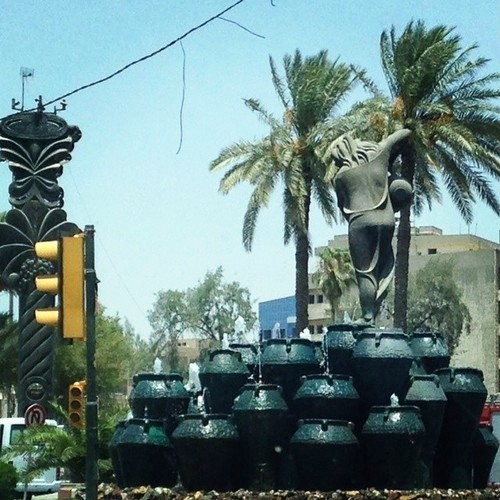
As I wandered through the bustling streets of Baghdad, the city’s historical grandeur often whispered its stories. Among the many iconic landmarks, one stood out, not just for its artistry, but for the powerful story it told—a story that resonated with me, especially during my years in Iraq. The statue of Kahramana, standing tall at the crossroads of Karrada Dakhil and Karrada Kharij, became an enduring symbol of resilience and hope, something I couldn’t ignore every time I passed by.
Created in the 1960s by the talented Iraqi sculptor Mohammed Ghani Hikmat, this statue is more than just a remarkable piece of art. It portrays a young woman gracefully pouring water from a jar, surrounded by forty others, encapsulating both elegance and strength. For many, the statue is synonymous with the famous tale of “Ali Baba and the Forty Thieves” from One Thousand and One Nights. In this classic story, the clever slave girl Morgiana foils the plans of the thieves by pouring boiling oil into the jars they hide in, saving her master and ensuring the safety of the household.
But it’s not just the famous folk tale that makes this statue significant. There is an older, lesser-known version of the story—one rooted in pre-Islamic Baghdad—that carries a profound message of bravery and intelligence. According to this version, Kahramana was a young woman who helped her father run a small hotel during a harsh winter night. When thieves broke in, they hid in empty oil jars, thinking they would go undetected. Kahramana, with sharp wit and quick thinking, devised a clever plan. She alerted her father and, knowing the thieves were hiding in the jars, poured hot oil into each one, capturing the intruders. Her courage and resourcefulness saved her family and guests, and she became a hero in the community.
Kahramana: The Symbol of Hope
The name Kahramana itself means “heroine” in Arabic, and it is hard to imagine a name more fitting for a statue that stands as a symbol of hope and perseverance. As I lived and worked in Baghdad, this monument became a quiet reminder of the strength of the human spirit, especially during times of hardship. Iraq, a country with a history marred by conflict and turmoil, found in Kahramana a figure who embodied the resilience of its people.

This statue, despite being a target for vandals and enduring the ravages of war, remains an unyielding beacon of Iraq’s cultural heritage. Through all the challenges, it endures, drawing both locals and tourists alike. I, too, found solace in its presence, especially during the difficult years I spent in the country.

Every time I passed the statue on my way to the Iqama office, I couldn’t help but feel a connection to its symbolism. In the face of adversity, there is always room for courage and intellect, and this statue was a reminder of that.
A Monument for the Ages
What struck me the most about the statue of Kahramana was its unique position in the Arab world. In a region where female figures are often underrepresented in public art, this statue stood proudly, showcasing a female heroine. It was not just an artistic statement but a tribute to the intellect and bravery of women throughout history—a reminder that stories of women’s courage deserve to be told and celebrated.

In a time when Iraq was grappling with its own struggles, I found the statue’s presence deeply comforting. It stood, almost defiantly, amidst the noise of the world, a quiet yet powerful symbol of hope, and a testament to the idea that even in the darkest times, light will find its way. Iraq, in all its complexity and beauty, was rebuilding—its people determined to rise again. And in the heart of Baghdad, Kahramana was a story worth holding onto, one that would continue to inspire future generations.
A Personal Reflection
As I reflect on my time in Baghdad, Kahramana remains one of the most poignant symbols of my journey. Beyond its historical significance, it was a personal reminder for me during my years in Iraq, particularly as I worked on strategic projects, often navigating through uncertainty. The resilience of the statue mirrored the spirit of the people I worked alongside—people who, like the heroine of the story, were determined to outsmart the odds and emerge stronger.
Whether it was in the quiet moments as I passed the statue or during the larger moments of reflection after work, Kahramana reminded me that perseverance, courage, and intellect are always the tools that lead to victory. In Iraq’s story of rebuilding, Kahramana wasn’t just a statue—she was a living testament to the indomitable strength of a nation and its people.
As Iraq moves forward into a brighter future, Kahramana will undoubtedly remain a powerful reminder of the past and a source of inspiration for the generations that follow. For me, she will always be more than just a statue; she is a symbol of hope, strength, and the enduring power of the human spirit.

At the first glance to the statue of Kahramana, and reading about the 40 jars, I too thought she was the legendary girl Marjiana. The other story is fascinating as well… 🙂
The post reminded me of the stories of the Arabian Nights…so fascinating they’re…
LikeLiked by 1 person
We all grew up reading stories from Arabian Nights. Some of the stories fascinated me more like the voyages of Sindbad and the ruler Haroon Rashid. May be that drew me to Baghdad. 🙂
LikeLiked by 1 person
বাগ্দাদের খলিফ’র গল্প… 😀 কত পড়েছি…
LikeLiked by 1 person
I will probably never go here so I so appreciate people who do and share their experience!
LikeLike
Thanks Georgia.
LikeLike
I have read the folk tale of Ali Baba and the Forty Thieves and also seen a movie based on it. It is interesting to know that Kahramana could be Morgiana!
LikeLiked by 1 person
Beautiful sculpture and interesting folklore that might have inspired the story of Ali Baba.
LikeLiked by 1 person
बढ़िया मूर्ति और मज़ेदार क़िस्सा .
LikeLiked by 2 people
धन्यवाद!
LikeLike