
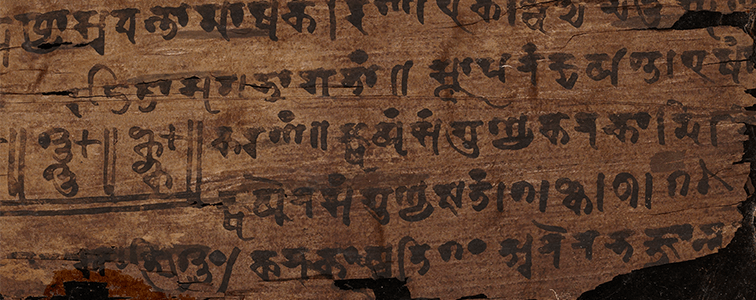
In 1881, a farmer in the village of Bakhshali, located near modern-day Peshawar in Pakistan, stumbled upon an extraordinary artefact buried in history—the Bakhshali Manuscript. This mathematical treasure, written in Sanskrit on birch bark, dates back to the 3rd or 4th century CE and is considered one of the oldest surviving mathematical texts from the Indian subcontinent. It opens a window into ancient India’s advanced mathematical knowledge and cultural ethos.
Peshawar: A Historic Backdrop
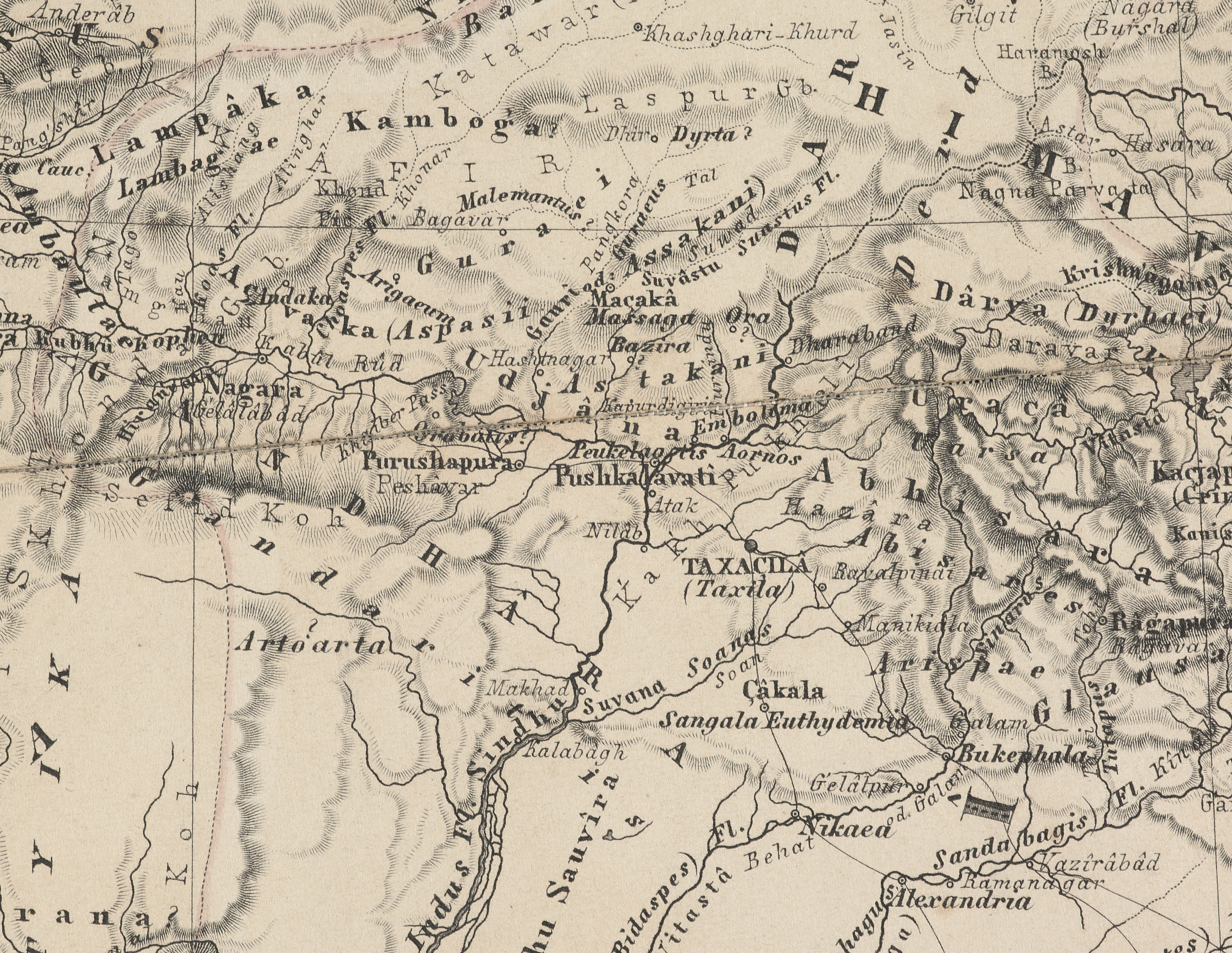
The manuscript hails from Purushapura, now Peshawar, a city with a recorded history since 539 BCE. Once the capital of the Kushan Empire, Peshawar was a thriving hub of trade, culture, and intellectual pursuits. The rich legacy of this region provides the perfect backdrop for the emergence of such a groundbreaking text.
Mathematical Content and Innovations
The Bakhshali Manuscript comprises 70 leaves of birch bark, containing problems and solutions spanning arithmetic, algebra, geometry, and trigonometry. Its practical applications—such as calculating the volume of bricks or the area of fields—reflect its relevance to daily life.
One of its most groundbreaking contributions is using the decimal place value system, which revolutionized mathematics. The manuscript employs a dot as a placeholder for zero, a concept that later evolved into the hollow-centered symbol we use today. The Indian innovation of zero, rooted in philosophical reflections on nothingness, profoundly influenced mathematical progress worldwide.

Additionally, the manuscript demonstrates methods for solving quadratic equations through “completing the square” and solutions to cubic equations, showcasing the sophistication of ancient Indian mathematics.

Philosophy and the Concept of Zero
Historically, zero faced resistance in Europe due to theological opposition. After the advent of Christianity, religious leaders in Europe argued that since God is in everything that exists, anything that represents nothing must be satanic. In an attempt to save humanity from the devil, they promptly banished zero from existence, though merchants continued secretly to use it.
The fifth-century BCE Greek thinker Parmenides proclaimed that nothing could exist since to speak of something is to talk about something that exists. This Parmenidean approach kept prominent historical figures busy for a long while.
Unlike Western scepticism toward “nothingness,” ancient Indian philosophy embraced the void, viewing it as a source of potential. This cultural openness led to the development of zero not just as a placeholder but as a mathematical entity.
Indian mathematicians like those behind the Bakhshali Manuscript celebrated its practical and philosophical significance. Zero’s journey—from its Indian origins to becoming a cornerstone of global mathematics—took centuries, facilitated by Arab traders along the Silk Road and mathematicians like Fibonacci, who admired its efficiency.
The Manuscript’s Historical Impact
The Bakhshali Manuscript was rediscovered in 1902 by the Bodleian Library at Oxford University and has since been meticulously studied. Carbon dating revealed that the folios span centuries, with some dating as far back as 224–383 CE, making them invaluable resources for historians and mathematicians.

In addition to its mathematical content, the Bakhshali Manuscript also provides insight into the culture and society of ancient India. The manuscript includes a number of references to social customs and In the words of Richard Ovenden, Bodley’s Librarian, the manuscript highlights India’s “rich and longstanding scientific tradition” and underscores the subcontinent’s profound contributions to global scholarship.
Determining the date of the Bakhshali manuscript is of vital importance to the history of mathematics and the study of early South Asian culture and these surprising research results testify to the subcontinent’s rich and longstanding scientific tradition. The project is an excellent example of the cutting-edge research conducted by the Bodleian’s Heritage Science team, together with colleagues across Oxford University, which uncovers new information about the treasures in our collections to help inform scholarship across disciplines.
Richard Ovenden, Bodley’s Librarian
So after zero finally emerged in ancient India, it took almost 1,000 years to set foot in Europe, much longer than in China or the Middle East.
The method of the Indians surpasses any known method to compute. It’s a marvellous method. They do their computations using nine figures and the symbol zero.
Italian mathematician Fibonacci, 1200 CE
Legacy of the Bakhshali Manuscript
The Bakhshali Manuscript is more than a mathematical text; it is a testament to the intellectual curiosity and ingenuity of ancient Indian society. Its decimal system and solutions to complex equations laid the groundwork for modern mathematical practices.
Beyond its mathematical brilliance, the manuscript reflects the intertwined nature of science, philosophy, and daily life in ancient India. It stands as a beacon of a rich scientific heritage that continues to inspire mathematicians, historians, and thinkers around the globe.

Very beautifully explained Indrajit of the zero’s history and its importance. I am baffled that even the Zero had it’s ups and downs. Hahaha
But our ancestors found it long long back may be even much earlier than its known.
Today the whole of the world and essentially the IT sector depends on the Zero.
So the Big Zero is the base of Existence itself. 😃
Shiva
LikeLiked by 2 people
Thanks Shiva.
India made another contribution to world culture as well as zero: the idea of nirvana, the transcendent state of “nothingness”, when you are liberated from suffering and desires. In fact, the word used in philosophical texts to mean nothing, or the void, is “shunya”, the same word later used to mean zero. Zero emerged as a result of spiritual as well as numeral thinking. In the modern world it is common to see religion and science as always in conflict. Yet in ancient India, one cannot untangle mathematics and mysticism.
Zero was a significant step on the route to the democratisation of mathematics.It expanded the mathematical capacity of human minds. You have rightly said: “So the Big Zero is the base of Existence itself.”
LikeLiked by 1 person
Big Zero is base of existence! Wow! I can see the theory of nothingness related to it. That’s a profound wisdom. Thank you for sharing.
LikeLiked by 1 person
Thanks Meenakshi.
LikeLiked by 1 person
Very informative read Sir. Thank you for sharing🙏🏻
LikeLiked by 1 person
Thanks Shivangi.
LikeLike
These things today is at a session to prove how we knew things from centuries. Just like zero one of the most significant contributions to the world . India is a treasure of knowledge and has always been. Many greatest inventions made are only discoveries which were already known to the Indians. Thank you sir for sharing such informative piece of information.
LikeLiked by 1 person
Thank you. Very true.
LikeLiked by 1 person
This is wonderful! Thank you for the information sir😊
LikeLiked by 1 person
Thanks Puja.
LikeLiked by 1 person
Welcome 😊
LikeLiked by 1 person
Another great post! It is only but still a mystery how the entire Mathematics from the basics to the post-grad level and beyond have been covered in just 16 chapters of Vedic mathematics. I only realized it after 30+ yrs what I could have actually learnt as a child.
What is more concerning to me now as I read this is – what are Indian manuscripts doing in the British libraries? Have they been stolen and now getting decoded for research purposes, so that they can be patented and sold back to the rest of the world with a British label? Wright Brother’s were not the original beholder of the ‘Aircraft Design’.
As a matter of fact, the absence of such rich information is only keeping us who are the real originators, who could have decoded it much better. Needless to say, that all our traditional temples and historic institutions had authentic information which held a wealth of knowledge. Now travelers go there, just click some pictures and come back, with no significance or connectivity, because they miss the vital piece in the clue – the manuscripts.
During my tenure in the North East, I was fortunate to meet a person, whose father was a Tai Ahom poet (Tai Ahom is the oldest manuscript of the Assamese). When I checked the hand written books, they exactly looked like the present day Thai script. We are deprived of the wealth that in all sense belongs to us. That calls in for a major ‘responsible travel need’.
LikeLiked by 2 people
Thanks Rajat for your value addition to my post.
The Bakhshali manuscripts were found by a farmer in 1881 and that time India was under British rule. So, it’s quite natural that the manuscript landed in a British university.
There is a huge apathy among Indian historians towards our ancient history for reasons known best to them. They have failed to create proper base for general public to know and learn the heritage and history behind such temples and monuments. Also, government action is much needed. Such spots should have proper information boards to educate the public. ASI is too understaffed. They can’t cover every such place. I think a PPP model should be developed by Ministry of Tourism and ASI to protect such buildings and educate the tourists of the value of the place. This will give boost to tourism also.
We Indians also have a very bad habit of vandalising and distorting old buildings by etching and marking our failed love stories.
Thanks for informing me about Tai Ahom. I wasn’t aware of this manuscript.
LikeLiked by 2 people
Well said Sir. That reminds me I have a huge ASI library in my city too. It is time for me to hunt down some hidden stories. Thanks for the inspiration.. 🙂
LikeLiked by 1 person
I am waiting for some interesting posts in coming days. Cheers!
LikeLiked by 1 person
Today we cannot imagine numbers with zero, but the fact that this mathematical concept is actually an extension of the spiritual beliefs and philosophical traditions of India and it existed 1000 years before it spread out to Europe is so interesting to know. It is a praiseworthy effort by the Oxford University to commission research on the Bhakshali manuscript. Thank you, sir, for sharing such information that actually makes us proud of our heritage.
LikeLiked by 1 person
Thanks Somali. Yes, India is indeed a storehouse of diverse heritage and we’re proud to be Indian.
LikeLiked by 1 person
I think you meant ” we cannot imagine numbers without zero”?
LikeLiked by 1 person
You’re right 👍
LikeLike
Very interesting stuff! I wish I knew this before I wrote my blog on Peshawar’s history!
LikeLiked by 1 person
Thanks.
LikeLike