

In the heart of Baghdad, where every breeze carries centuries of memory, and every street corner feels like a page from an ancient manuscript, lives a legend as eternal as the city itself—Scheherazade. Her stories shaped civilisations, crossed deserts and seas, and nestled into our childhoods with the comforting warmth of a familiar lullaby.
Growing up in India, many of us first met her in richly illustrated editions of the Arabian Nights. Years later, when fate brought me to Iraq, I realised with awe that I was walking in the very land where her tales first drew breath. As I wandered through Mansour at dusk, explored Mutanabbi Street’s bookshops, or paused by the Tigris during a quiet evening, I felt an almost palpable connection to the stories that once shaped my imagination.
It was as though the Baghdad I walked through, and the Baghdad of Scheherazade were layered upon one another—two cities separated by centuries but united by the magic of storytelling.
When Were These Stories First Told? A Journey Through Time
The enchantment of One Thousand and One Nights feels timeless, but its origins stretch across an extraordinary span of history. The core tales were first told more than a thousand years ago, long before printing presses or modern literature.
- The earliest layers date to the 8th century, during the early Abbasid era—when Baghdad shone as the intellectual heart of the world.
- By the 10th century, the Persian collection Hazar Afsanah (“A Thousand Stories”) formed the backbone of the narrative frame that would become Alf Layla wa-Layla.
- From the 11th to the 14th centuries, storytellers from Persia, Arabia, India, and Central Asia enriched the tales further.
- The version closest to what we know today emerged around the 15th century, with later refinements during the Ottoman period.
These stories were once recited in caravanserais, royal courts, marketplaces, and traveller’s lodges along ancient trade routes. And when I walked through Baghdad’s old quarters or along the book-lined lanes of Mutanabbi Street, I felt—almost unmistakably—that I was passing the very places where storytellers once gathered attentive listeners under lantern light, sharing early versions of the tales we now treasure.
A Dance of Words: Survival Through Storytelling
In the royal court of old, where suspicion reigned, and King Shahryar’s heart was hardened by betrayal, Scheherazade stood not with weapons but with words. Instead, she weaves a tale, each one more enchanting than the last, drawing the king into a world of wonder. With every dawn, her life is spared, for King Shahryar, moved by the beauty of her stories, cannot bring himself to end her life. Her voice—full of emotion and wisdom—becomes the bridge that mends a heart shattered by pain. Her stories, told with such precision and passion, begin to soften the bitterness of the king’s soul, and through her words, a path to redemption is paved.

This is the core of Scheherazade’s power: not brute force, not charm, but the transformative ability of storytelling. As I sat in the cafes of Baghdad, sipping my tea and reflecting on the ancient history surrounding me, I couldn’t help but marvel at how her words transcended time and space. Every night, she revived hope, reigniting the king’s capacity to feel, to dream, and to love again. In her storytelling, I see a reminder of our own humanity—a reminder of the strength we can find in vulnerability and creativity.
When we were young, these stories came to us through parents, grandparents, teachers, or tattered library books. We heard them not as history, but as moral lessons wrapped in enchantment. They taught us resilience, wit, courage, and the quiet strength of compassion.
In many ways, Scheherazade prepared us for life long before we understood her genius.
A Tapestry of Cultures: The Origin of Her Tales
The beauty of One Thousand and One Nights lies not just in the enchanting plots, but in the tapestry of cultures that inform it. Drawing from the rich oral traditions of the Middle East, Persia, India, Greece, and Central Asia, the stories come together to create a mosaic that celebrates the diversity of human experience. Scheherazade’s tales, though framed within the confines of a royal court, are not limited by geography or time. They mirror the shared human experience—our fears, our joys, our desires, and our enduring spirit.
I couldn’t help but think about how these stories, passed down through the generations, were once spoken in the very streets I walked. The warmth of the people in the cafes, the laughter of the children playing, the colours of the markets—it all seemed to echo the stories of Scheherazade, passed down through centuries. The ancient rituals of storytelling, whether through oral tradition or the written word, remind us that every culture, every civilization, carries its own collective wisdom, shared through generations.


The Layers of One Thousand and One Nights
Scheherazade did something extraordinary—she created a labyrinth of stories. What truly makes One Thousand and One Nights exceptional is its intricate narrative structure. Scheherazade does not merely tell stories; she weaves them within stories. Each tale becomes a world unto itself, intertwined with the larger narrative like a complex maze of human experience. The technique of “stories within stories” not only enhances the literary beauty of the work but mirrors the very complexities of life itself—each individual tale is a reflection of the infinite paths that human lives take, each intersecting in unexpected ways.
It’s a narrative that invites you to lose yourself in its maze, to wander through the layers of its storytelling, and to discover something new with each retelling. And perhaps this is the greatest gift that Scheherazade gave us: the notion that within every story, other stories are waiting to be discovered, offering wisdom and insight at every turn.
Eternal Monuments to a Timeless Tale
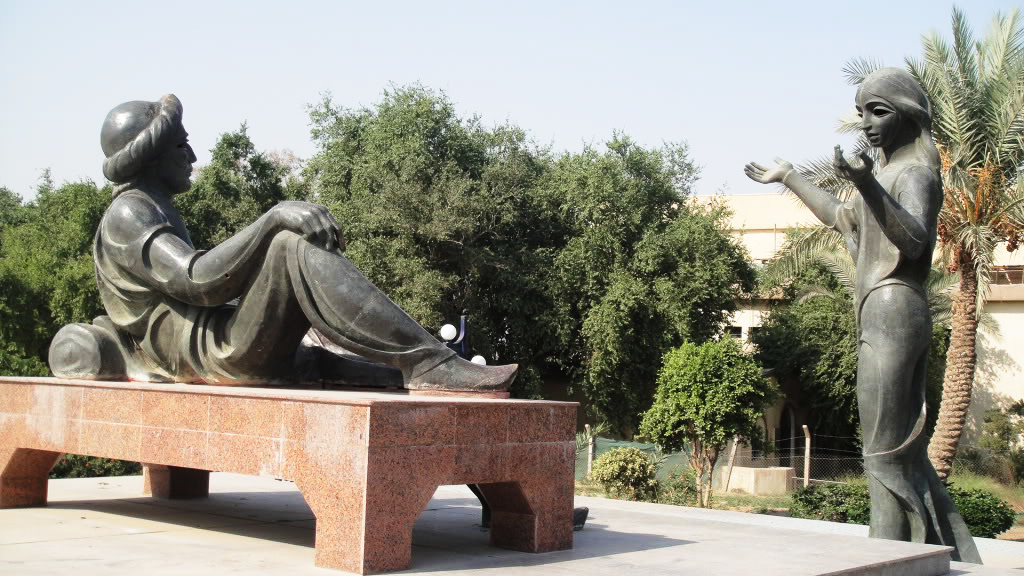
One of my most cherished routines in Baghdad was driving past the bronze statues of King Shahryar and Scheherazade, sculpted by the master artist Mohammed Ghani Hikmat. Each time, I felt a familiar thrill—as if stepping momentarily into the pages of the legendary tales. They are reminders of the power of words to shape destinies and the deep connection between the past and the present. I often drove past these statues, and each time, I felt as though I were stepping into the story itself, transported back to the time when Scheherazade first captivated the heart of King Shahryar.
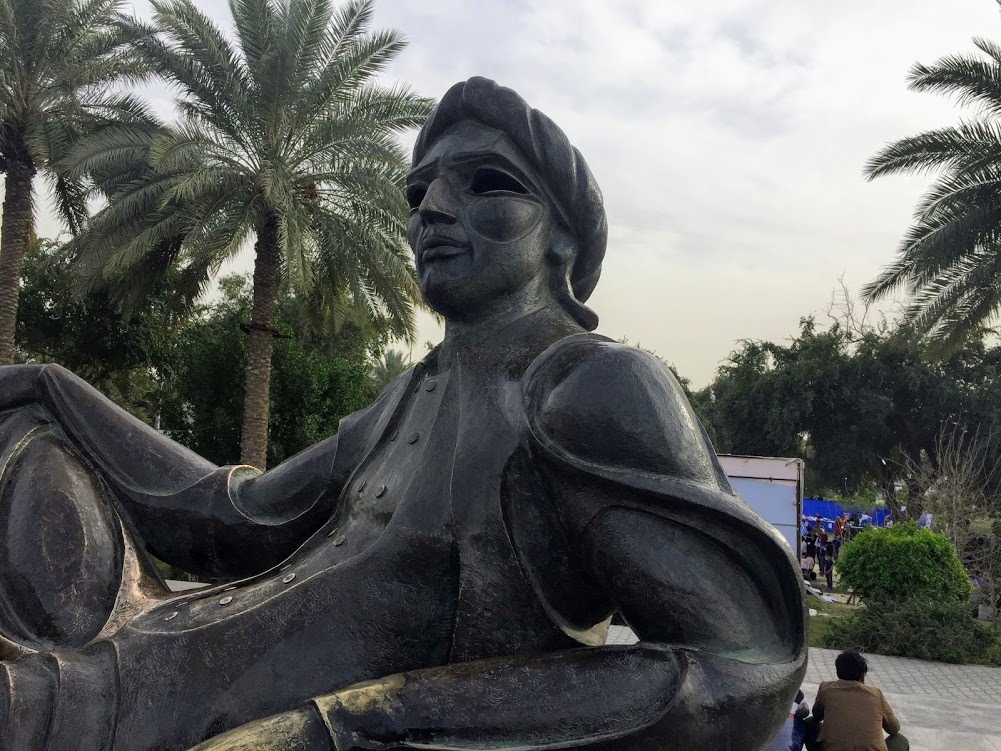
These monuments are not just art. They are anchors of cultural memory—reminders that even in a city that has witnessed wars, empires, and rebirths, the power of imagination remains unbroken.
The Universal Power of Storytelling
Scheherazade’s legacy is one that transcends the specificities of her time and place. Her stories are not confined to Baghdad or the ancient Near East—they have travelled the world, reaching audiences across continents, cultures, and centuries. Through her tales, we find universal truths about resilience, creativity, and the transformative power of human connection.
As I reflect on my time in Iraq, I am reminded that storytelling is not just an art form—it is a lifeline. In our darkest moments, in the midst of uncertainty and fear, stories offer us hope. They remind us of the beauty and the possibility that exists within our own lives. Like Scheherazade, we can turn words into our shield, using them to weave dreams, inspire change, and create a world where love and wisdom triumph over hate and despair.
Let us honour her legacy by cherishing the power of storytelling, for in the tales of Scheherazade, we find not just a story, but the essence of what it means to be human—our shared capacity to imagine, to dream, and to create.
Closing Thoughts: A Tribute to the Storytellers of Our Lives
Scheherazade endures not because of magic carpets or jinns, but because she understood the human heart. Her stories connect us across continents and centuries. They accompany us from childhood to adulthood, revealing new meanings at every stage.
As I reflect on my evenings in Baghdad—walking under its golden sunsets, listening to the murmur of life around me—I am reminded that storytelling is the thread that binds us all. Across cultures. Across eras. Across the landscapes of childhood and adulthood.
For those of us who grew up with Arabian Nights, the tales of Scheherazade are not just folklore. They are a shared cultural heartbeat. A reminder of our capacity to imagine, to dream, and to endure.
And in that enduring whisper of her stories, carried across centuries, we find the truest essence of humanity.

Alif Laila and Scheherazade became two of the most watched serials in the late 90’s on Doordarshan. No wonder Ramanand Sagar mastered in crafting these fables so well. It is always good when you are able to spot in ‘real’ something that you have been reading for so long in the books. Nice post…. 🙂
LikeLiked by 1 person
Yes, very true. We grew up reading and watching these stories. Thanks, Rajat. 🙂
LikeLiked by 1 person
Interesting read about the storytelling queen. I wonder why the stupid king had to execute a wife each morning.
LikeLiked by 1 person
The queens of King Shahryar and his brother Zaman betrayed them and so out of his anger towards womenfolk King Shahryar used to marry a woman and kill them next morning. So the story goes.
LikeLiked by 2 people
Pingback: Dar es Salaam Festival – INDROSPHERE
Wow, it’s great to see “the statue of storytelling”… we grew up reading the stories of Arabian Nights.
LikeLiked by 1 person