

Old Goa—or Velha Goa as the Portuguese once called it—has a way of making you pause. The moment you step into its cathedral-lined avenues, you feel time folding in on itself. The Renaissance arches, the baroque facades, the quiet courtyards—all seem to whisper stories of conquest, faith, and endurance.
We began our journey that morning at the Basilica of Bom Jesus, perhaps Goa’s most famous attraction and a UNESCO World Heritage Site. Completed in 1605, the 17th-century Basilica houses the tomb of St. Francis Xavier, the missionary whose reach stretched across Asia. As we walked through its cool interiors, sunlight filtering through stained glass, I could almost sense the generations of pilgrims who had come here before us, their footsteps echoing faintly in the silence.
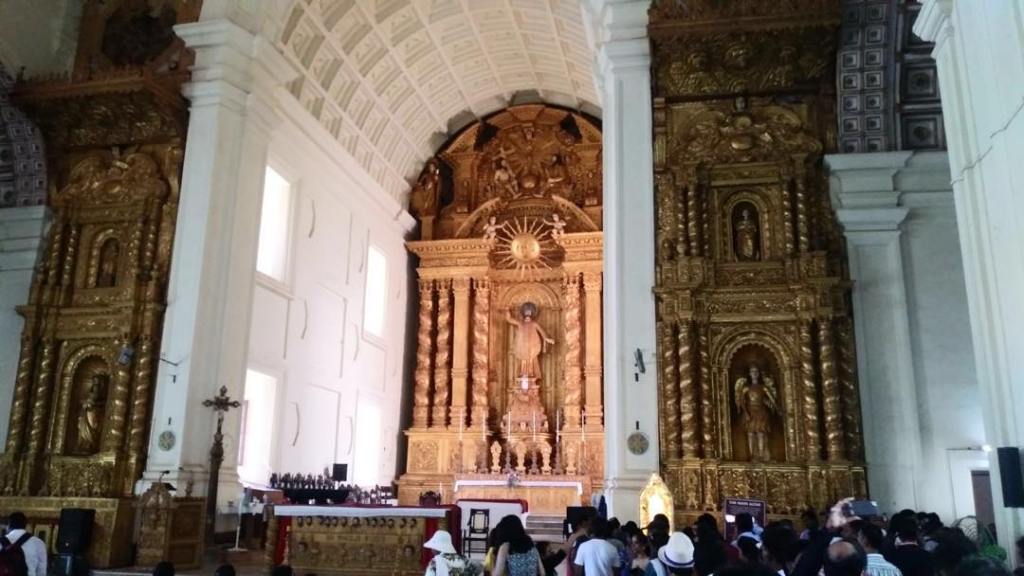
From there, we made our way to another jewel of Old Goa—the Sé Cathedral. While the Basilica of Bom Jesus exudes intimacy, the Sé Cathedral overwhelms with grandeur. Standing before it, I felt small, dwarfed by its massive façade, yet deeply curious about the stories held within its walls.
The cathedral’s very existence is tied to a turning point in Goan history. In 1510, Afonso de Albuquerque’s Portuguese forces defeated the army of Adil Shah of Bijapur. The victory fell on the feast of St. Catherine of Alexandria, and the cathedral was dedicated to her.
Construction began much later, in 1562, under King Dom Sebastião. It took nearly 90 years to complete—long enough for entire generations to live and die while the edifice was still rising. By 1619, the structure stood largely finished, but the altars were not completed until 1652. The result was staggering: a cathedral bigger than any in Portugal itself, paid for partly from the Crown’s treasury, partly from confiscated estates.
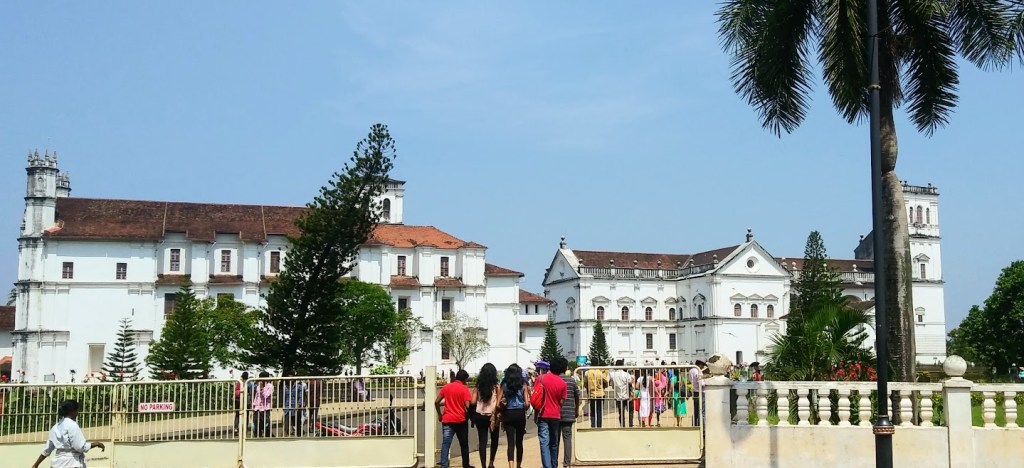
As I stood at the threshold, it was impossible not to think of the ambition that went into its making. This was not just a place of worship, but also a statement of power and permanence.
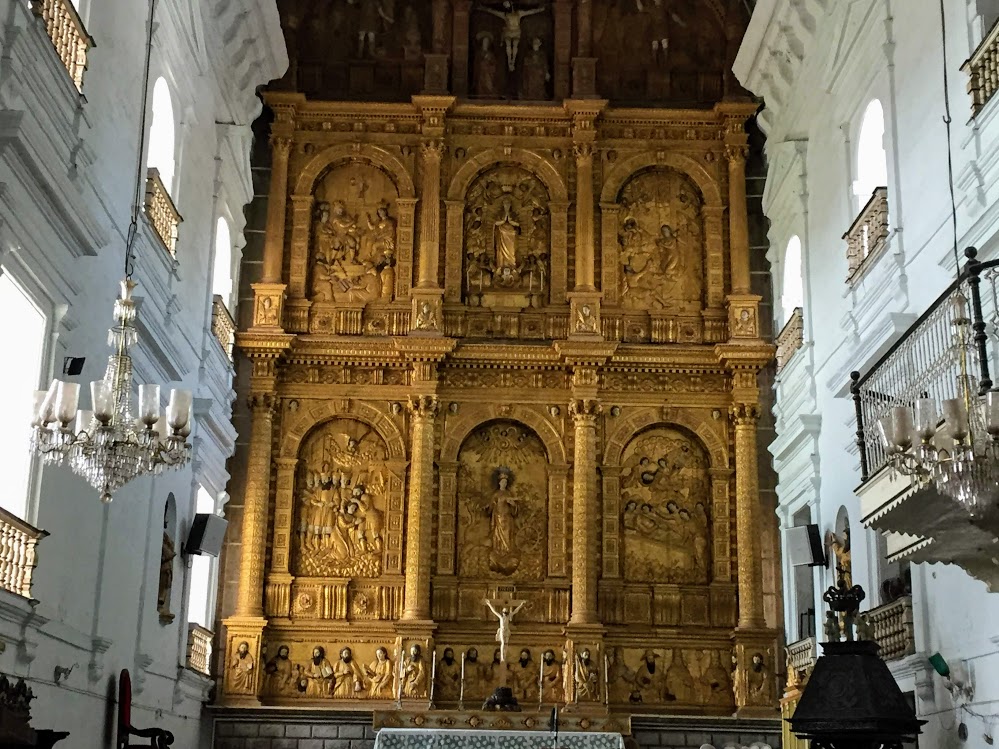
Inside, the cathedral opens up in hushed magnificence. The gilded reredos above the main altar instantly draws the eye. Dedicated to St. Catherine, it tells her story in six panels—her trial, her execution, and her ascent carried by angels to Mt. Sinai.
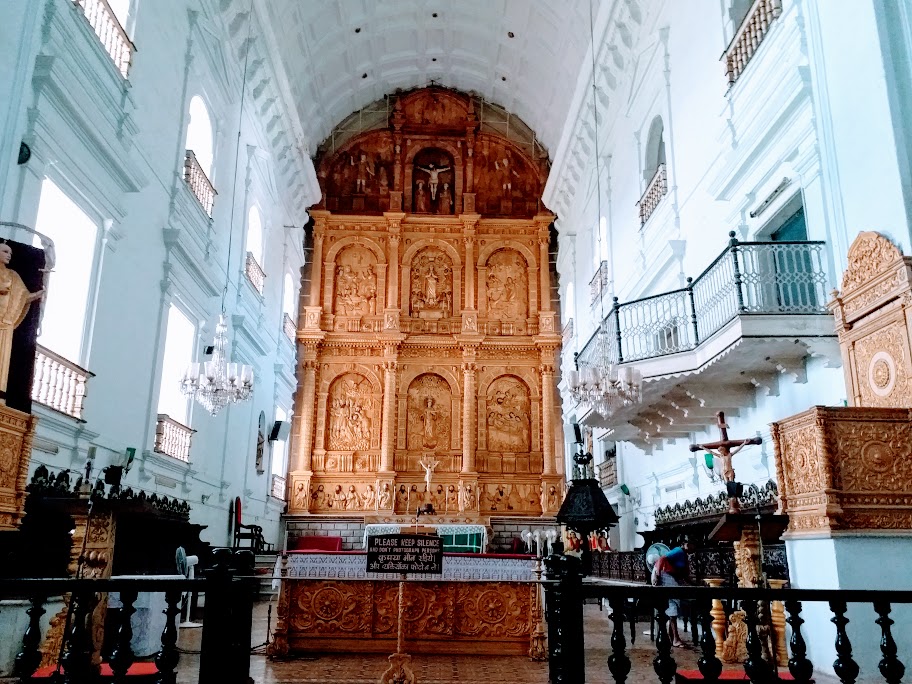
Her story fascinated me. A princess and a scholar, she is said to have converted to Christianity at just 14, and was martyred by the Roman emperor Maxentius at 18. In the carvings, she appears crowned (a nod to her royal birth), holding a book (wisdom), and steering the spiked wheel of her martyrdom.
Standing there, I couldn’t help but reflect on how the Portuguese saw her not just as a saint but as a symbol—an intellectual and spiritual defender of the faith.
The exterior is equally impressive, a blend of Gothic solidity and Renaissance elegance. Originally, the façade had two bell towers, but the southern one collapsed in 1776 and was never rebuilt. This gives the cathedral its distinctive, slightly asymmetrical look.
The northern tower, however, still stands tall, housing the famed Golden Bell, said to be the largest in Goa. When it tolls, its deep resonance carries far beyond the Mandovi River. Inside, the Chapel of the Cross shelters a crucifix believed by many to have miraculous powers. Even for someone like me, who arrived as a curious traveler, not a pilgrim, the atmosphere was humbling.
What moved me most was how alive the Sé Cathedral remains. Despite its World Heritage status and its draw as a tourist landmark, it isn’t frozen in time. Masses are still held here. Locals still gather to pray. Candles still flicker against the gilded backdrop.
Walking back out into the sunlight, I lingered for a moment on the steps, taking in the quiet expanse of Old Goa around me. Once the center of a sprawling empire that stretched from the Atlantic to the Pacific, the city is quieter now, but its monuments still carry the pulse of history.
For me, visiting the Sé Cathedral wasn’t just about admiring Portuguese architecture or ticking off a heritage site. It was about experiencing how faith, power, and art came together to shape a city—and how, centuries later, we are still touched by it.
Old Goa is not a place you simply see. It is a place you feel. And walking from the Basilica of Bom Jesus to the Sé Cathedral was like moving through chapters of an old, beautifully illustrated manuscript—one that refuses to fade, no matter how many centuries pass.

Now, I haven’t visited this church. Next time…
LikeLiked by 2 people
So your next visit to Goa will include a spiritual side in the itinerary. 😃
LikeLiked by 2 people
I will. I have explored other old churches including one of the lesser known and one of the first churches in Goa – Reiss Magos Church.
LikeLiked by 2 people
Quite an architectural grandeur! So, you are exploring Goa as a post-pujo refreshment 😀 It’s a place I would love to visit again. Have missed many things during my earlier visit.
Subho Bijaya’r shubheccha neben… 🙂
LikeLiked by 2 people
Yes, it was a very short getaway to Goa. Goa always mesmerises.
শুভ বিজয়ার শুভেচ্ছা আপনাকেও। 🙂
LikeLiked by 2 people
🙂 …
LikeLiked by 2 people
Asia’s largest Church- Sumi, nagaland
LikeLiked by 1 person
You’re right, Samy. Sumi Baptist Church, Zunheboto (Nagaland) is also believed to be one of the largest church buildings in Asia. As per the official website of Department of Tourism, Government of Goa, Se Cathedral is the largest church in Asia.< http://www.goatourism.gov.in/destinations/churches/134-se-cathedral >
LikeLiked by 1 person
This is the cathedral with a large number of steps, right? I have been there but had no idea that this was supposed to be one of the largest church in Asia. Btw, the story of St Francis Xavier is very interesting too
LikeLiked by 2 people
I think you’re confusing with the Our Lady of the Immaculate Conception Church in Panaji. It has a stone walkway with ziz-zag stairs.
LikeLiked by 1 person
Maybe I am.
LikeLiked by 1 person
Anyway, all churches in Goa are beautiful.
LikeLiked by 1 person
That’s true!
LikeLiked by 1 person