

Nestled in the heart of Baghdad, Iraq, Al-Mustansiriya Madrasa is one of the oldest and most prestigious Islamic institutions of higher learning. Established in 1227 CE by the Abbasid Caliph Al-Mustansir, the madrasa was named in his honour and has long been a centre of intellectual and cultural significance.
A Hub of Diverse Learning
Al-Mustansiriya Madrasa was meticulously designed to be a bastion of Islamic sciences, including theology, law, and Arabic grammar. Its comprehensive curriculum also extended to mathematics, astronomy, medicine, and philosophy, attracting scholars and students from across the Islamic world. The rigorous academic environment fostered many notable alumni, including the philosopher Ibn Rushd (Averroes), the historian Ibn Khaldun, and the theologian Al-Ghazali.
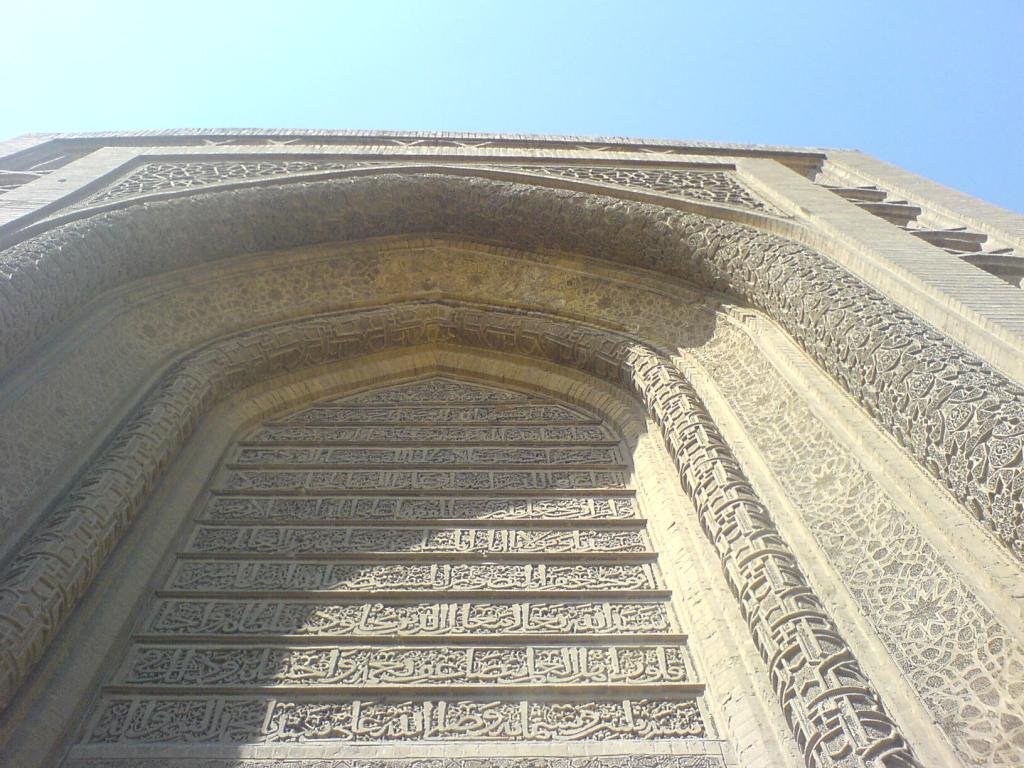
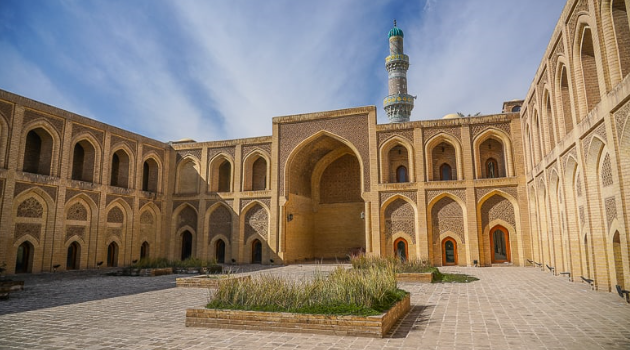
The Mustansiriya Madrasa is one of the only existing buildings that provides evidence of Baghdad’s role as a centre for Islamic Art and the city’s role in developing geometric ornament. This brick, two-story, rectangular madrasa is situated on the Tigris River around a central courtyard. Three iwans open onto the court while the fourth side leads down a long corridor, three open spaces that function as an oratory. The entrances exhibited arabesque-sculpted terracotta and geometric patterned masonry work, featuring vegetal themes that recall earlier Abbasid and Umayyad motifs.
Architectural Marvel
The madrasa’s architecture is a testament to Baghdad’s historical role as a centre for Islamic art and geometric ornamentation. The two-story brick structure is organized around a central courtyard on the Tigris River. Three iwans open onto the courtyard, while a fourth side leads to a corridor with three open spaces functioning as an oratory. The entrances are adorned with arabesque-sculpted terracotta and geometric patterned masonry, featuring vegetal themes reminiscent of earlier Abbasid and Umayyad designs.
A History of Trials and Triumphs
Throughout its long history, Al-Mustansiriya Madrasa has faced numerous periods of decline and resurgence. One of the most devastating events was the Mongol Siege of Baghdad in 1258, led by Hulagu Khan, a grandson of Genghis Khan. The siege resulted in the massacre of students and the destruction of the madrasa’s extensive library. It marked the end of the Abbasid Dynasty, signalling the end of the Islamic Golden Age.
Despite these catastrophic events, the madrasa rose again, enduring further Mongol invasions by Timur (Tamerlane) in 1392 and 1400. Each invasion brought significant destruction, yet Al-Mustansiriya continued to rebuild and adapt.
Cultural and Social Significance
Beyond its academic achievements, Al-Mustansiriya Madrasa has played a vital cultural and social role in Iraqi society. It has been a venue for public events such as poetry readings, musical performances, and political debates, reflecting its enduring importance as a community hub.
Modern Restorations and Legacy
Over the centuries, the madrasa has undergone various renovations and expansions, maintaining its original character and architectural style. The main building’s central courtyard and four iwans remain decorated with intricate tilework and calligraphy, preserving its historical grandeur.
In the late 18th to early 20th centuries, the madrasa served military purposes, becoming a rest stop and storage for soldiers. Later, the Ottomans converted it to a customs office in 1865. In 1973, the Directorate of Antiquities in Iraq took over the madrasa’s oversight, initiating continuous reconstruction efforts to restore its historical boundaries.
Today, Al-Mustansiriya Madrasa is part of Al-Mustansiriya University, embodying Iraq’s resilience and enduring spirit. The complex is a powerful reminder that knowledge and culture can withstand the ravages of barbarism and terrorism.
A Symbol of Cultural Heritage
Despite numerous challenges, including wars and political instability, Al-Mustansiriya Madrasa remains a symbol of Iraq’s rich cultural heritage and intellectual tradition. It continues to attract scholars worldwide, drawn to its storied past and its commitment to learning. The madrasa’s legacy is a testament to the enduring power of education and culture in the face of adversity.

Looks like this building has witnessed a lot over all these centuries
LikeLiked by 1 person
Yes, the Madrasa withstood conflicts and the test of time. Most of the time the building was used for purposes other than educational.
LikeLike
Agree with your conclusion. Art should transcend violence.
LikeLiked by 1 person
Any idea what was its state under Saddam Hussein?
LikeLiked by 1 person
The restoration started in 1970s. Most of the Saddam regime Iraq was in war or under severe sanction… they had financial crisis although they are endowed with huge natural assets.
LikeLike
This is again a good amount of information on this beautiful structure. Sighting the political scenario and the unrest, Iraq is not considered as a favourite destination for tourism despite its numerous heritage structures and rich history. Just out of mere curiosity, have you been there for tourism purpose or work related?
LikeLiked by 1 person
I am in Baghdad in connection with work. You’re right the perception of Iraq is not very good outside the country, although the security situation has improved a lot. This country has a lot of tourism potential. Maybe, in future, it will pick up.
LikeLiked by 1 person
You have captured the whole story.
You seem to be a Historian.
Regards
LikeLiked by 1 person
Thanks, Shiva.
LikeLike