
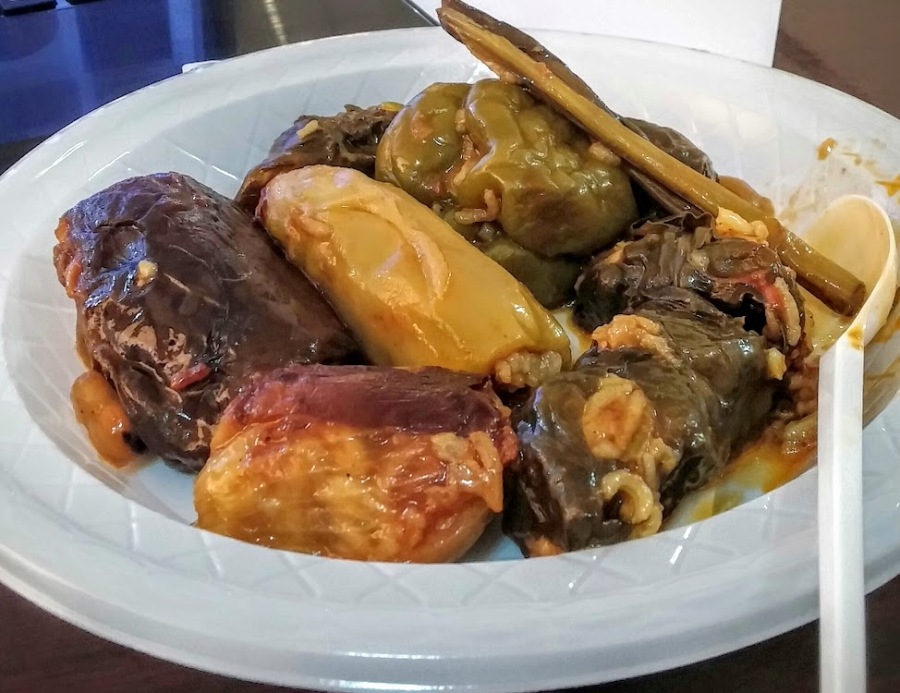
Imagine a dish—a small bundle of flavour—that has travelled across continents, weaving through centuries of history, speaking the languages of empires long gone, and whispering stories of bustling marketplaces. This dish is dolma. But it’s more than just food. It’s a living, edible history book, one that has crossed borders, adapted to new lands, and evolved with every step it took.
The platter arrives like a mosaic: grape leaves rolled into neat cylinders, zucchini and peppers stuffed to the brim, onions hollowed and filled with spiced rice. Each piece glistens with olive oil, as though the cook had polished them for presentation. Dolma is less a dish and more a collection of stories—each vegetable a vessel, each roll a chapter.

From Topkapi to Tiffin: Dolma’s Imperial Origins
The word dolma comes from the Turkish dolmak, “to be stuffed.” From the grand kitchens of the Ottoman Empire, it travelled across borders, reshaping itself with every stop. In Greece, it became dolmades, bright with lemon and dill; in the Balkans, it grew heartier with meat; in Iraq and Kurdistan, it blossomed into a lavish spread of stuffed vegetables, simmered together so their flavours mingled like neighbours in a courtyard.
Step into Topkapi Palace and you glimpse its royal beginnings. Chefs wrapped rice, herbs, and minced meat in grape leaves with the precision of jewellers setting stones. These parcels weren’t just food—they were edible diplomacy. Later, in Baghdad’s souks, dolma lost its palace exclusivity. It became street food with soul, turning humble gatherings into feasts.

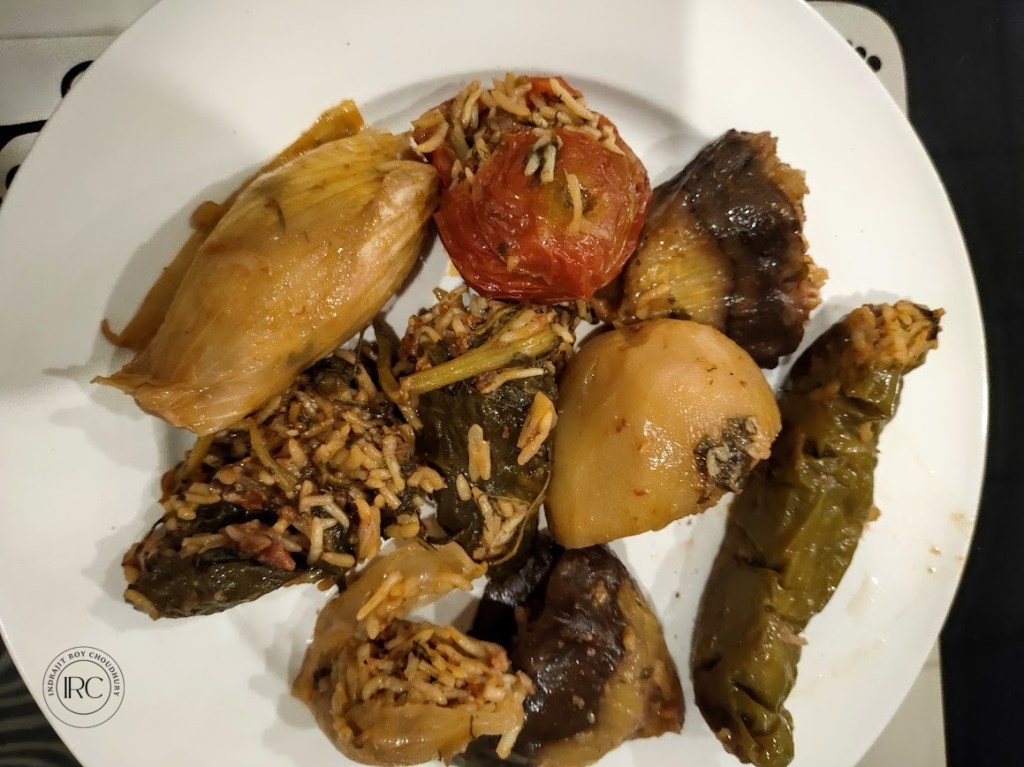


The Greeks, even in Alexander’s era, are believed to have wrapped meat in vine leaves, a precursor to modern dolma. The Arabs brought spices, the Ottomans refinement. What remained constant was the act of stuffing—turning everyday vegetables into extraordinary meals.

And then, quite unexpectedly, it appeared in my own backyard in Bengal. There, the grape leaves gave way to potol—the pointed gourd—hollowed out and filled with spiced minced meat or fish, then simmered in a rich gravy of yoghurt, cashew, and coconut milk.
More than a recipe, Dolma is a symbol of cultural migration and adaptation—a dish that carries within it the intertwined histories of the Mediterranean, the Middle East, and, in its Bengali avatar, the humid kitchens of home. Each version is a reminder that food is never static; it evolves, travels, and takes root in unexpected soil, much like the stories we carry across generations.
Dolma is not just food—it is heritage on a plate, a reminder of centuries of cultural exchange.
The Ritual of Making
Dolma is not a solo act. It is a communal ritual, often prepared by women gathered in kitchens, grape leaves spread out like parchment, conversations flowing as steadily as the rice filling. Rolling each leaf requires patience, precision, and a touch of gossip.
In Kurdish households, dolma is a dish for gatherings—weddings, holidays, or homecomings. The act of making it together matters as much as eating it. In Azerbaijan, this tradition is so vital that dolma-making has earned UNESCO recognition as part of intangible cultural heritage. Each vine-leaf parcel is a connection to ancestors, a culinary link across generations.

And Then, Bengal Happened
How did dolma, with its Mediterranean swagger and Ottoman pedigree, end up in the lush kitchens of Bengal? Enter the Mughals, who brought Persian-Turkish tastes to India, and the Armenians, early settlers in Bengal with their own traditions of stuffed vegetables. What emerged was not a copy, but a reinvention.
In Bengal, grape leaves gave way to potol—the pointed gourd. Hollowed and filled with spiced minced meat or fish, then simmered in a rich gravy of yoghurt, cashew, and coconut milk, potoler dolma was born. It was dolma in a new accent—wearing a sari, humming a Rabindra Sangeet.
I remember my mother preparing potoler dolma on special occasions. The kitchen would fill with cumin, cinnamon, and anticipation. She hollowed each gourd with surgical precision, stuffed them as though they were secrets, and simmered them until the house smelled like celebration. Each potol was a treasure chest—holding not just flavour, but memory.

Unlike the communal grandeur of Iraqi Dolma, this was a dish of domestic celebration—served on birthdays, festivals, or when guests arrived unannounced. It was less about spectacle and more about intimacy, a reminder that even in Bengal, far from the Ottoman kitchens where the dish began, Dolma had found a new home.
Dolma: A Global Dish, A Local Heart
Today, dolma is everywhere—on restaurant menus across the world, in family kitchens, and at casual gatherings. Vegetarian, vegan, or meat-laden, dolma adapts to every palate. Its journey shows that food is never static; it travels, evolves, and takes root in unexpected soil.
For me, dolma is a reminder that food connects us to the past, to faraway lands, to people who came before us. It is a story of migration—of how one recipe can cross continents, adapt to climates, and carry with it the spirit of shared humanity.
Each dolma is a time capsule. A bite-sized memoir. A love letter to ancestors who believed that food was never just sustenance—it was storytelling.
So, the next time you savour a dolma—whether wrapped in grape leaves, simmered in potol, or another creative twist—pause to reflect on its journey. From imperial palaces to bustling bazaars, and finally to the kitchens of Bengal, dolma is proof that life, like a grape leaf, is fragile. But with the right filling, it holds together beautifully.

Wow, didn’t know that dolma has such history!
LikeLiked by 1 person
Interesting. This is the first time, I have heard about Dolma
LikeLiked by 1 person
Next time when you visit Kolkata or any Bengali restaurant, ask for “potoler dolma.” You will love it.
LikeLike
Hey I have nominated you for the Sunshine Blogger Award.
LikeLike
This is such an intriguing revelation. I always liked Dolma in its vegetarian version but never gave a thought about its history. So good that you enlightened me with the information, thank you. 🙂
LikeLiked by 1 person
Thank you! 🙂
LikeLike
While looking for dolma history I stumbled into your article, loved it!
LikeLiked by 1 person
Thank you 👍
LikeLike
While looking for something on dolmas history I stumbled upon your article, loved it!
LikeLiked by 1 person
Thank you for your liking.
LikeLike