
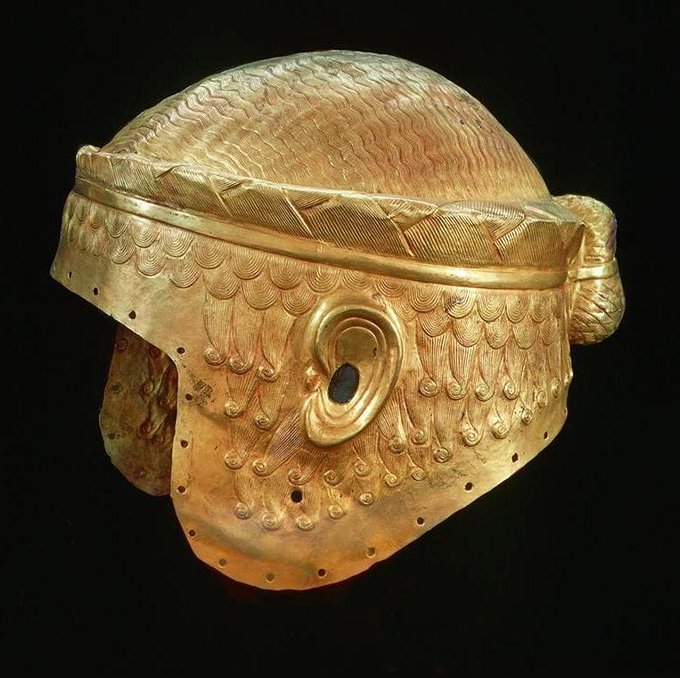
In the cradle of civilization, kingship wore many faces. Some ruled with the quiet weight of ceremony and divine favor, others with the iron of conquest and unyielding ambition. Across the centuries of Mesopotamia, two crowns tell the story of this duality: one of gold, fashioned to shine like the sun, the other of bronze, forged to endure the clash of steel and stone.
Meskalamdug of Ur, “Hero of the Good Land,” walked beneath the gaze of the gods, his golden helmet a testament to the harmony between king and city, mortal and divine. Sargon of Akkad, the self-made conqueror, bore bronze upon his brow, a symbol of human will and the might to seize empires from the dust of battle.
The Gold That Spoke for Me
The sun was just rising over Ur when the gold was first brought before me. I remember the way its light mingled with the dawn—two suns meeting, one in the heavens, the other in the hands of my craftsmen.
They had labored for many moons to shape it. From a single sheet of gold—pure, flawless—they coaxed a form so lifelike that it seemed almost to breathe. Each engraved strand of hair flowed like ripples on the Euphrates after a summer wind. The edges were strengthened so that it sat firm upon my head, and yet it was light, as if the gods themselves had whispered to the gold to shed its weight in honor of a king.
It was not a warrior’s helm, no bronze to turn the edge of an enemy’s blade. This was the language of power, not of war. Gold does not belong in the dust and blood of the battlefield—it belongs in the eyes of the people, in the hearts of those who look upon their king and see not a man, but the living thread between the mortal and the divine.
I wore it on the day of the New Year festival, when all of Ur gathered before the great ziggurat. My robes shimmered with gold thread, my beard was oiled and curled, my hair bound in braids beneath the golden shell of the helmet. As I walked through the crowd, the people lowered themselves like stalks of barley in the wind. The gold caught the sunlight and returned it in a blaze, so that for a moment even I felt I had become more than flesh—become the very embodiment of Nanna’s blessing upon our city.
Meskalamdug’s name, meaning “Hero of the Good Land,” is fitting for a king whose tomb revealed such remarkable riches. His helmet, found among an array of luxurious goods, underscores his high status in Sumerian society. However, unlike more famous figures such as Sargon of Akkad, whose military conquests are well-documented, Meskalamdug’s reign is shrouded in mystery. We know little of his deeds, but his burial suggests a ruler who was deeply respected, both as a warrior and as a sovereign.
In Sumer, kingship is not given; it descends from heaven. I ruled not because I was born to wealth or strength, but because the gods had chosen my line to hold back chaos, to keep the rivers in their banks, the fields fertile, the temples rich in offerings. The helmet reminded everyone—myself included—of that sacred trust.
When my time among the living ended, the helmet did not pass to another. It was placed beside me in the tomb, a guardian in gold to travel with me into the shadowed lands below. Around it, they laid silver bowls, weapons of bronze, strings of lapis and carnelian, and all the goods a king might need in the afterlife. The walls of my chamber closed, sealing me with the treasures of Ur and the quiet eternity that followed.
Centuries passed. The voices of my priests faded, the ziggurat weathered under a thousand suns, and the sands crept close. But gold does not yield to time. Long after my name was only a whisper in the wind, strangers came—men from beyond the lands I knew. They unearthed my resting place and, in the flicker of their lamps, the helmet blazed once more.
It spoke for me across the ages. It told them of my city, my reign, the faith my people placed in me. They could not hear my voice, but they could see the gold, and in its gleam they found my story: Meskalamdug, Hero of the Good Land, who ruled in the age when Sumer’s rivers sang, and whose crown was the sun itself.
Bronze, Blood, & Empire
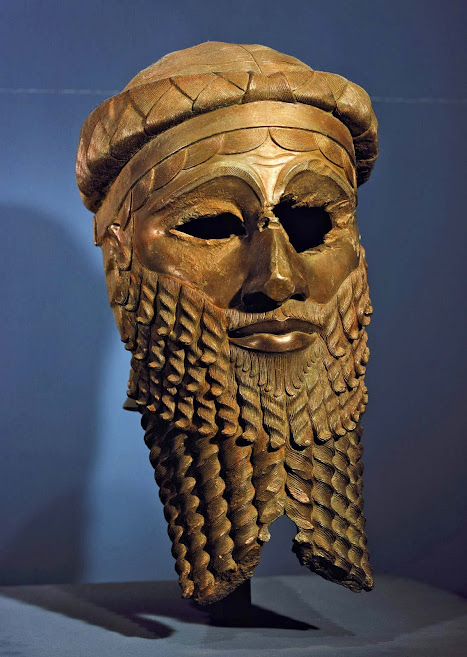
They call me the Great King, the King of Kish, the Ruler of the Four Quarters of the Earth. But before the clay tablets bore my name, before the scribes sang of my conquests, I was a soldier—a man who took the crown not because it was given, but because I seized it.
My helmet is not gold. It is bronze—strong, unyielding, and forged to turn the edge of a blade. Gold belongs to temples and ceremonies; bronze belongs to the field of battle, where dust and blood cling to your skin, and victory is carved from the bones of the day.
I remember the weight of it the first time I wore it, its edges pressing against my brow as I led my warriors beyond Kish. The sun beat down, and the metal grew hot, but it mattered little. For the helmet was more than protection—it was my standard, my defiance, my claim that I would not bow to the kings of Sumer, but make them bow to me.
Battle after battle, the bronze bore the scars of war—scratches from spears, dents from the swing of an enemy axe. I wore those marks as I wore my victories, for each was a step toward the unthinkable: an empire stretching from the mountains in the north to the seas in the south.
When I rode into conquered cities, the people saw the bronze before they saw my face. It caught the sun not with the warm glow of gold, but with a hard, sharp gleam, like the edge of a freshly forged blade. The message was clear: Sargon has come, and his will is iron.
In the years that followed, my bronze helmet became as much a symbol of my reign as my armies themselves. It did not speak of divine favor in the way gold does—it spoke of human will, ambition, and the power to take what one desires and hold it against all challengers.
They will say I was a builder of the first empire. They will say I united the lands of Sumer and Akkad, brought the cities to heel, and stretched my power over all I could see. But I know this: long after my voice is silenced, my bronze helmet will endure, as the mark of a man who was not content to rule one city when the world itself could be taken.

I like the hair bun in the helmets. These are amazing; so detailed with the hairstyles!
LikeLiked by 1 person
😀 Thanks.
LikeLike
Excellent piece of information… You used your long solitary holidays very productively to produce such gem of information. Bravo Bro…. 👍👍
LikeLiked by 1 person
Thanks, buddy.😄
LikeLike
26th century BCE! Wow! Around the time of the pyramids.
LikeLiked by 1 person
yes, sir.
LikeLike
Wow!! Wonderful information. King Sargon the great of Sumerian is believed to have established first empire in the world. Major source of gold must have been either from Indus Valley or Egypt.
LikeLiked by 1 person
Thanks, Mano. The large concentration of early gold objects and the fact that there are no metal-bearing deposits in Lower Mesopotamia prompts a question concerning the origin of the raw material used to create these artifacts. Studies say that Mesopotamian gold was mainly sourced from Egypt. Gold artifacts in Mesopotamia are often combined with lapis lazuli sourced from Afghanistan and carnelian, probably imported through the Indus valley.
LikeLike