
If you’ve ever found yourself wandering through the chaos and charm of Kolkata, you’ll know that the city’s street food is more than just a quick snack—it’s an intimate embrace, wrapping itself around your senses like a familiar old song. The sharp tang of phuchka, the smoky spice of jhal muri, and the indulgent roll of egg and paratha pressed together at a roadside cart—each bite is a fragment of the city’s soul. It’s not just food; it’s a memory, served on paper plates with generous helpings of mustard oil.
But not all mornings in Kolkata are made for quick bites. Some mornings call for more—an immersion into the very essence of what it means to be a Bengali. And for me, when that craving hits, there’s one place that always takes me back in time: Adi Haridas Modak, nestled near the vibrant chaos of Shyambazar Crossing.
It was just this past weekend that a casual WhatsApp chat with my old schoolmates evolved into a nostalgic discussion about traditional Indian breakfasts. From idli-sambar to poori-bhaji, every corner of India has its own glorious breakfast. But when someone mentioned kochuri and chholar daal, I was instantly transported—not to my phone screen, but straight to Shyambazar, to that iconic little shop where time seems to stand still.
Stepping Into Time
My last visit to Adi Haridas Modak was earlier this year, and I remember it as though it were yesterday. I was in Kolkata for a dear friend, Debabroto’s son’s wedding—a beautiful occasion that doubled as a nostalgic reunion with my school classmates. Before the rituals began, my son, Judhajit, and I set off early for breakfast. The air was soft with the winter chill, and the city, though bustling, felt unusually intimate.
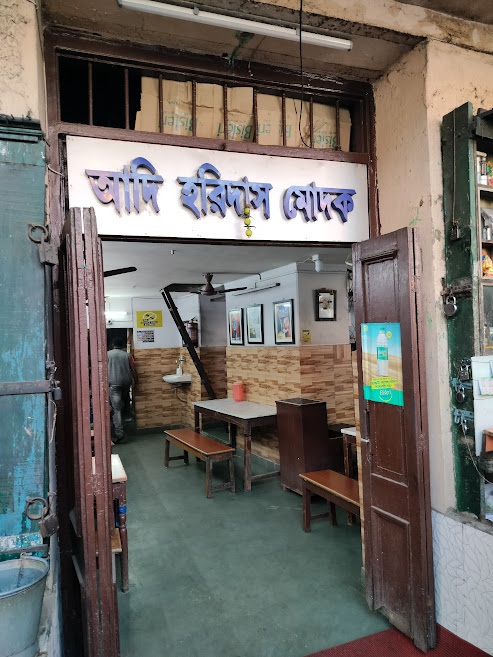

Adi Haridas Modak isn’t just a place you walk into. It’s a journey—a walk through layers of time, scent, and sentiment. The first thing that strikes you is the simplicity. No glossy signage, no digital menus flashing in your face—just humble wooden tables and benches, worn smooth by generations of diners. And the aroma! It’s the unmistakable smell of hing (asafoetida) infusing the kochuris as they fry in hot oil, filling the air with the promise of something special.
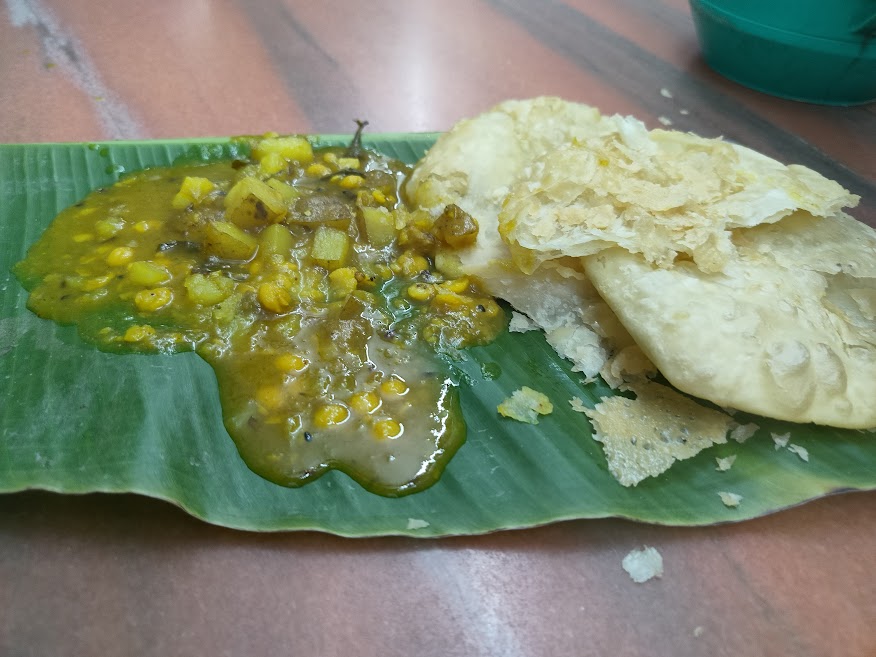
This place doesn’t strive to keep up with trends; it simply exists as it has, unchanged and timeless. The food here is served on kolapata (banana leaves)—a subtle reminder of wedding feasts and childhood lunches, where the mingling of flavours was always accompanied by memories, passed down through generations.
A Breakfast Worth Waking Up For
The menu at Adi Haridas Modak may be simple, but each dish is a celebration of what makes Bengali food so beloved. The kochuri—delicately puffed, golden, and stuffed with biulir dal (black gram) and a whisper of hing—is nothing short of divine. Paired with chholar daal, thick and fragrant with coconut and raisins, it forms a union of textures and histories that make every bite feel like a homecoming.
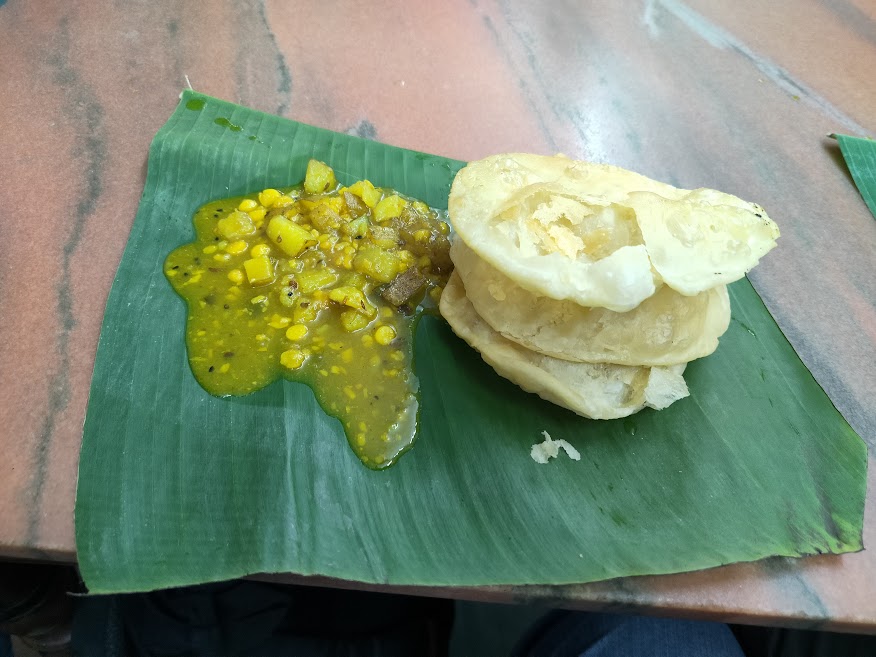

And then there’s the aloo’r tarkari. Soft spiced potatoes, wrapped in mustard oil, with the sharp bite of green chillies, offer a kind of comfort that takes you back to your grandmother’s kitchen. It’s not just food; it’s a memory, a story with every spoonful.
No Bengali breakfast is complete without a sweet finish, and here, it arrives in the form of jilipis—coiled, crisp, and soaked in syrup. As you bite into them, it’s as if you’re tasting sunshine. The crunch, the sweetness, the sticky fingers—they’re an experience, not just a dish.
More Than a Meal — A Legacy
As Judhajit and I sat there, savouring the flavours and trading stories, I couldn’t help but marvel at how much had changed around us—and how little had changed inside those walls. The place has been in operation for over 250 years, still run by the Modak family, now in its sixth or seventh generation.
Over the years, legends have grown up around this little eatery. Icons like Rani Rasmani, Sri Ramakrishna Dev, Netaji Subhas Chandra Bose, Abanindranath Tagore, and even Raja Rammohan Roy have been said to have dined here. Whether these stories are fact or myth doesn’t matter—the thought of sharing a meal in the same space as those great minds adds a weight to the almost spiritual experience.
The walls here don’t just bear the marks of time; they hum with the stories of a city, of a culture, and of people who shaped both. Every meal at Adi Haridas Modak isn’t just about food—it’s about connecting to a legacy, a sense of belonging, and a deeper understanding of what it means to be Bengali.
The Essence of Bangaliyana
In a world where everything seems to be moving towards efficiency, protein shakes, and gluten-free options, Adi Haridas Modak stands firm, unhurried and unapologetic. It’s a reminder that food isn’t just about sustenance—it’s about culture, memory, and identity, served on a banana leaf.
I was reminded of a line from our conversation that morning with my schoolmates: “Bangaliyana isn’t in museums, it’s on your plate.” That sentiment came alive at Haridas Modak.
Bangaliyana—the essence of being Bengali—is not confined to art galleries or history books. It is lived and breathed in the streets of Kolkata, in the food we eat, and in the way we celebrate life through rituals and relationships. From the language we speak to the clothes we wear, from the music we hum to the customs we hold dear, Bangaliyana is a vibrant, living tradition, passed down from one generation to the next.
For me, sharing that moment with Judhajit—my son, my companion through so many of life’s journeys—was the real feast. We weren’t just eating kochuri and tarkari; we were tasting our roots, binding generations together in the most delicious way possible.
Until Next Time…
So, if you ever find yourself in Kolkata—drawn by the buzz of rickshaws, the rhythm of Rabindra Sangeet wafting from a roadside tea stall, or the scent of phuchka filling the air—carve out a morning to visit Adi Haridas Modak. Step into a past that refuses to fade, and leave with your heart a little fuller than your stomach.
Because some meals aren’t meant to be forgotten. They’re meant to be passed on—like heirlooms, like stories, like love.

I wish more people would start eating here. Despite being deep fried, I believe the food will be far healthier than the plastic food, full of preservatives, dished out at fast food eateries. Many small food joints in India start with fresh raw material in the morning and close shop when food is over. Food is never stale. No need of preservatives.
LikeLiked by 1 person
Absolutely agree! Freshly cooked food from small joints, even if deep-fried, is often far healthier than mass-produced fast food loaded with preservatives. Taste, tradition, and health in one plate!
LikeLiked by 1 person
I was thinking of visiting this place for a long, but somehow could not make it there. Reading your post, I am getting tempted to visit there in my next visit to Kolkata.
LikeLiked by 1 person
Do visit the place. Am sure, you won’t be repenting it.
LikeLike
I remember I visited there once I was just a young girl. It’s good that it is still maintaining the “Bangaliyana”,
LikeLiked by 1 person
Thanks, Nilanjana.
LikeLike
The breakfast was delicious. Really loved the food and the setting. It was wonderful that they were able to preserve it over these years.
LikeLiked by 1 person
Yes, indeed. It’s heartening to see places that not only serve great food but also preserve their charm and legacy over the years.
LikeLike