

There are places where history does not merely whisper—it resonates. The ruins of Taq Kasra, southeast of Baghdad, are one such place. Standing before this majestic archway, I felt the weight of centuries pressing in from every direction. Amid the sunburnt plains rose a structure that once symbolised imperial glory, intellect, and power—an echo of the grandeur that was once Ctesiphon, capital of the mighty Sasanian Empire.
As I stood before this awe-inspiring structure, I couldn’t help but imagine the countless souls who had passed through its halls: emperors, scholars, merchants, and soldiers, each leaving behind whispers of a bygone era.
Nestled along the banks of the Tigris River, Ctesiphon was once the beating heart of Persia. Established by the Parthians in the 2nd century BCE and elevated by the Sasanians in 224 CE, the city rivalled Rome and Constantinople in its splendour. At its peak, it was among the largest cities in the ancient world, famed for its palaces, gardens, and bustling trade routes that connected East and West.
The majestic Taq Kasra—the colossal vaulted arch that survives today—was part of a grand palace complex constructed during the reign of Khosrow I (531–579 CE), also known as Anushirvan the Just. Under his rule, the Persian Empire witnessed an age of prosperity, territorial expansion, and cultural brilliance.
The arch itself remains an architectural marvel even by modern standards: a 25-meter-wide span rising 37 meters high, built entirely of brick and mortar—without scaffolding or formwork. It stands as the largest single-span brick vault ever constructed, a timeless testament to Sasanian engineering genius.

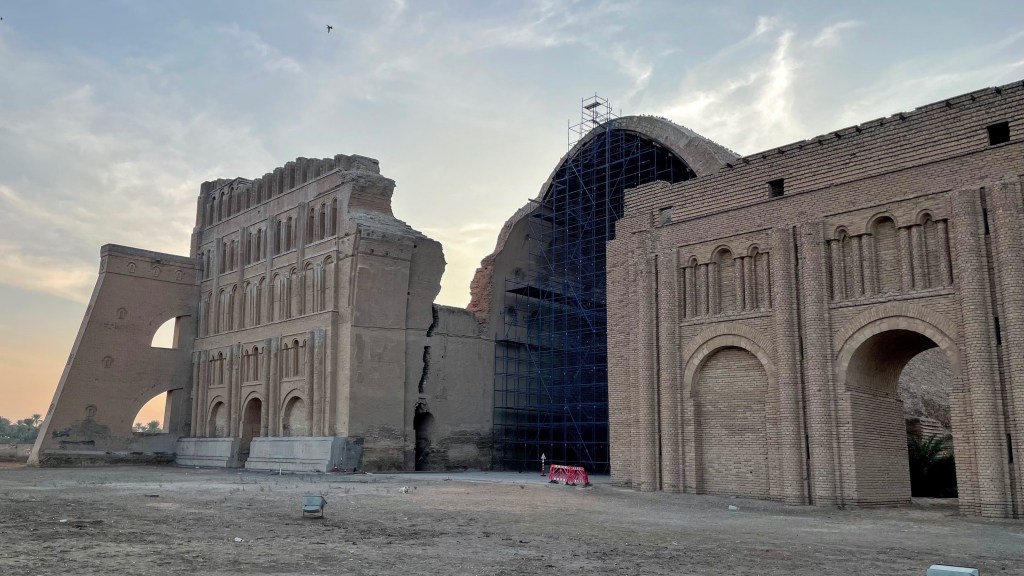
Walking around the ruins, I could almost hear the whispers of its glorious past—the footsteps of courtiers, the murmur of scholars, the rustle of silk as Khosrow I held audience beneath the towering vault. Here, Byzantine envoys would present tributes, poets would recite verses of wisdom and war, and strategies that shaped empires would be crafted beneath the vast curve of brickwork.
The structure was far more than an audience hall; it was a symbol of Sasanian might and sophistication. Every curve of its brickwork and every measured proportion reflected a civilisation that valued both power and beauty.
The iwan, or vaulted hall, that defines Taq Kasra became a cornerstone of Persian and later Islamic architecture, influencing mosques, palaces, and citadels across centuries. It stands as an architectural manifesto of human ingenuity—power expressed not through size alone, but through grace and balance.
Yet, as history reminds us, empires fall as surely as they rise. Ctesiphon fell to the Arab Muslim armies in the 7th century, marking the end of the Sasanian dynasty. Time, war, and neglect took their toll. When I visited, large sections had already crumbled, and the structure bore the marks of both endurance and erosion.
In 2019, relentless rains caused further damage, reigniting fears for its survival. Although the Iraqi government and international bodies continue preservation efforts, progress is slow, constrained by instability and limited resources. To stand before Taq Kasra today is to feel both admiration and melancholy—admiration for what human hands once achieved, and sorrow for what the world risks forgetting.

As the sun dipped behind the horizon, casting the arch in a golden hue, I took one last look. Despite its scars, Taq Kasra still stands proud, a sentinel of memory. It reminds us that history is not a relic of the past—it is the living foundation upon which our present rests.
Taq Kasra, the Archway of Ctesiphon, is more than a ruin; it is a symbol of endurance, artistry, and the eternal dialogue between creation and decay. It deserves not neglect, but reverence—an enduring tribute to the brilliance of human civilisation.
For those who cherish heritage, architecture, and the echoes of lost empires, Taq Kasra offers a humbling reminder:
Empires may fade, but their legacies endure—if we choose to remember them.
If you ever journey through Iraq, make time to visit Al-Mada’in, about 35 km southeast of Baghdad. There, rising against the horizon, stands Taq Kasra—silent yet eloquent, a bridge across two millennia of history.

Enjoy these vicarious travels around sites in modern-day Iraq 🙂
LikeLiked by 1 person
👍 thanks, sir.
LikeLike
How do you pronounce “Ctesiphon”???
Interesting read…
LikeLiked by 1 person
Thanks, Aro. It’s pronounced as “tes” + “i” + “fon”
LikeLiked by 1 person
I guessed so… And was wondering what the Eff was C doing there!!! 😜
LikeLiked by 1 person
This is the Roman style of having silent alphabets… Probably to confuse people like us. 😉
LikeLiked by 1 person