
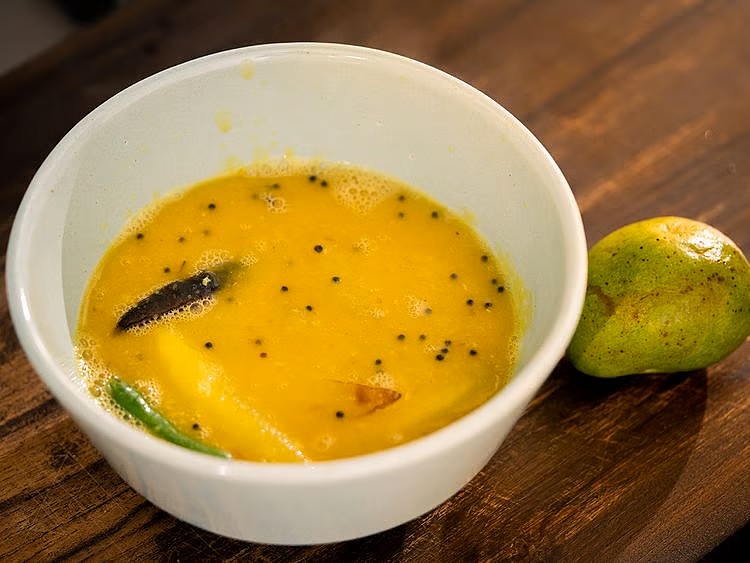
The Delhi summer. Just the words bring a rush of memories—a wave of heat washing over me even now. It wasn’t the bone-dry scorch of the loo that I remember most, though. It was the promise of relief, a culinary oasis tucked inside our modest flat in Sarojini Nagar. It was Tok Dal.
Our modest first-floor government quarter in Sarojini Nagar, with its balcony jutting out into the unforgiving sun, offered little comfort. The fan churned overhead like a tired old warrior, doing its best against the molten afternoons. But in our narrow galley kitchen, magic unfolded daily—Ma’s culinary spells, simple yet sacred. Among them, Tok Dal stood out like a calm breeze on a sweltering day.
The Humble Hero: Raw Mango
For a Bengali, summer isn’t just about heat—it’s about aam. Mangoes in all their glory. The city markets overflowed with sweetness: langda, dussehri, chausa—fragrant jewels stacked high. But Tok Dal didn’t ask for sweetness. It demanded the sharp tang of the unripe green mango, the kind that made your mouth water before it even touched your tongue.
Ma knew exactly which mango to pick. Firm, bright-skinned, its scent already hinting at its sour secrets. She’d dice it—peel and all—into chunky crescent moons, each slice a promise of the relief to come.
The Ritual of Dal
The masoor dal or matar dal glinting in the colander would be rinsed and set to boil, slowly losing its brightness as it softened into a golden, comforting base. And then came the real transformation—when Ma added the mango slices, letting them melt into the dal, releasing their mouth-puckering sourness into the heart of the pot.
The tempering was always a moment of drama. A splash of mustard oil into the kadhai, heated just until it shimmered, followed by a handful of black mustard seeds or the earthy melody of panch phoron. The seeds would pop and sizzle, announcing their presence, and the whole kitchen would come alive in a haze of aroma. A dash of turmeric, a touch of salt, and the dal was ready. No garlic, no onion—this was food in its purest, most austere form, designed to soothe and restore.
A Sacred Meal
Lunch was never extravagant, but it was sacred. A gleaming mound of white rice, steam rising like incense, waiting for the first ladleful of golden Tok Dal to grace it. The dal would spread slowly, a tangy river soaking every grain. Often, there would be a side of aloo bhaja—thinly sliced potatoes fried to a golden crisp, sprinkled with a hint of kala namak or just plain salt. The interplay of textures—the soft, slippery dal and the crisp, salty potato—was divine.
And it wasn’t just about the taste. Ma would often repeat her little homilies: “Tok khao, ghorom’er tap kombe.” (“Eat sour things, the heat will feel lighter.”) She knew what science now confirms—raw mango is rich in Vitamin C and helps prevent dehydration. The dal itself, a gentle source of protein, was perfect for our hot, sluggish bodies. It was wisdom passed down through generations, served warm on our steel plates.
A Taste of Time Travel
Now, decades later, Jagrata sometimes make Tok Dal in our own kitchen. The mangoes come from elsewhere, the stove is sleeker, and the fan is replaced by a whispering AC—but the essence is the same. One taste, and I’m back in that Delhi flat, watching Ma in her cotton saree, her brow glistening as she stirred the pot. One mouthful, and I’m a boy again, my legs swinging off the dining chair, eyes watering delightfully from the mango’s sour punch.
More Than a Dish
In every Bengali home, food is memory. Tok Dal isn’t just a summer dish. It’s the story of survival, of nourishment, of finding home in unfamiliar places. It’s a lullaby cooked into lentils, a mother’s love tempered in mustard oil.
So when the heat outside begins to feel unbearable, I reach not for the AC remote always, but sometimes for the raw mango and the masoor dal or matar dal. Because nothing cools the soul like a bowl of Tok Dal and a memory that still lingers on the tongue.

Love your food descriptions.
Dal flavoured with sour mango slices in the blazing summer heat seems to be one of the universal secrets of Indian households of an era gone by.
LikeLiked by 1 person
Thanks, sir. Yes, but we do it often during summer in our home..
LikeLike
Happy to know that 🙂
LikeLiked by 1 person
👌🙏
LikeLike
My favourite. But what telepathy! Have planned to make it tomorrow with dahi bhindi.
LikeLiked by 1 person
Wow! Sutripti!
LikeLiked by 1 person
Kudos to you for sharing your knowledge and love for Taker Dal with the world. Your writing is a treat to read, and I’m grateful for the insight you’ve provided.
Tok Dal, a traditional Bengali lentil soup, is a staple in many Bengali households during the scorching summer months. This cooling, nutritious, and flavorful dish is made with split red lentils (masoor dal) or yellow lentils (moong dal), tempered with aromatic spices and herbs.
LikeLiked by 3 people
Thanks, Dipen for your information and appreciation.
LikeLike