

This is a guest post written by Sibaram Das. The insights, perspectives, and experiences presented in this article are solely those of the author and do not necessarily represent the views of Indrosphere. While we are committed to maintaining high editorial standards, we cannot assume responsibility for the content contributed by our esteemed guest contributors.
Just like ripples on water, history moves—interconnected, spreading outward, shaping the world in ways we often fail to notice. Yet if one follows those ripples with patience, they may find an origin point—a forgotten moment in time that still echoes in the present. My recent journey to Lalish, the holiest site of the Yazidis in northern Iraq, felt like tracing such a ripple—one that might stretch all the way back to India, or perhaps simply reflect the deep universality of certain human beliefs.
During the 10th and 11th centuries, waves of Turkish invasions shook the Indian subcontinent, displacing communities. Some fled westward from Rajasthan, Punjab, and Sindh, seeking refuge in foreign lands. While many settled in Persia or moved on to Europe as the Romani, I couldn’t help but wonder: could others have journeyed yet another way, settling quietly in the rugged mountains of Mesopotamia? Could they have preserved fragments of an ancient faith that, over centuries, fused with local traditions to create something entirely new, yet faintly familiar?
Today, the Yazidis remain a mysterious people, their beliefs hinting at possible echoes of a forgotten Indian past—or perhaps reflecting parallel spiritual developments that transcend borders.
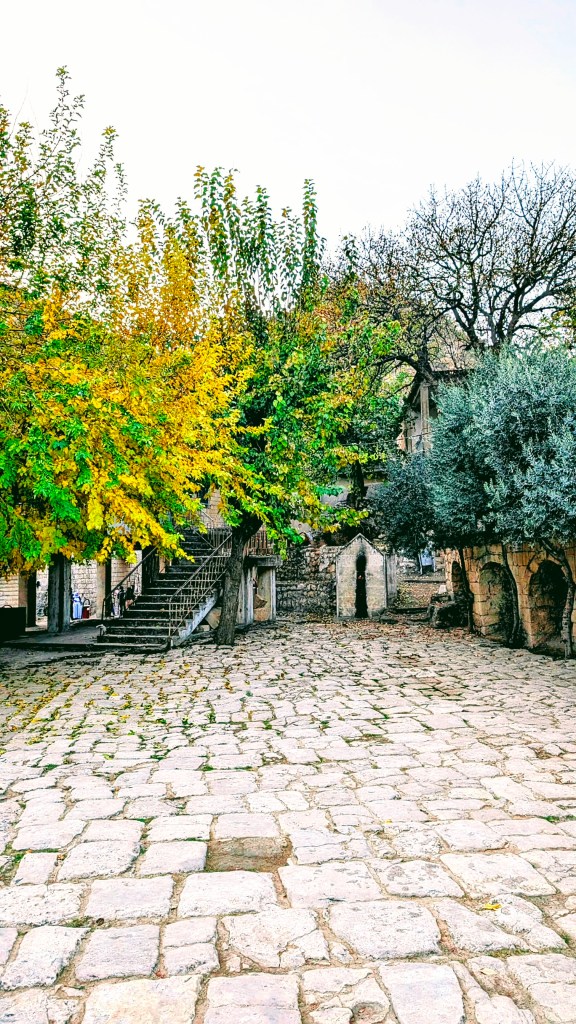
When I arrived in Lalish, I stepped slowly along a narrow gravel path into a sacred valley surrounded by ancient stone houses and timeless shrines. The place radiated peace, as if untouched by the outside world. At the temple entrance, I removed my shoes—just as one would before entering a Hindu temple.


The conical domes, stone steps, and wooden doors felt startlingly reminiscent of North Indian temples. A black serpent carved into the entrance wall was considered auspicious to touch, while stepping on the threshold was forbidden—another practice I knew well from Hindu traditions.


Inside, oil lamps cast flickering shadows on the stone walls. There was no electricity; only the eternal glow of flames that, I was told, had burned for centuries. The scent of oil and incense lingered in the cool air. An elderly priest guided me into an underground chamber where a sacred black stone rested. Almost instinctively, I bowed before it—an act that brought a knowing smile to his face, as if he recognised a shared reverence.


Rituals that Feel Like Home
In another part of the temple, a man carried a lit lamp, chanting prayers as he walked—eerily similar to the Hindu aarti. Yet despite the parallels, something about the place felt uniquely of this land. This was not a temple transplanted from India; it was a shrine of Mesopotamia, deeply woven into the soil and spirit of these mountains.
After leaving the temple, I was invited by a man waving from his rooftop to join him for a meal. On his terrace under the open sky, we shared a warm, simple lunch. Language was a barrier, but with gestures and Google Translate, we connected. They were surprised to meet an Indian, especially a Bengali. None of them had met one before.
Their children had returned from Europe for pilgrimage, seeking to reconnect with their ancient roots in a world that constantly pulls them away.
Breaking Bread, Finding Reflections
The meal was humble but satisfying: a wheat-based pilaf that reminded me of Indian rice dishes, served with tender lamb. Alongside it was ayran, a tangy yoghurt drink perfect for the afternoon heat. They washed their hands before and after eating—a practice familiar from Indian customs around ritual purity.
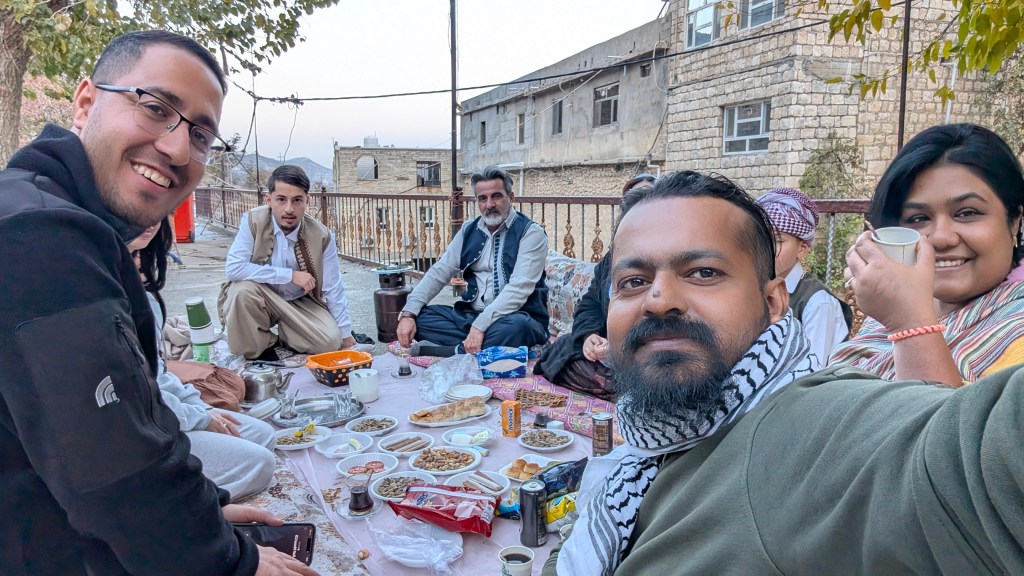
Their clothing, too, seemed timeless: men in long white or grey robes cinched at the waist, some with colourful turbans; women in long, flowing garments, with white or black headscarves. On special days, bright clothes and silver jewellery passed down through generations adorned them with quiet dignity.
As I sat with them, the parallels between Yazidism and Hinduism began to swirl in my mind:
- Removing shoes before entering sacred spaces.
- Eternal flames burning inside shrines.
- Reverence for a black stone.
- Circumambulation during worship.
- The offering of light.
- Fire as a sacred element.
- Belief in reincarnation and the cyclical nature of time.
But was this more than a coincidence? Could Yazidism be an offshoot of a faith carried from India, later mingled with local Mesopotamian traditions into a syncretic tapestry? Or are these shared elements simply reflections of universal human impulses toward light, purity, and the mysteries of life and death?
The Yazidis’ supreme deity, Melek Taus—the Peacock Angel, guardian of the universe—especially fueled my curiosity. Kartikeya, or Murugan in Hinduism, is also a guardian deity and rides a peacock. Yet was this a sign of ancient connection, or another case of symbols arising independently across cultures?
As I departed Lalish, walking again on the gravel path under the fading light, I carried with me more questions than answers. Perhaps Yazidism is very much a faith of this place—rooted in Mesopotamia—yet shaped, in part, by distant migrations and forgotten meetings of peoples long ago.
Or perhaps these echoes are simply proof that certain spiritual truths are universal, re-emerging wherever humans search for meaning.
For a fleeting moment, history seemed to whisper something profound. And in that whisper, the world felt smaller, yet more infinite than ever before.
Author Bio:
Sibaram Das is an aircraft maintenance engineer turned full-time entrepreneur, but his true passion lies in exploring the world as a seeker of stories. Having travelled to 38 countries, he ventures beyond conventional tourism to uncover the deeper layers of human culture, forgotten traditions, and nearly lost civilisations. From tribal gatherings in Africa to the ruins of Mesopotamia, Sibaram’s journeys are about breaking stereotypes, building empathy, and listening deeply to the stories that shape humanity.

The remarkable parallels between Yazidism and various Indian spiritual traditions provide a captivating window into ancient cultural interactions and shared proto-Indo-European heritage. Although Yazidism has absorbed influences from ancient Iranian religions, as well as Judaism, Christianity, and Islam over the centuries, its broad similarities with Indian spirituality—particularly the reverence for the peacock and the belief in reincarnation—stand out as especially intriguing. Some scholars propose that these connections may trace back to ancient migrations or cultural exchanges spanning thousands of years, potentially tied to the broader Indo-European dispersals or even earlier nomadic movements. This exploration offers a compelling narrative of humanity’s shared spiritual heritage and the enduring impact of deep historical bonds across continents.
LikeLiked by 1 person
Today, I rise not merely to applaud a written work, but to pay heartfelt tribute to a narrative so eloquently etched that it transcends geography, history, and belief. This is not just a blog post—it’s a journey through time, a quest for meaning, and a bridge between worlds long thought disconnected.
👏To the author— though I may not know you personally, your words have reached far beyond borders. With grace and clarity, you have woven together threads of lost migrations, ancient rituals, and cultural kinship in a way that leaves the reader both enlightened and yearning to learn more.
You ventured into the heart of Lalish, the spiritual sanctuary of the Yazidi people—not as a tourist, but as a pilgrim of history. With each detail—the gravel paths, the sacred flames, the black serpent at the threshold—you breathed life into a place most of us may never see, yet now somehow feel connected to.
You dared to ask questions that don’t come with easy answers. Could the echoes of India lie hidden among the mountain stones of northern Iraq? Could reincarnation, ritual purity, and reverence for light all stem from the same primal yearning across civilizations? In tracing these connections, you did not impose conclusions—you invited contemplation.
Your reflections remind us that while borders may divide our lands, beliefs have always found ways to speak to each other. A peacock here is Murugan’s mount; there, it is Melek Taus, a guardian angel. Fire flickers in both Yazidi and Hindu sanctuaries—not merely as a symbol, but as a presence.
And when you shared a meal on a rooftop, bridging silence with gestures and kindness, we were reminded that the true language of humanity is connection.
Your storytelling is a gift—not just to your readers, but to anyone who has ever felt that history is more than a textbook, that culture is more than costume, and that spirit knows no map.
To you—and to the friend who shared this brilliance—I extend the deepest appreciation. May your words continue to ripple out like the echoes you so beautifully follow, and may they stir many others to look backward, inward, and across the world with wonder and respect.
Thank you for tracing the past so that others may find direction.
With admiration and applause, A grateful reader inspired by your wisdom.
LikeLiked by 2 people
Thank you so much for your moving words and heartfelt appreciation. It means the world to know the article resonated so deeply. Your reflections beautifully capture the very essence of what we hoped to convey—that our shared human heritage transcends borders and time. May we all continue to seek connection, understanding, and wonder in each other’s stories. Grateful for your kindness and encouragement! 🙏
LikeLike
Your words truly warmed my heart. Thank you for weaving such beauty into the world—may your journey of stories continue to inspire! 🙏🏽
LikeLiked by 2 people
No culture, in modern times, can boast of exclusivity. Intermingling of faith and influence is deeply entrenched in modern practices and myths abounding religion and beliefs. Very interesting article.
LikeLiked by 3 people
Thanks, Geeta. Absolutely agree with your perspective. The richness of today’s cultures lies in their shared histories and the constant exchange of ideas, faiths, and traditions. This intermingling not only shapes our beliefs but also fosters greater understanding and empathy among diverse communities.
LikeLiked by 1 person
Well written
LikeLike
Mesmerizing narrative! I could not stop reading, there was something about the inter mingling of ancient cultures that is fascinating. Besides recognizing the universal truths of life, it opens a window to another world strangely similar to ours. Thank you for sharing.
LikeLiked by 1 person
The echoes of ancient cultures truly remind us how interconnected human experiences are, no matter the era. It’s fascinating to see how wisdom and stories from long ago still resonate with the truths we live by today. Thank you for sharing your thoughts—it adds depth to the conversation.
LikeLike